
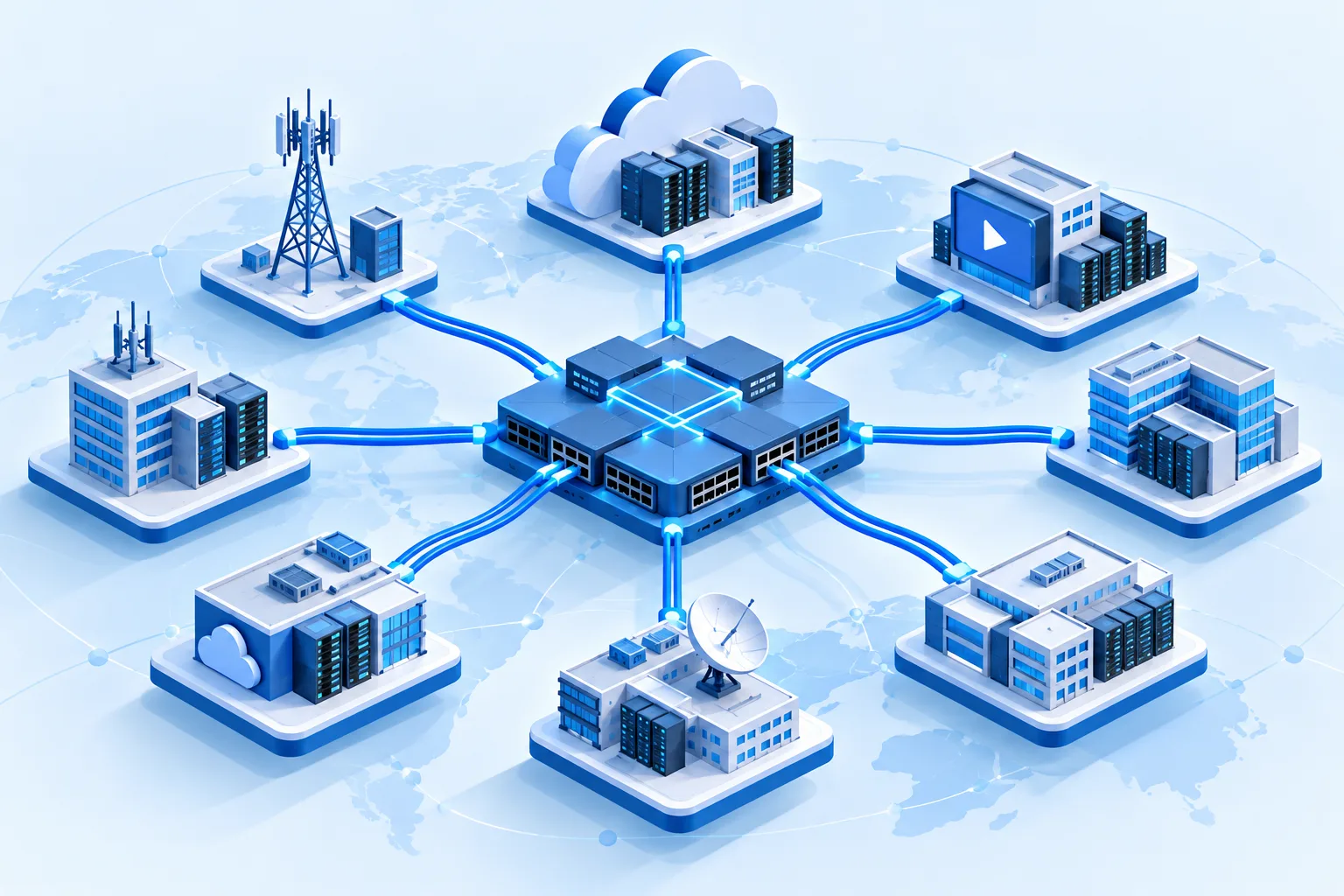
An Internet Exchange Point, or IXP, is infrastructure where independent networks connect to exchange Internet traffic directly. Instead of sending all traffic through third-party transit providers, participating networks can establish peering relationships at an IXP, helping traffic move along shorter and often more efficient paths.
Internet Exchange Points are an important part of the physical and logical structure of the Internet.
Internet service providers, cloud platforms, content delivery networks, universities, enterprises and other Autonomous Systems can meet at an exchange and exchange traffic under agreed routing arrangements.
This helps answer a basic question about how the Internet works:
If the Internet consists of thousands of independent networks, where do those networks actually connect to one another?
IXPs are one important answer.
According to the Internet Society Pulse IXP Tracker, approximately 1,082 active Internet Exchange Points were being tracked worldwide in October 2026, using a definition that includes active IXPs with at least three members.
But an IXP is more than a large switch.
Understanding how IXPs work requires understanding Autonomous Systems, BGP, peering, transit and the relationship between independent networks.
What Is an Internet Exchange Point?
An Internet Exchange Point is a physical or virtual interconnection platform that allows independent networks to exchange traffic with one another.
Participants typically connect their routers to shared switching infrastructure.
Those networks can then establish BGP peering relationships with:
- individual networks;
- multiple participating networks; or
- an IXP route server.
The Internet Society IXP Tracker describes IXPs as places where networks can exchange traffic through peering, creating an alternative to sending traffic through more distant transit paths.
A simplified structure looks like this:
Network A
↓
IXP switching fabric
↕
Network B
Instead of traffic from Network A first travelling through another transit provider before reaching Network B, the two networks may exchange traffic directly at the IXP.
This can create a shorter and more efficient path.
Why Do Internet Exchange Points Exist?
The Internet is not one centrally operated network.
It is a collection of independently operated networks.
Each network can have its own:
- infrastructure;
- routing policy;
- customers;
- IP addresses;
- Autonomous System Number;
- upstream providers;
- peering relationships; and
- operational priorities.
But independent networks still need to communicate.
Without interconnection, an independently operated network would remain isolated.
IXPs provide one mechanism for bringing many networks together while allowing each participant to retain control over its own routing decisions.
That combination reflects a fundamental Internet principle:
independent operation
combined with:
shared technical coordination.
LARUS Foundation discusses this broader architecture in Why Decentralisation Enhances System Survivability.
What Is Internet Peering?
Internet peering is an arrangement in which two networks exchange traffic directly between their Autonomous Systems.
Consider two networks:
AS64500 — an Internet service provider
and
AS64501 — a content provider.
If both connect to the same IXP, they may establish a BGP session and exchange routing information.
Traffic from users in AS64500 to content hosted by AS64501 may then travel directly across the interconnection.
Without peering, the path might be:
ISP → Transit Provider → Other Network → Content Provider
With appropriate local peering:
ISP → IXP → Content Provider
The actual path depends on routing policy, but the principle is straightforward:
Peering allows networks to exchange traffic more directly rather than requiring every packet to pass through an intermediary transit provider.
What Is BGP's Role at an IXP?
The IXP provides the interconnection infrastructure.
Border Gateway Protocol, or BGP, provides the mechanism through which Autonomous Systems exchange reachability information.
BGP is the inter-domain routing protocol used across the public Internet. Its core protocol specification is defined in RFC 4271.
When two networks peer at an IXP, their routers may use BGP to exchange information about the prefixes they can reach.
For example:
Network A announces:
203.0.113.0/24
Network B announces:
198.51.100.0/24
Each network can then learn that the other's prefix is reachable through the peering connection.
The IXP does not normally decide the participant's entire routing policy.
The participating operators retain control over questions such as:
- which prefixes to announce;
- which routes to accept;
- which path to prefer;
- whether to establish bilateral peering;
- whether to use a route server; and
- how to handle failover.
In simple terms:
The IXP provides interconnection.
BGP exchanges routing information.
The network operator determines routing policy.
What Is an Autonomous System?
An Autonomous System is a network or group of networks operating under a defined external routing policy.
Each public Autonomous System is identified using an Autonomous System Number, or ASN.
At the global coordination level, ASNs are part of the Internet number-resource system coordinated through IANA. LARUS Foundation explains that function in What Is IANA?.
ASN growth and IXP growth are closely connected concepts.
As more independently operated routing domains participate in the Internet, there are more opportunities for:
- peering;
- transit;
- multihoming;
- local traffic exchange;
- regional interconnection; and
- diverse network paths.
LARUS Foundation's 2026 ASN data analysis examines how the number of Autonomous Systems visible in global routing continues to grow.
IXPs provide part of the infrastructure where those independent networks can meet.
Peering vs IP Transit: What Is the Difference?
Peering and transit both connect networks, but they solve different problems.
| Feature | Peering | IP Transit |
|---|---|---|
| Main purpose | Exchange traffic between participating networks | Provide wider Internet reachability |
| Relationship | Network-to-network | Customer-to-provider |
| Typical route scope | Routes covered by the peering arrangement | Broad or full Internet routes |
| Common at IXPs | Yes | Transit may also be offered nearby |
| Uses BGP | Yes | Yes |
| Commercial structure | Varies | Usually a paid service |
| Replaces all Internet connectivity? | Usually no | Can provide general Internet reachability |
Suppose Network A peers with Network B.
Network A may gain direct access to Network B's routes.
That does not necessarily mean Network A can reach the entire Internet through Network B.
A transit provider, by contrast, normally sells broader Internet reachability.
This is why many operators use both peering and transit.
How Does an IXP Work?
A simplified IXP connection can be understood in five stages.
1. The Network Reaches the IXP
The participant first needs connectivity to the exchange.
This may involve:
- a physical port in a participating data centre;
- metro transport;
- remote peering;
- a connectivity provider; or
- another supported access arrangement.
2. The Network Connects to the Exchange Fabric
The participant's router connects to the IXP switching infrastructure.
This creates a shared Layer 2 interconnection environment between participating networks.
3. BGP Sessions Are Established
Participants can establish bilateral BGP sessions directly with selected networks.
Alternatively, they may connect to an IXP route server.
4. Routes Are Exchanged
Networks announce permitted prefixes according to their routing policies.
Each participant remains responsible for deciding which routes to accept and how those routes should be treated.
5. Traffic Can Flow Directly
If routing policy selects the peering path, traffic can flow directly between participants through the exchange instead of following a more indirect transit path.
What Is an IXP Route Server?
Large exchanges may contain hundreds or thousands of participating networks.
Creating a separate bilateral BGP session with every participant would become operationally complex.
Many IXPs therefore provide route servers.
Instead of:
Network A ↔ Network B
Network A ↔ Network C
Network A ↔ Network D
a participant may establish a session with:
Network A ↔ Route Server
The route server can then facilitate route exchange between participating networks according to the exchange's configuration and participant policies.
Importantly:
A route server generally facilitates routing-information exchange; it does not need to become the traffic path itself.
Data traffic can still flow directly between participant routers across the exchange fabric.
This separation helps public peering scale.
Why Do Networks Join an IXP?
There are several common reasons.
Lower Latency
Shorter network paths can reduce latency.
If two networks in the same region exchange traffic through distant upstream networks, packets may travel much farther than necessary.
Local peering can reduce that distance.
Local Traffic Exchange
IXPs can help traffic remain within a local or regional ecosystem rather than travelling internationally before returning to nearby users.
Reduced Transit Dependency
Traffic exchanged directly with peers does not need to use the same transit path.
This can reduce dependence on upstream providers for some traffic.
More Routing Options
Peering creates additional potential paths.
More paths can give operators additional routing-policy choices.
Content Distribution
CDNs and cloud platforms can peer directly with access networks, helping content reach users through shorter paths.
Resilience
Additional independent connectivity relationships can contribute to resilience.
However, logical path diversity should not automatically be confused with physical infrastructure diversity.
Internet Exchange Points in 2026: What the Data Shows
The global IXP ecosystem has become substantial.
The Internet Society Pulse IXP Tracker reported approximately 1,082 active IXPs worldwide in October 2026.
But simply counting exchanges does not tell the entire story.
An IXP with ten participants is operationally different from an ecosystem connecting hundreds or thousands of networks.
Useful IXP metrics include:
- participant count;
- connected port capacity;
- actual traffic;
- geographic reach;
- facility count;
- content-network presence; and
- network diversity.
These measurements should not be treated as interchangeable.
What 2026 Peering Data Shows About Major IXPs
An APNIC analysis of public Internet Exchange capacity examined deployments by major CDN, cloud and content networks including:
- Akamai;
- Meta;
- Amazon;
- Cloudflare;
- Fastly;
- Microsoft;
- Google;
- Netflix;
- Hurricane Electric; and
- ByteDance.
The study found substantial public peering deployments.
For example:
- Akamai showed approximately 79.0 Tbps of deployed public peering port capacity across 248 exchanges;
- Meta showed approximately 69.4 Tbps across 202 exchanges;
- Amazon showed approximately 51.2 Tbps across 163 exchanges;
- Cloudflare appeared at more than 350 exchanges in the dataset.
These figures represent deployed port capacity, not actual traffic.
That distinction matters.
The data nevertheless demonstrates the continuing importance of public interconnection even for networks that also operate extensive private infrastructure.
Which Internet Exchanges Are Among the Largest?
The same APNIC study found that, among the selected content and cloud networks it analysed:
IX.br São Paulo had approximately 22.8 Tbps of combined deployed peering capacity.
DE-CIX Frankfurt followed at approximately 11 Tbps.
Equinix Singapore was also among the leading exchanges.
The study reported approximately:
- 1,861 PeeringDB participants at IX.br São Paulo;
- 1,017 at DE-CIX Frankfurt;
- 465 at Equinix Singapore.
See the full methodology and dataset in APNIC's 2026 public peering analysis.
These figures do not mean that total exchange capacity is limited to those numbers.
The capacity totals refer to the selected major networks studied by APNIC.
This demonstrates an important lesson:
There is no single universal definition of the world's largest Internet Exchange Point.
An exchange might be ranked by:
- participants;
- connected capacity;
- peak traffic;
- average traffic;
- number of locations;
- or content-provider capacity.
Participant Count, Capacity and Traffic Are Different
Three IXP metrics are particularly easy to confuse.
Participant Count
This measures how many networks participate in an exchange ecosystem.
A large participant count may suggest a broad interconnection community.
Connected or Port Capacity
This measures provisioned network-interface capacity.
A network connecting through a 100 Gbps port contributes 100 Gbps of theoretical port capacity even if it does not continuously use all of it.
Actual Traffic
This measures data actually passing through the exchange.
It may be reported as:
- average traffic;
- peak traffic;
- daily traffic; or
- total transferred volume.
A network exchange can rank highly by participants while another ranks more highly by peak traffic.
Therefore, data-driven IXP comparisons should always specify the metric being used.
Why São Paulo Is Important in Global Peering
The 2026 APNIC analysis found IX.br São Paulo at the top of its selected-network capacity ranking.
It also showed a broader geographic pattern.
Major public interconnection is no longer limited to traditional North American and Western European hubs.
Strong exchange ecosystems are visible in:
- São Paulo;
- Singapore;
- Tokyo;
- Mumbai;
- Hong Kong;
- Johannesburg;
- Frankfurt;
- Amsterdam;
- London; and
- other major network centres.
This reflects the continued regionalisation of Internet infrastructure.
More content, access networks and cloud systems can now meet closer to the users they serve.
Public Peering vs Private Interconnection
Not every major traffic relationship uses a shared IXP fabric.
Large networks can also establish Private Network Interconnections, commonly called PNIs.
A PNI directly connects two networks.
Large operators may therefore use:
public peering
for broad connectivity with many networks,
while using:
private interconnection
for particularly high-volume relationships.
The two models can coexist.
A mature interconnection ecosystem can include:
- public IXPs;
- private interconnections;
- transit;
- embedded caches;
- cloud interconnect;
- and private backbones.
That is why slower membership growth at an established IXP does not automatically mean interconnection is declining.
The architecture may simply be evolving.
Do IXPs Make the Internet Faster?
They can.
Consider two networks in the same city.
Without local interconnection, traffic between them might travel through a remote transit provider before returning.
This can introduce:
- additional latency;
- more network hops;
- greater distance; and
- increased dependence on third parties.
If those networks peer locally, traffic may follow a shorter path.
However, an IXP does not guarantee lower latency.
Performance also depends on:
- BGP policy;
- physical fibre routes;
- congestion;
- peering capacity;
- server location;
- traffic engineering; and
- application architecture.
The more accurate statement is:
IXPs make shorter and more efficient paths possible when operators choose and engineer those paths appropriately.
Do IXPs Reduce Internet Costs?
They can reduce some transit requirements.
Suppose an ISP exchanges a large amount of traffic with a content provider.
Without direct peering, that traffic may pass through a paid transit service.
With peering, some of it can move directly between the two networks.
But peering itself is not necessarily cost-free.
Participants may still pay for:
- IXP ports;
- cross-connects;
- transport;
- colocation;
- routers;
- remote peering;
- engineering; and
- operations.
The economic value depends on traffic volume and network design.
How IXPs Support Network Resilience
IXPs can contribute to resilience by creating additional interconnection options.
A network with:
one upstream provider
has fewer external connectivity relationships than a network using:
multiple transit providers + peers + IXP connectivity.
Additional paths can provide more options during failures.
However, this does not guarantee true redundancy.
Two apparently independent connections might still share:
- the same fibre route;
- the same building;
- the same power system;
- the same upstream carrier;
- or the same submarine cable.
LARUS Foundation's article Why Decentralisation Enhances System Survivability explains why resilience depends on reducing common points of failure, not merely increasing the number of logical connections.
Do More IXPs Mean a More Decentralised Internet?
IXPs can contribute to decentralisation at the interconnection layer.
More exchanges can support:
- more local routing choices;
- regional traffic exchange;
- greater upstream diversity;
- more peering opportunities; and
- reduced dependence on distant interconnection hubs.
But IXP count alone cannot tell us whether the whole Internet is decentralised.
Thousands of networks may still depend heavily on:
- a few major cloud providers;
- large transit networks;
- concentrated data-centre ecosystems;
- submarine-cable systems;
- or dominant content platforms.
This is why Internet decentralisation should be studied across multiple layers:
routing
interconnection
physical infrastructure
cloud
content delivery
and:
governance.
LARUS Foundation's 2026 ASN analysis explores a similar distinction between the number of independent routing domains and the concentration of the infrastructure connecting them.
How IXPs Help Local Internet Ecosystems
One of the most important benefits of an IXP can be local traffic exchange.
Imagine two networks serving users in the same country.
Without local peering, traffic between their users might need to:
leave the country
→ cross an international transit network
→ and return.
This is sometimes referred to as unnecessary traffic tromboning.
A local IXP can give networks a place to exchange that traffic domestically.
Potential benefits include:
- lower latency;
- reduced international transit dependency;
- stronger local hosting ecosystems;
- better access to local content;
- and additional resilience during some external disruptions.
The Internet Society Pulse IXP Tracker uses IXP membership, availability and network coverage as indicators of the health of national interconnection ecosystems.
Why Content Networks Use IXPs
Major content networks can generate enormous amounts of traffic.
Video, software updates, cloud applications, social media and web content all benefit from efficient delivery.
By connecting to large IXPs, content providers can peer with many access networks.
This can bring content closer to:
- ISPs;
- enterprises;
- mobile networks;
- and ultimately end users.
The APNIC 2026 peering-capacity analysis shows how widely major cloud and content platforms participate in public exchange infrastructure.
Public peering is only one part of their architecture.
Large networks may also operate:
- private backbones;
- embedded caches;
- private interconnections;
- cloud regions;
- and edge infrastructure.
IXPs and Routing Security
Interconnection makes routing possible at greater scale.
It also makes routing security increasingly important.
Networks participating in BGP can use mechanisms including:
- RPKI;
- Route Origin Authorisations;
- Route Origin Validation;
- IRR filtering;
- max-prefix limits;
- prefix filters; and
- route-server security controls.
LARUS Foundation's RPKI Adoption in 2026 analysis explains how RPKI-valid route coverage has grown while Route Origin Validation deployment still varies significantly between networks and regions.
The relationship is useful:
IXPs enable interconnection.
BGP exchanges reachability information.
RPKI can help networks validate route origins.
These are separate but complementary layers.
What an IXP Does Not Do
An IXP is important infrastructure, but it does not perform every network function.
An IXP does not automatically:
- provide complete Internet connectivity;
- replace all transit providers;
- determine every participant's routing policy;
- guarantee low latency;
- guarantee resilience;
- replace RPKI;
- replace an ASN;
- eliminate congestion;
- or force every participant to peer with every other participant.
Operators remain responsible for their own:
- routing policies;
- capacity planning;
- redundancy;
- BGP configuration;
- routing security;
- and operational risk.
This reflects a broader Internet architecture principle:
Shared infrastructure can enable coordination without centralising every operational decision.
Internet Exchange Point vs Data Centre
An IXP and a data centre are not the same thing.
A data centre provides infrastructure such as:
- power;
- cooling;
- rack space;
- servers;
- routers;
- and physical connectivity.
An IXP provides an environment where networks can exchange traffic.
Many IXPs operate across multiple data centres in the same metropolitan area.
This is one reason major interconnection cities often combine:
- dense fibre networks;
- multiple colocation facilities;
- cloud regions;
- content providers;
- submarine-cable connectivity;
- and large ISP populations.
Internet Exchange Point vs CDN
An IXP is also different from a Content Delivery Network.
A CDN distributes content closer to users.
An IXP creates an environment where the CDN can interconnect with the networks serving those users.
The relationship can be represented as:
CDN
→ distributes content
IXP
→ enables interconnection
ISP
→ connects users
BGP
→ exchanges routing information
This is why major CDNs often connect to many exchanges.
What Does 2026 IXP Data Tell Us?
Several useful conclusions emerge from the data.
1. Internet Exchange Points Are Global Infrastructure
More than one thousand active IXPs are tracked worldwide by Internet Society Pulse.
2. Public Peering Remains Important
Major content and cloud providers continue to provision substantial public peering capacity.
3. Interconnection Is Becoming More Geographically Distributed
São Paulo, Singapore, Tokyo, Mumbai and other regional hubs now appear alongside traditional European and North American centres.
4. IXP Size Has More Than One Meaning
Participants, capacity and actual traffic are different measurements.
5. Public and Private Interconnection Coexist
IXPs, PNIs, transit, caches and private backbones all form part of the modern Internet.
6. IXPs Can Increase Routing Choice
More peering opportunities can reduce dependence on a single upstream path.
7. IXP Growth Alone Does Not Prove Complete Decentralisation
Transit, cloud, fibre, data-centre and content concentration must also be examined.
Frequently Asked Questions
What is an Internet Exchange Point?
An Internet Exchange Point is infrastructure where independent networks connect to exchange Internet traffic, usually using BGP peering over shared switching infrastructure.
What does IXP stand for?
IXP stands for Internet Exchange Point.
How does an IXP work?
Networks connect routers to an exchange platform and establish BGP peering relationships with other participants or route servers. Traffic can then flow directly between participating networks when routing policy selects those paths.
What is Internet peering?
Internet peering is an arrangement in which two Autonomous Systems exchange traffic directly rather than relying entirely on a third-party transit provider.
What is the difference between peering and transit?
Peering typically exchanges traffic between participating networks. Transit provides broader Internet reachability.
Does an IXP provide Internet access?
Not necessarily. An IXP provides interconnection. Participants generally still need suitable peering, transit or other connectivity to reach the rest of the Internet.
Does an IXP use BGP?
Yes. BGP is commonly used by Autonomous Systems at IXPs to exchange route information.
What is an IXP route server?
A route server allows multiple IXP participants to exchange routing information through a shared BGP service, reducing the need for every participant to create a separate bilateral session with every other network.
How many Internet Exchange Points are there?
The Internet Society Pulse IXP Tracker reported approximately 1,082 active IXPs worldwide in October 2026.
What is the largest IXP in the world?
There is no single answer because IXPs can be ranked by participant count, traffic, provisioned capacity, facility count or other metrics.
Do IXPs reduce latency?
They can. Direct local peering can reduce path length and latency compared with indirect transit paths, although the outcome depends on routing policy and physical infrastructure.
Do IXPs improve resilience?
They can provide additional network paths and interconnection options. However, true resilience also depends on physical infrastructure diversity and avoiding shared points of failure.
Are IXPs part of Internet decentralisation?
Yes, particularly at the interconnection layer. They allow independently operated networks to exchange traffic without requiring all traffic to pass through one central network.
Conclusion
Internet Exchange Points are one of the clearest examples of how the Internet combines shared infrastructure with independent operation.
The Internet does not depend on one global network carrying every packet.
Instead, thousands of Autonomous Systems operate independently.
IXPs provide places where those networks can meet.
BGP allows them to exchange routing information.
Peering allows traffic to move directly between networks.
Transit provides broader connectivity when needed.
And network operators retain responsibility for their own routing decisions.
The scale of this architecture is visible in 2026.
The Internet Society Pulse IXP Tracker tracks more than 1,000 active IXPs worldwide, while APNIC's public peering research shows major cloud and content networks deploying tens of terabits of capacity across global exchange ecosystems.
But the importance of IXPs is not simply about traffic volume.
Their deeper value is structural.
They allow independent networks to interconnect without requiring those networks to surrender their independent routing policies.
They can create more local paths.
They can reduce some forms of upstream dependency.
They can support regional traffic exchange.
And they can create additional choices for network operators.
That does not mean the Internet is completely decentralised.
Networks still depend on fibre, data centres, transit providers, submarine cables, cloud platforms and other shared infrastructure.
But IXPs demonstrate an important Internet principle:
Global interoperability does not require one operator to control every path. It requires independent networks to have reliable ways to connect and exchange traffic with one another.
For Internet infrastructure, that distinction matters.
The strength of the Internet is not only the number of networks it contains.
It is also the diversity of ways those networks can connect.
Internet Exchange Points are one of the key mechanisms that make that diversity possible.