
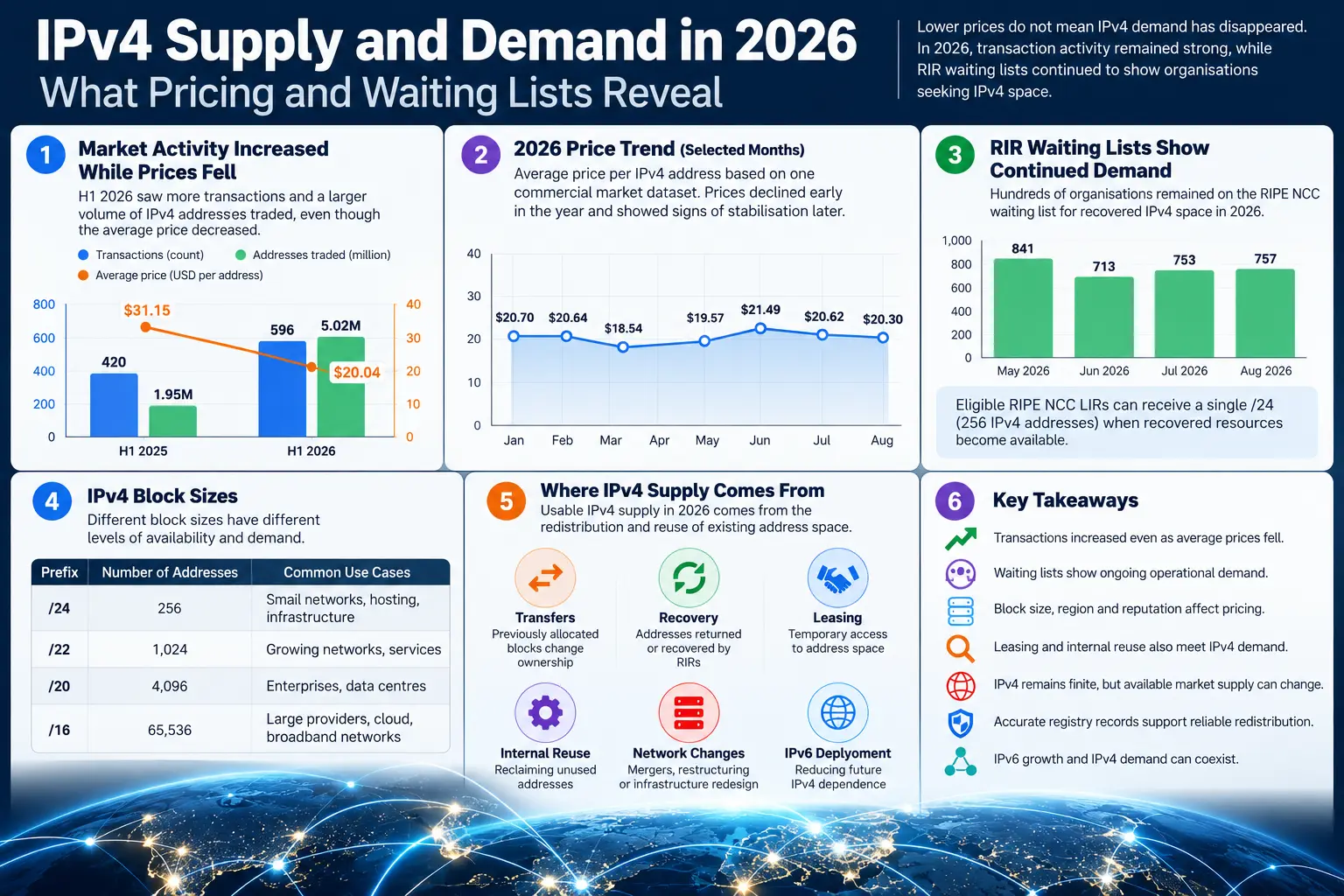
IPv4 market data in 2026 presents an interesting picture: prices have remained well below some earlier market highs even as transaction activity continues, while Regional Internet Registry waiting lists still show organisations seeking limited IPv4 space. Together, these signals demonstrate why lower prices do not necessarily mean IPv4 demand has disappeared.
The IPv4 market is shaped by several factors at the same time:
- secondary-market inventory;
- block size;
- regional availability;
- recovered address space;
- transaction liquidity;
- leasing;
- internal address reuse;
- IPv6 deployment; and
- continuing operational demand for IPv4 connectivity.
That distinction matters.
IPv4 has a fixed 32-bit address space. The protocol itself cannot produce additional IPv4 addresses.
But the amount of usable IPv4 capacity available to networks can change when previously allocated address blocks are transferred, recovered, divided, leased, reclaimed internally or returned to operational use.
Demand can also remain substantial even while market prices decline.
To understand IPv4 supply and demand in 2026, we therefore need to look beyond price alone.
What Does IPv4 Supply and Demand Mean?
In a conventional market, supply refers to how much of something is available, while demand describes how much users want or need.
IPv4 is more complicated because the underlying address space is technically fixed.
IPv4 uses 32-bit addresses, providing roughly 4.3 billion possible addresses before accounting for reserved and special-purpose ranges.
The large pools of previously unallocated IPv4 space available through the traditional allocation system have been exhausted or heavily constrained across the Regional Internet Registry system.
LARUS Foundation explains the underlying distribution process in What Is IP Allocation?.
Today, usable IPv4 supply can come from several sources:
- previously allocated blocks entering transfer markets;
- addresses returned to a registry;
- resources recovered from closed organisations;
- network consolidation;
- underused historical allocations;
- IPv4 leasing;
- internal address reclamation;
- infrastructure redesign; and
- reduced IPv4 dependence through IPv6 or address-sharing technologies.
So when we discuss IPv4 supply in 2026, we are mainly discussing the redistribution and reuse of existing address space rather than the creation of new IPv4 addresses.
2026 Market Data: Prices Fell While Transactions Remained Active
Commercial IPv4 market data provides a useful example of why price alone can be misleading.
One market dataset from IPv4Center reported that during the first half of 2026 there were:
| Metric | H1 2026 |
|---|---|
| Transactions | 596 |
| IPv4 addresses traded | 5,016,064 |
| Average price per address | $20.04 |
| Median price per address | $20.00 |
In the same dataset, the first half of 2025 recorded:
| Metric | H1 2025 | H1 2026 | Change |
|---|---|---|---|
| Transactions | 420 | 596 | +41.9% |
| Addresses traded | 1,954,304 | 5,016,064 | +156.7% |
| Average price/IP | $31.15 | $20.04 | -35.7% |
According to that dataset, average prices fell significantly while transaction count and traded-address volume increased.
See: IPv4Center – IPv4 Market Report 2026 H1
This illustrates an important point:
Lower IPv4 prices do not automatically mean lower operational demand.
Prices reflect the interaction between available inventory and demand.
If supply entering the market increases faster than buyer demand, prices can fall even when many networks still need additional IPv4 capacity.
Why Falling Prices Do Not Necessarily Mean Falling Demand
Consider a simplified example.
Suppose one market has:
100 buyers competing for 50 available blocks.
Competition may push prices upward.
Later, imagine there are:
120 buyers competing for 150 available blocks.
Demand increased from 100 buyers to 120.
But supply increased even faster.
Prices could fall despite higher absolute demand.
Real IPv4 markets are much more complex, but the principle is useful.
The market price of IPv4 depends not only on whether networks still require addresses, but also on:
- how much inventory becomes available;
- which block sizes are available;
- how quickly holders want to transact;
- regional transfer conditions;
- buyer timing;
- address history; and
- overall market liquidity.
This is why price is a market signal, not a complete measurement of IPv4 demand.
IPv4 Pricing Is Not One Global Number
It is also important not to treat a single market average as an official worldwide IPv4 price.
There is no universal mandatory price per IPv4 address.
Commercial transaction prices can vary according to:
- block size;
- registry region;
- routing history;
- address reputation;
- geolocation records;
- transfer complexity;
- documentation;
- buyer urgency; and
- seller expectations.
One commercial dataset may therefore report a different average from another because they observe different transactions.
The most responsible interpretation is not:
“An IPv4 address costs exactly $20.”
Instead:
Some 2026 commercial datasets have shown average transaction pricing around the low-$20-per-address range, while actual transaction prices vary significantly by block and market conditions.
This distinction is especially important for public-interest analysis.
Market Conditions Can Change During the Year
IPv4 supply and demand are dynamic.
A market may experience strong available inventory early in the year and tighter conditions later.
For example, IPv4.Global's 2026 market reports described firmer pricing in several block-size categories during the middle of the year as available inventory tightened.
That does not necessarily contradict lower H1 averages from another dataset.
Both can be true:
Longer-term IPv4 prices may have corrected downward
while:
specific market segments become tighter again as inventory changes.
This is another reason to avoid treating one monthly price or one platform as a complete description of the IPv4 market.
Block Size Matters
IPv4 supply is not perfectly interchangeable.
A /24 contains:
256 addresses
A /22 contains:
1,024 addresses
A /20 contains:
4,096 addresses
A /16 contains:
65,536 addresses
An organisation that requires a single /24 is not necessarily competing in exactly the same market as a cloud or hosting provider seeking multiple /16 blocks.
Different block sizes can have different:
- available inventory;
- buyer pools;
- transaction frequency;
- routing usefulness; and
- pricing behaviour.
This means it is more accurate to think of IPv4 as several overlapping market segments rather than one perfectly uniform global market.
Why Large IPv4 Blocks Can Behave Differently
Larger contiguous IPv4 blocks can be operationally useful for networks requiring significant public address capacity.
They may support:
- cloud infrastructure;
- hosting platforms;
- broadband networks;
- large enterprise environments;
- data centres;
- telecommunications networks; and
- service-provider infrastructure.
But large contiguous historical allocations are limited.
A large block can sometimes be divided into smaller blocks.
Combining many unrelated smaller prefixes into one equivalent contiguous address block is not possible in the same way.
As a result, large-block inventory can become tight even when smaller prefixes remain relatively available.
This helps explain why different IPv4 block sizes may experience different pricing trends during the same year.
Registry Waiting Lists Provide a Different Demand Signal
Commercial transactions are only one way to observe IPv4 demand.
Regional Internet Registry waiting lists provide another.
The RIPE NCC has exhausted its normal IPv4 free pool but continues to distribute recovered IPv4 space through a waiting-list mechanism.
Eligible LIRs can receive a single /24, containing 256 addresses, when recovered resources become available.
See: RIPE NCC – IPv4 Address Space
Throughout 2026, RIPE NCC member updates continued to report hundreds of LIRs waiting for IPv4 resources.
Published snapshots included figures such as:
| RIPE NCC Update | LIRs on IPv4 Waiting List |
|---|---|
| May 2026 | 841 |
| June 2026 | 713 |
| July 2026 | 753 |
| August 2026 | 757 |
These figures fluctuate as addresses are recovered, distributed and new eligible organisations join the queue.
The broader signal, however, is clear:
hundreds of networks continued to wait for even relatively small IPv4 allocations in 2026.
What Does the Waiting List Tell Us?
A /24 contains only 256 addresses.
That is small compared with many commercial IPv4 transfers.
Yet organisations can remain in a queue for access to this amount of IPv4 space.
That demonstrates that demand does not exist only among very large cloud or telecommunications providers.
Smaller networks may still require IPv4 for:
- public-facing applications;
- hosting;
- customer connectivity;
- DNS infrastructure;
- NAT gateways;
- network appliances;
- security infrastructure; and
- interoperability with IPv4-only systems.
Waiting-list data does not measure total global demand.
But it does show that IPv4 scarcity continues to have practical operational effects.
ARIN Also Continues to Redistribute Recovered IPv4 Space
ARIN's normal IPv4 free pool was depleted in 2015.
However, recovered address blocks can still be distributed through ARIN's waiting-list mechanism.
In January 2026, ARIN reported fulfilling 149 waiting-list requests using 59 IPv4 blocks.
Recovered space therefore remains a limited source of IPv4 supply.
But this should not be interpreted as a return to the historical environment of plentiful unallocated address space.
Recovered inventory exists only when previously allocated resources become available again.
Recovered Supply Is Not New Supply
When a registry redistributes recovered address space, IPv4 has not gained additional addresses.
Those addresses already existed.
They may have been:
- returned;
- recovered;
- deregistered;
- released after organisational changes; or
- otherwise made available again.
The same underlying principle applies to transfers.
The modern IPv4 environment is increasingly based on redistribution rather than new allocation.
The address lifecycle may look like:
Allocation
↓
Operational use
↓
Changing network requirement
↓
Transfer, return or recovery
↓
Registry update
↓
Redeployment
LARUS Foundation examines this process in What 2026 IPv4 Transfer Data Reveals About Address Reuse and Market Demand.
Why Waiting Lists and Commercial Markets Can Exist Together
A reasonable question is:
If IPv4 can be obtained through transfers, why do organisations still join registry waiting lists?
Because the two channels are not equivalent.
Waiting-list resources may involve:
- eligibility requirements;
- limited allocation sizes;
- uncertain timing;
- restricted availability; and
- registry-specific conditions.
The commercial transfer market may provide:
- larger blocks;
- more block-size options;
- faster availability;
- broader inventory; and
- different transaction structures.
But commercial transfers involve market pricing and transaction costs.
Organisations therefore choose different approaches depending on:
- how many addresses they need;
- how quickly they need them;
- budget;
- network architecture;
- registry region; and
- operational requirements.
Transfer Activity Provides Another Signal
IPv4 transfer records help show how much existing address space is moving between organisations.
But transfer statistics should also be interpreted carefully.
A registered transfer can represent:
- a commercial transaction;
- merger;
- acquisition;
- corporate restructuring;
- inter-company reorganisation; or
- another recognised change in resource registration.
Therefore:
Transfer volume measures registered resource movement, not pure buyer demand.
This distinction matters for market analysis.
A transfer database is extremely useful for understanding how address space moves.
It does not reveal the complete economic reason behind every movement.
Leasing Makes IPv4 Demand Harder to Measure
IPv4 leasing adds another layer.
A network may need additional addresses without purchasing them.
For example, an operator might lease addresses for:
- a temporary deployment;
- customer services;
- hosting;
- cloud workloads;
- regional expansion; or
- a project with uncertain long-term requirements.
The operational demand is real.
But no permanent transfer may appear in purchase statistics.
This means:
purchase demand
is not the same as:
total operational IPv4 demand.
IPv4 demand can be satisfied through:
- transfers;
- leasing;
- provider-assigned space;
- cloud-assigned addresses;
- recovered registry allocations;
- internal reclamation; and
- address-sharing technologies.
A complete view of the market therefore requires understanding several mechanisms.
Internal IPv4 Reclamation Is an Invisible Supply Source
One of the least visible sources of IPv4 capacity is internal reclamation.
Large organisations can sometimes increase available capacity without acquiring additional addresses.
They may:
- reclaim abandoned subnets;
- consolidate infrastructure;
- reduce oversized assignments;
- retire legacy applications;
- move suitable systems to private address space;
- increase IPv6 deployment; or
- reorganise inefficient public-address assignments.
Suppose an organisation discovers 20,000 public addresses that are no longer actively required.
From the global protocol perspective, no new IPv4 space has been created.
But from the organisation's perspective:
20,000 addresses of usable supply have become available.
This activity is difficult to observe in public market data.
That is another reason no external market report can measure total IPv4 supply perfectly.
Why IPv4 Demand Persists Alongside IPv6 Growth
IPv6 is the long-term expansion path for Internet addressing.
But the relationship between IPv4 and IPv6 is not a simple switch.
Many networks operate both.
IPv4 can remain necessary for:
- legacy infrastructure;
- IPv4-only clients;
- enterprise allowlists;
- APIs;
- hosting;
- cloud services;
- security platforms;
- broadband access;
- partner systems; and
- third-party applications.
A network may therefore increase IPv6 deployment while continuing to require IPv4.
This creates a transition environment in which:
IPv6 adoption can grow
while:
IPv4 demand remains operationally significant.
The continued existence of an IPv4 market does not mean IPv6 has failed.
Likewise, growing IPv6 traffic does not mean all IPv4 requirements disappear immediately.
IPv4 Scarcity Has More Than One Meaning
One useful way to understand the market is to distinguish three different kinds of scarcity.
Technical Scarcity
IPv4 has a fixed 32-bit address space.
The protocol cannot expand beyond that limit.
Allocation Scarcity
RIRs no longer maintain large traditional free pools of IPv4 space for ordinary allocation.
Recovered resources may still become available, but supply is limited.
Market Scarcity
Only some holders are willing or able to make existing address space available at any particular time.
Unlike technical scarcity, market scarcity can change quickly.
If many holders make addresses available, market inventory may rise.
If fewer holders make suitable blocks available, inventory can tighten.
This produces an important conclusion:
IPv4 can remain technically scarce while market prices fall.
The underlying protocol limit has not changed.
The quantity of addresses currently available in the market has.
IPv4 Price Is Not Only About Scarcity
The value of a particular IPv4 block can also depend on operational characteristics.
Block Size
Different prefix sizes have different buyer pools and liquidity.
Address Reputation
Previous spam or abuse activity may create work for the new operator.
Registry Region
Transfer arrangements differ across registry environments.
Geolocation Data
External geolocation databases may need time or manual updates after redeployment.
Routing History
Historical BGP announcements can be relevant during due diligence.
RPKI and IRR Records
Routing-security and routing-registry information may need to be updated when operational control changes.
Timing
A network that urgently needs address space may value immediately available inventory differently from an organisation planning years ahead.
For these reasons, a simple average price should be treated as an indicator rather than a universal valuation.
Address Reputation Can Outlive the Previous User
The reuse of IPv4 addresses introduces another practical issue.
An address can receive:
new registration information
while third-party systems still retain information associated with its previous use.
These systems can include:
- spam blocklists;
- geolocation databases;
- reputation services;
- security platforms;
- reverse-DNS data; and
- cached routing information.
Operators receiving reused IPv4 space may therefore need to review these external dependencies before production deployment.
This illustrates a broader principle:
Effective address reuse requires more than moving the resource. The surrounding technical records also need to reflect current operational reality.
LARUS Foundation discusses the importance of reliable shared records in Why Accurate Registry Data Supports a Stable Internet.
Why Registry Accuracy Matters in a Secondary IPv4 Market
As address space moves more frequently, accurate registry information becomes increasingly important.
Transfers, returns and redeployments change the real-world relationship between an IPv4 resource and the organisations using or managing it.
Registry records help maintain shared information about those changes.
This can support:
- contactability;
- resource administration;
- security coordination;
- troubleshooting;
- transfer auditing; and
- operational continuity.
But registry records are only one layer.
A network receiving new address space may also need to update:
- BGP routing;
- RPKI ROAs;
- Internet Routing Registry objects;
- reverse DNS;
- IPAM;
- firewalls;
- monitoring;
- reputation databases; and
- internal documentation.
Registration describes the resource relationship.
It does not replace the network itself.
That distinction is important in a market where addresses can move between different operational environments.
What Does the 2026 Data Tell Us?
Looking at market data, waiting lists and technical reality together suggests several lessons.
1. Lower IPv4 Prices Do Not Mean Demand Has Disappeared
Some 2026 commercial datasets show substantially lower average prices than 2025 while transaction activity remained significant.
2. Secondary-Market Supply Can Change Quickly
More sellers or more available blocks can place downward pressure on pricing.
If suitable inventory later tightens, price pressure can move in the opposite direction.
3. Waiting Lists Show Continuing Demand Outside the Market
Hundreds of RIPE NCC LIRs continued waiting for recovered /24 resources during 2026.
ARIN also continued redistributing recovered IPv4 space.
4. Different Block Sizes Behave Differently
Supply conditions for a /24 are not necessarily the same as those for a /16.
5. Purchase Data Does Not Capture All IPv4 Demand
Leasing, provider assignments, recovered allocations and internal reclamation can all satisfy operational demand.
6. Address Reuse Is Becoming Increasingly Important
With little traditional free-pool supply remaining, existing IPv4 space must increasingly move from old uses to new ones.
What the Available Data Cannot Tell Us
IPv4 market statistics have limitations.
Commercial marketplaces do not observe every transaction.
Registry transfer records do not reveal every transaction price.
Waiting lists do not represent every organisation needing additional IPv4 capacity.
Private leasing arrangements may not appear in transfer statistics.
Internal reclamation is mostly invisible externally.
A merger recorded in a transfer database may not represent a conventional open-market transaction.
Therefore, no single dataset should be described as the complete IPv4 market.
The strongest analysis combines:
commercial pricing data
with:
official registry information
and:
technical network context.
What Should Network Operators Monitor?
Organisations planning future IPv4 capacity should consider several indicators rather than price alone.
Market Pricing
Provides evidence about current commercial conditions.
Available Inventory
Shows whether suitable address blocks are readily obtainable.
Block-Size Availability
Large and small blocks can experience different supply conditions.
Registry Transfer Activity
Shows how existing resources are moving between organisations.
Waiting Lists
Provide evidence of demand for limited recovered space.
Lease Availability
Represents another route for satisfying operational requirements.
IPv6 Deployment
Can help reduce long-term dependence on IPv4.
Internal Utilisation
Existing resources may contain recoverable capacity.
For many operators, the cheapest additional IPv4 address may be one already inside their own network but not being used efficiently.
Frequently Asked Questions
Is IPv4 still scarce in 2026?
Yes. IPv4 has a finite 32-bit address space, and the major traditional pools of previously unallocated public IPv4 addresses have been depleted or heavily constrained. Existing addresses can still be transferred, recovered, leased and reused.
What is the IPv4 price in 2026?
There is no single official global IPv4 price. One commercial dataset reported an average of approximately $20.04 per address for H1 2026, but prices vary according to block size, region, reputation and transaction conditions.
Why can IPv4 prices fall if IPv4 is scarce?
Technical scarcity and market inventory are different. IPv4 remains technically finite, but more existing holders can make addresses available at the same time. Increased market supply can push prices lower even while underlying demand remains.
Does a lower IPv4 price mean demand is disappearing?
No. Prices can decline when supply increases faster than demand. Some H1 2026 market data showed higher transaction counts and address volume despite lower average pricing.
Are organisations still waiting for IPv4 addresses?
Yes. RIPE NCC member updates in 2026 continued to report hundreds of LIRs on its IPv4 Waiting List.
What is an IPv4 waiting list?
A registry waiting list allows eligible organisations to wait for limited IPv4 resources that become available through returns or recovery. Availability and eligibility rules vary by registry.
Are recovered IPv4 addresses new addresses?
No. They are existing IPv4 resources that have returned to available inventory and can be redistributed.
Is an IPv4 transfer the same as creating new supply?
No. A transfer changes the organisation associated with existing address space. It does not increase the total IPv4 address space.
Can IPv6 reduce demand for IPv4?
Yes, over time. But many networks still require IPv4 interoperability, so IPv4 and IPv6 can remain in use simultaneously.
Does IPv4 leasing count as demand?
Yes. Leasing reflects operational demand for IPv4 even when there is no permanent transfer or purchase.
Conclusion
IPv4 supply and demand in 2026 cannot be understood from a price chart alone.
Commercial datasets have shown lower average prices than some earlier market periods.
At the same time:
transactions continue;
millions of addresses continue to move;
registry waiting lists remain active;
recovered resources continue to be redistributed;
and:
some market segments experience tighter inventory than others.
These signals are not necessarily contradictory.
They describe different parts of the same IPv4 environment.
IPv4 remains technically finite.
Traditional free-pool availability remains constrained.
Secondary-market inventory can rise and fall.
Prices respond to available inventory and buyer demand.
Operational demand can be satisfied through transfers, leasing, waiting lists, provider assignments and internal reuse.
The broader shift is therefore not simply about how expensive an IPv4 address is.
It is about how a fixed pool of existing Internet number resources can continue moving between changing operational requirements.
For Internet infrastructure, the important question is not only what IPv4 addresses cost, but how accurately, transparently and reliably existing address space can move from one operational use to another.
That requires more than an efficient market.
It also requires accurate registry records, reliable routing information, clear operational responsibility and network planning that reflects the way resources are actually being used.
IPv4 scarcity is increasingly a question of reuse and redistribution.
Understanding that transition is essential for understanding the modern lifecycle of Internet number resources.