
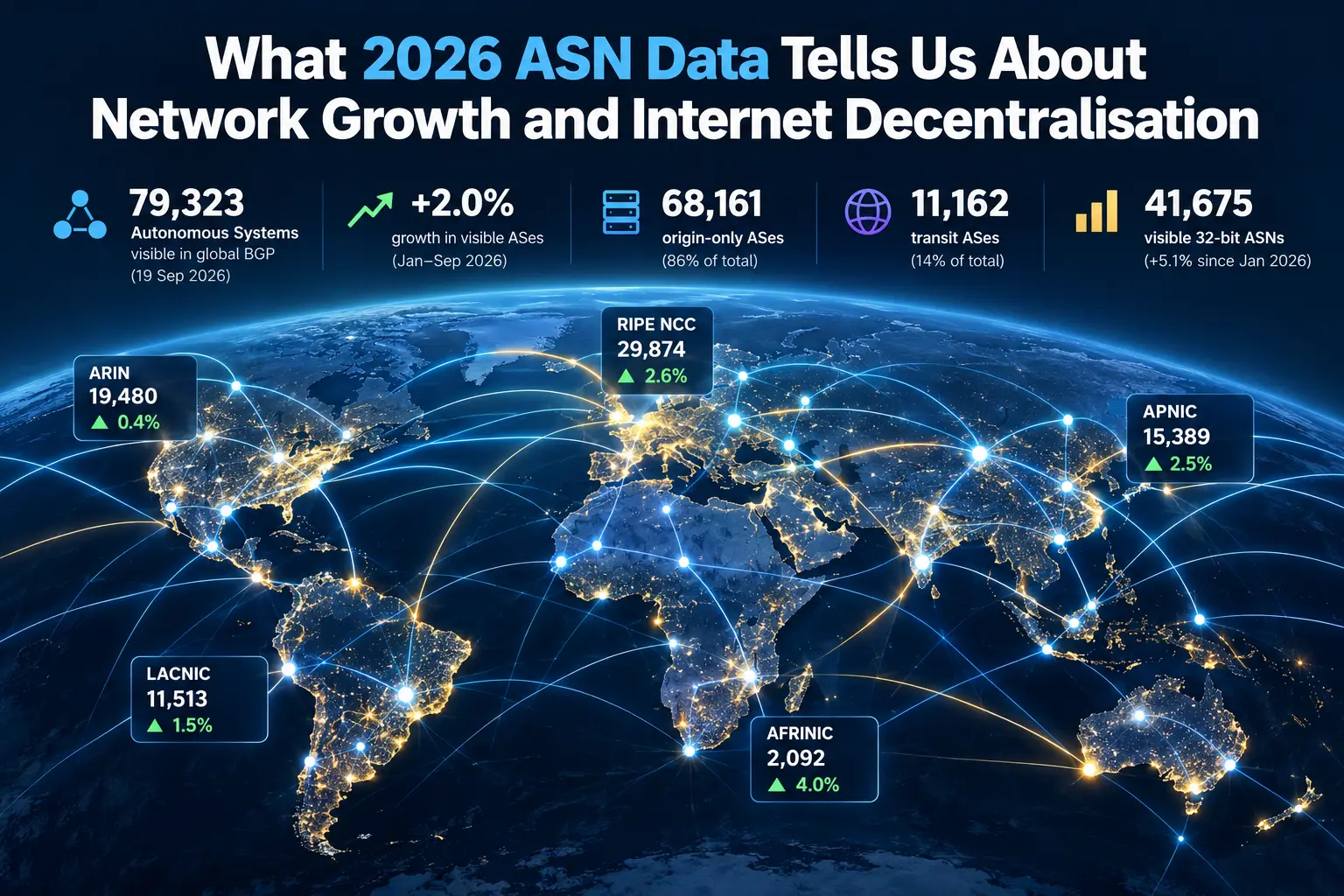
2026 routing data shows that the number of Autonomous Systems visible on the public Internet is still growing. Between mid-January and 19 September 2026, the number of ASes visible in one widely followed global IPv4 BGP view increased from 77,778 to 79,323—an increase of about 2%.
That growth matters because an Autonomous System is not simply another device connected to the Internet.
An AS represents a network operating under its own defined external routing policy.
More visible ASes therefore suggest that the Internet continues to gain independently identified routing domains.
But there is an important qualification:
More Autonomous Systems do not automatically mean that Internet infrastructure, traffic, market power or connectivity has become equally decentralised.
A network can have its own ASN while still depending heavily on a small number of upstream providers, cloud platforms, transit networks or physical infrastructure providers.
ASN data therefore provides a useful measure of network participation and routing autonomy, but it is only one part of the decentralisation picture.
The 2026 data helps show both sides of that story.
What Is an Autonomous System Number?
An Autonomous System Number, or ASN, is a globally unique identifier used by networks that exchange routing information using the Border Gateway Protocol (BGP).
APNIC defines an Autonomous System as a connected group of one or more IP prefixes operated under a single, clearly defined routing policy. An ASN identifies that system when routing information is exchanged with other Autonomous Systems.
Examples of organisations that may operate an ASN include:
- Internet service providers;
- telecommunications networks;
- cloud providers;
- content delivery networks;
- universities;
- data centres;
- large enterprises;
- governments;
- research networks; and
- infrastructure operators.
ASNs help turn the Internet into what it fundamentally is:
a network of independently operated networks.
At the global coordination layer, IANA manages the top-level ASN registry and allocates ASN blocks to the Regional Internet Registries, which then assign ASNs to network operators under their respective policies.
LARUS Foundation explains this wider number-resource coordination structure in What Is IANA?.
What Does the 2026 ASN Data Show?
One useful data source is the weekly Global IPv4 Routing Table Report, based on a BGP view observed from APNIC infrastructure in Japan.
On 17 January 2026, that view contained:
- 77,778 total ASes
- 66,853 origin-only ASes
- 10,925 transit ASes
- 39,655 visible 32-bit ASNs
By 19 September 2026, the corresponding figures had risen to:
- 79,323 total ASes
- 68,161 origin-only ASes
- 11,162 transit ASes
- 41,675 visible 32-bit ASNs
The comparison indicates continued growth during 2026.
| Metric | 17 Jan 2026 | 19 Sep 2026 | Change |
|---|---|---|---|
| Total ASes visible | 77,778 | 79,323 | +1,545 |
| Origin-only ASes | 66,853 | 68,161 | +1,308 |
| Transit ASes | 10,925 | 11,162 | +237 |
| 32-bit ASNs allocated by RIRs | 48,411 | 51,301 | +2,890 |
| 32-bit ASNs visible in BGP | 39,655 | 41,675 | +2,020 |
That represents approximately:
- 2.0% growth in total visible ASes;
- 2.0% growth in origin-only ASes;
- 2.2% growth in transit ASes;
- 6.0% growth in allocated 32-bit ASNs; and
- 5.1% growth in visible 32-bit ASNs.
These figures should be interpreted as measurements from a particular BGP observation point, not a perfect census of every network relationship on the Internet.
Still, using a consistent measurement source across time provides a useful way to observe the direction of change.
Finding 1: The Internet Is Still Adding Independently Identified Networks
The first conclusion is straightforward:
the number of ASes visible in global routing continues to increase.
Around 1,545 additional ASes appeared in the measured global IPv4 routing table between January and September 2026.
That does not mean 1,545 entirely new companies were created.
Changes in visible ASN counts can result from:
- newly established networks;
- existing organisations obtaining their own ASNs;
- networks becoming multihomed;
- infrastructure being separated into independently routed domains;
- mergers or restructuring;
- previously assigned ASNs becoming visible in global BGP; or
- changes in routing policy.
But the direction is still important.
The Internet has not converged into a single routing domain.
Thousands of independently identified networks continue to participate in BGP.
What Does an ASN Tell Us About Network Autonomy?
The word autonomous is central to the concept.
An organisation using its own ASN can establish an external routing policy distinct from another network's routing policy.
That can allow the operator to make decisions about:
- which routes to announce;
- which upstream networks to use;
- which routes to accept;
- local preference;
- traffic engineering;
- peering;
- failover;
- route filtering; and
- how traffic should enter or leave its network.
This does not mean every ASN has complete infrastructure independence.
But it does create a unit of routing autonomy.
APNIC's resource policy specifically describes multihoming as connecting an autonomous network to the public Internet through more than one AS.
That distinction matters for resilience.
A network that can connect through multiple independent external networks may have more routing options than one entirely dependent on a single provider.
Finding 2: Most Visible Autonomous Systems Are Origin Networks, Not Transit Networks
The September 2026 data contains another revealing distinction.
Of the 79,323 ASes visible in the measured global IPv4 table:
- 68,161 were origin-only ASes
- 11,162 were transit ASes
That means the majority of visible ASes were primarily observed originating routes rather than providing transit between other Autonomous Systems.
This tells us something important about Internet structure.
There may be tens of thousands of independently identified networks, but the number of networks participating in transit is much smaller.
That is one reason ASN counts should not be equated directly with complete decentralisation.
Imagine a simplified Internet containing:
10,000 independent edge networks
but only:
10 major networks carrying most of their upstream traffic.
The network would be decentralised in terms of the number of independent origins, but much more concentrated at the transit layer.
The real Internet is far more complex than that example, but the principle remains useful.
More ASNs Do Not Automatically Mean More Decentralisation
This is the most important limitation of ASN-based analysis.
A rising ASN count tells us that more autonomous routing identities exist.
It does not, on its own, tell us how evenly infrastructure power is distributed.
To understand decentralisation more fully, we would also need to examine:
- transit-provider concentration;
- upstream diversity;
- peering relationships;
- Internet Exchange Point participation;
- submarine-cable ownership;
- cloud infrastructure concentration;
- data-centre dependency;
- DNS infrastructure;
- content delivery networks;
- geographic diversity;
- traffic volumes; and
- routing-path diversity.
Two networks can each operate their own ASN but both depend on the same upstream provider.
Likewise, thousands of ASNs may depend on infrastructure controlled by a relatively small number of major cloud or transit providers.
ASN growth therefore measures one particular kind of decentralisation:
routing-domain diversity.
It should not automatically be treated as proof of economic, physical or infrastructure decentralisation.
Finding 3: 32-Bit ASNs Are Driving Much of the Number-Space Growth
One of the clearest 2026 trends is the continued expansion of 32-bit ASN use.
In January 2026, the routing report showed:
48,411 32-bit ASNs allocated by RIRs
and:
39,655 visible in the routing table.
By September, those numbers had increased to:
51,301 allocated
and:
41,675 visible.
That is roughly:
6.0% growth in allocated 32-bit ASNs
and:
5.1% growth in visible 32-bit ASNs
in roughly eight months.
This reflects an important historical change in Internet addressing.
The original ASN system used a 16-bit number space.
As Internet growth placed pressure on that space, BGP was extended to support four-octet, or 32-bit, ASNs.
IANA's current ASN registry therefore contains both 16-bit and 32-bit ASN registries, with 32-bit ranges distributed to Regional Internet Registries for assignment to operators.
The expansion of visible 32-bit ASNs shows how the routing architecture has adapted to continued network growth without requiring every new network to fit inside the original ASN space.
ASN Requests Are Growing, But the Trend Is Not Explosive
The 2026 numbers should also be placed in longer-term context.
At the APNIC AGM in March 2026, APNIC reported that ASN request levels in 2025 were relatively stable, excluding an unusual increase observed in 2021.
That suggests the current story is not simply an ASN boom.
Instead, the Internet appears to be experiencing steady structural expansion.
New networks continue joining the global routing system.
Existing organisations continue creating independent routing domains.
32-bit ASN use continues increasing.
But the change is gradual rather than a sudden transformation.
For infrastructure analysis, that may be more important than a temporary spike.
Steady growth compounds over time.
Finding 4: Network Growth Is Uneven Across RIR Regions
The routing data also shows that Autonomous Systems are not distributed evenly across registry regions.
The September 2026 report identified the following origin-AS counts:
| RIR Region | Origin ASes Visible — Jan 2026 | Origin ASes Visible — Sep 2026 | Change |
|---|---|---|---|
| RIPE NCC | 29,121 | 29,874 | +753 |
| ARIN | 19,393 | 19,480 | +87 |
| APNIC | 15,015 | 15,389 | +374 |
| LACNIC | 11,346 | 11,513 | +167 |
| AFRINIC | 2,011 | 2,092 | +81 |
Based on these figures, the approximate growth rates over this period were:
- AFRINIC region: 4.0%
- RIPE NCC region: 2.6%
- APNIC region: 2.5%
- LACNIC region: 1.5%
- ARIN region: 0.4%
The absolute numbers and percentage growth tell different stories. RIPE NCC added the largest number of visible origin ASes, while the AFRINIC region grew faster from a much smaller base.
These categories should not be interpreted as a precise map of where every router, company or customer is physically located.
ASN registration region, network operation and actual infrastructure geography can differ.
The data is still useful for showing that network growth is occurring across multiple parts of the Internet rather than within one single region.
The Regional Distribution Is Highly Uneven
As of September 2026, the regional origin-AS counts in this dataset were approximately:
- RIPE NCC: 29,874
- ARIN: 19,480
- APNIC: 15,389
- LACNIC: 11,513
- AFRINIC: 2,092
This means the number of independently visible routing domains differs significantly between regions.
But simple comparisons can be misleading.
A region's ASN count can be influenced by:
- population;
- number of Internet service providers;
- historical Internet development;
- regulatory environment;
- availability of local peering;
- number-resource policies;
- business structure;
- data-centre ecosystems;
- market competition; and
- the maturity of local network engineering communities.
A smaller ASN count therefore does not automatically mean that a region has a smaller Internet in every possible sense.
Likewise, a larger ASN count does not automatically mean users experience better connectivity.
ASN data is one indicator among many.
Finding 5: The Routing Table Is Growing Faster Than the ASN Count
The 2026 data reveals another important pattern.
Between 17 January and 19 September:
Visible ASes
77,778 → 79,323
approximately +2.0%
But global IPv4 BGP table entries increased from:
1,027,408 → 1,077,979
an increase of more than 50,000 routes, or approximately 4.9%.
That means routing-table growth is not explained only by new Autonomous Systems.
Existing ASes can also announce more prefixes.
Networks may announce additional routes because of:
- network expansion;
- traffic engineering;
- acquisitions;
- address transfers;
- more-specific routing;
- DDoS mitigation arrangements;
- geographic segmentation;
- multi-provider connectivity; or
- operational restructuring.
This illustrates why counting ASNs and counting routes answer different questions.
ASN count measures routing identities.
Prefix count measures routes being announced.
Both are useful for understanding Internet growth.
More-Specific Prefixes Are Also Increasing
The same dataset shows that the number of announced IPv4 prefixes smaller than their registry allocations increased from:
335,174 in January
to:
354,568 in September 2026.
That is an increase of around 19,400 more-specific prefixes, or about 5.8%.
More-specific announcements are not automatically a problem.
Networks may have legitimate reasons to deaggregate address space.
For example, operators may use more-specific routes for:
- traffic engineering;
- redundancy;
- different geographic sites;
- customer routing;
- failover;
- security operations; or
- migration.
However, more-specific announcements contribute to routing-table growth.
This creates a continuing engineering balance between:
local routing flexibility
and:
global routing scalability.
The global Internet works because operators are free to make independent routing decisions, but the aggregate effect of those decisions still has to remain manageable for everyone participating in BGP.
ASN Growth and Internet Decentralisation
So what can 2026 ASN data actually tell us about decentralisation?
It provides evidence for several observations.
More Networks Can Express Independent Routing Policy
The continued growth in visible ASNs means more routing domains can participate independently in BGP.
That supports structural diversity.
Routing Authority Is Distributed Across Thousands of Networks
No single ASN contains the entire Internet routing system.
Routing decisions emerge from interactions among many independently operated Autonomous Systems.
New Networks Continue Entering the Routing System
The increase from 77,778 to 79,323 visible ASes suggests the system remains open to continued network participation rather than being structurally frozen.
But Dependency Can Still Be Concentrated
Having an ASN does not guarantee independent physical infrastructure, upstream connectivity or market power.
A network can control its own routing policy while depending heavily on other providers.
That means decentralisation has multiple layers.
Five Layers of Internet Decentralisation
A more useful framework is to separate decentralisation into different dimensions.
1. Routing Decentralisation
How many independent Autonomous Systems participate in BGP?
ASN data is especially useful here.
2. Connectivity Decentralisation
How many independent upstream providers and peering relationships does each network have?
This requires AS-relationship and topology data.
3. Physical Infrastructure Decentralisation
Who controls:
- fibre;
- submarine cables;
- data centres;
- towers;
- routers; and
- Internet Exchange infrastructure?
ASN counts cannot answer this.
4. Service Decentralisation
How concentrated are cloud, CDN, DNS, hosting and application services?
Again, ASN counts alone are insufficient.
5. Governance Decentralisation
How are standards, number resources, routing practices and technical policies coordinated?
This involves institutions, standards bodies, operators and community processes rather than BGP data alone.
This multidimensional view helps avoid a common mistake:
The Internet can become more diverse at one layer while becoming more concentrated at another.
LARUS Foundation discusses the wider relationship between distributed systems and resilience in Why Decentralisation Enhances System Survivability.
Why Multihoming Matters
One practical reason organisations obtain an ASN is to operate a multihomed network.
A multihomed network connects to more than one external Autonomous System.
Instead of:
Organisation → Provider A → Internet
the structure may look more like:
Provider A
↗
Organisation ASN
↘
Provider B
This can provide additional routing flexibility.
If one external connection becomes unavailable, the network may be able to route through another provider, depending on its architecture and routing policies.
But multihoming does not automatically create complete resilience.
Both providers might:
- use the same physical fibre;
- depend on the same submarine cable;
- share the same data centre;
- rely on the same upstream transit network; or
- fail because of the same regional event.
True resilience therefore requires looking beyond ASN count to the underlying dependencies.
Autonomous Systems Are a Form of Network Identity
An ASN also functions as a persistent identifier in the routing system.
IP addresses identify address space.
ASNs identify autonomous routing domains.
In BGP, ASNs appear in AS paths, allowing networks to understand which Autonomous Systems a route has traversed.
This enables several important functions:
- route selection;
- loop detection;
- routing policy;
- origin identification;
- topology analysis; and
- security validation.
For an operator, an ASN can therefore become part of its infrastructure identity.
LARUS Foundation discusses this broader relationship between identifiers and operational infrastructure in What Is Network Identity and Why Does It Matter?.
ASN Growth Also Increases the Importance of Routing Security
More Autonomous Systems means more independently managed routing relationships.
That diversity is one of the strengths of the Internet.
It also increases the importance of reliable routing-security practices.
When an organisation originates a prefix, other networks need reliable ways to evaluate whether the announcement is expected.
This is where tools such as:
- RPKI;
- Route Origin Authorisations;
- Route Origin Validation;
- IRR records;
- filtering policies; and
- operational coordination
become important.
LARUS Foundation's analysis of RPKI Adoption in 2026 shows that route-origin authorisation coverage has increased significantly, but also demonstrates that publishing a ROA and enforcing Route Origin Validation are different stages of routing-security deployment.
Network growth therefore increases both opportunity and coordination requirements.
Does a Larger Number of ASNs Make the Internet More Resilient?
Potentially—but not automatically.
A larger number of independently routed networks can reduce dependence on a single universal routing authority.
It can also allow:
- local routing decisions;
- multiple connectivity models;
- regional peering;
- competitive upstream choices;
- diverse routing policies; and
- multiple paths between parts of the Internet.
These characteristics can support resilience.
However, resilience depends on the relationships between networks, not simply their number.
Consider two models.
Model A
1,000 Autonomous Systems all depend on one upstream network.
Model B
1,000 Autonomous Systems connect through hundreds of diverse transit, peering and exchange relationships.
Both contain 1,000 ASNs.
But Model B is structurally very different.
Therefore:
ASN diversity is a useful ingredient in decentralisation, not a complete measurement of it.
Why Independent Routing Policy Matters
The Internet succeeds partly because different networks do not need to operate under one universal routing policy.
A university may prioritise research connectivity.
A content network may optimise latency.
A cloud platform may operate globally distributed infrastructure.
An enterprise may prioritise redundancy.
An ISP may maintain extensive peering relationships.
Each can operate its own routing policy while still using common technical protocols to communicate.
This creates a useful separation:
common protocol
does not require:
common operational policy.
BGP provides a shared language for exchanging reachability information.
ASNs identify the networks participating in that exchange.
Operators decide how to apply their own routing policy.
This combination of shared standards and local operational decision-making is a fundamental characteristic of Internet architecture.
Coordination Is Still Necessary in a Decentralised Routing System
Decentralisation does not mean that every network can independently choose conflicting identifiers.
ASNs must remain globally unique in the public routing system.
That is why global coordination still matters.
IANA maintains the top-level Autonomous System Number registry and distributes number ranges to the RIR system.
The RIRs then register and assign ASN resources under regional policies.
The shared layer therefore coordinates uniqueness.
Operators use those identifiers to make their own routing decisions.
This provides a useful example of how the Internet combines:
global coordination
with:
distributed operation.
The two concepts are not opposites.
A decentralised network can still require a thin shared coordination layer to prevent identifier collisions and maintain reliable records.
What 2026 ASN Data Does Not Tell Us
Good data analysis also requires recognising the limits of the dataset.
ASN statistics alone cannot tell us:
- which networks carry the most traffic;
- which companies control the most infrastructure;
- which ASes have the greatest routing influence;
- whether users have meaningful provider choice;
- whether two upstream networks share physical infrastructure;
- how much traffic crosses each AS;
- whether an ASN is economically independent;
- whether network governance is decentralised; or
- how resilient a network is during a real failure.
There is another methodological limitation.
The routing-table figures used here come from a particular BGP observation point.
Different collectors can see slightly different routes and AS relationships.
Therefore, the numbers should be treated as a consistent measurement of visible routing structure rather than a perfect universal census.
What Should We Measure Alongside ASN Growth?
A stronger analysis of Internet decentralisation would combine ASN data with other measurements.
BGP Prefix Growth
How many IPv4 and IPv6 routes are visible?
AS Relationship Diversity
How many peers and upstreams do networks have?
Transit Concentration
How much connectivity depends on a small number of transit providers?
IXP Participation
Are more networks exchanging traffic directly?
RPKI Adoption
Are independently operated networks securing route origins?
IPv6 Deployment
Are new networks building scalable address architectures?
Geographic Distribution
Where are networks, data centres, exchanges and interconnection points located?
Physical Path Diversity
Do apparently independent connections actually use independent infrastructure?
No single metric provides the complete answer.
What Does the 2026 Data Tell Network Operators?
Several practical lessons emerge.
1. Independent Routing Continues to Grow
The global routing system is still adding visible Autonomous Systems.
2. 32-Bit ASNs Are Increasing Faster Than the Overall ASN Count
The modern 32-bit ASN space is supporting continued expansion of the routing system.
3. More Networks Also Mean More Routes
BGP prefix growth is outpacing growth in visible AS numbers.
4. Network Growth Is Regional
Different RIR regions show different absolute counts and growth rates.
5. Decentralisation Requires More Than ASN Growth
Routing autonomy is important, but infrastructure, transit and interconnection diversity also matter.
6. Coordination Remains Essential
Independent networks still rely on common identifiers, accurate registry data and interoperable routing protocols.
Frequently Asked Questions
What is an ASN?
An Autonomous System Number is a globally unique identifier associated with an Autonomous System participating in Internet routing. It allows networks to identify themselves and exchange routing information using BGP.
How many Autonomous Systems are on the Internet in 2026?
A Global IPv4 Routing Table Report observed 79,323 ASes in the routing table on 19 September 2026. The exact number can vary by BGP observation point and measurement method.
Is the number of ASNs still growing?
Yes. The same reporting system observed 77,778 ASes on 17 January 2026 and 79,323 on 19 September, an increase of about 2%.
What is a 32-bit ASN?
A 32-bit ASN uses the expanded four-octet ASN number space introduced to support continued growth beyond the original 16-bit ASN space. IANA maintains registries covering both 16-bit and 32-bit ASNs.
Does having an ASN make a network independent?
It gives a network its own identity for external routing and allows it to apply its own routing policy. However, the network may still depend on upstream providers, physical infrastructure, data centres or other services.
Does more ASNs mean the Internet is more decentralised?
It indicates greater diversity of autonomous routing domains, but it does not prove that connectivity, infrastructure, economic power or traffic is evenly distributed.
What is the difference between an origin AS and a transit AS?
An origin AS originates prefixes into BGP. A transit AS carries traffic or routes between other Autonomous Systems. Some ASes perform both roles.
Why do organisations use multiple upstream providers?
Multihoming can improve routing flexibility and resilience by providing more than one external connectivity path. Its effectiveness depends on whether those paths are genuinely independent.
Who assigns Autonomous System Numbers?
IANA allocates ASN blocks to Regional Internet Registries. RIRs then assign ASNs to eligible network operators according to applicable regional policies.
Is an ASN the same as an IP address?
No. IP addresses identify network locations or address space. An ASN identifies an autonomous routing domain. BGP uses ASNs to describe how routes move between networks.
Conclusion
The 2026 ASN data shows an Internet that continues to grow as a network of networks.
Between January and September, the number of Autonomous Systems visible in the measured global IPv4 routing table increased from approximately 77,778 to 79,323.
Visible 32-bit ASNs grew even faster.
At the same time, the IPv4 routing table expanded by more than 50,000 entries.
These trends show that growth is occurring at several levels:
more routing domains;
more 32-bit ASNs;
more prefixes;
and:
more independent routing decisions.
That is meaningful evidence of continued network diversity.
But it is not enough to conclude that every layer of the Internet is becoming equally decentralised.
An ASN represents routing autonomy.
It does not tell us who owns the fibre beneath the route.
It does not tell us how concentrated cloud infrastructure is.
It does not show how much traffic passes through the largest networks.
And it does not prove that a network has genuinely independent upstream paths.
The strongest conclusion is therefore more precise:
The Internet continues to expand as a collection of independently identified routing domains, while the degree of decentralisation depends on how those networks connect, where infrastructure dependencies exist, and how much operational choice individual operators actually retain.
That distinction matters.
The Internet's resilience does not come from having no coordination.
It comes from combining globally unique shared identifiers and interoperable protocols with thousands of independently operated networks capable of making local routing decisions.
2026 ASN data shows that this architecture is still growing.
Understanding whether that growth produces a more resilient and decentralised Internet requires looking not only at how many networks exist, but at how independently—and how diversely—they can actually connect.