
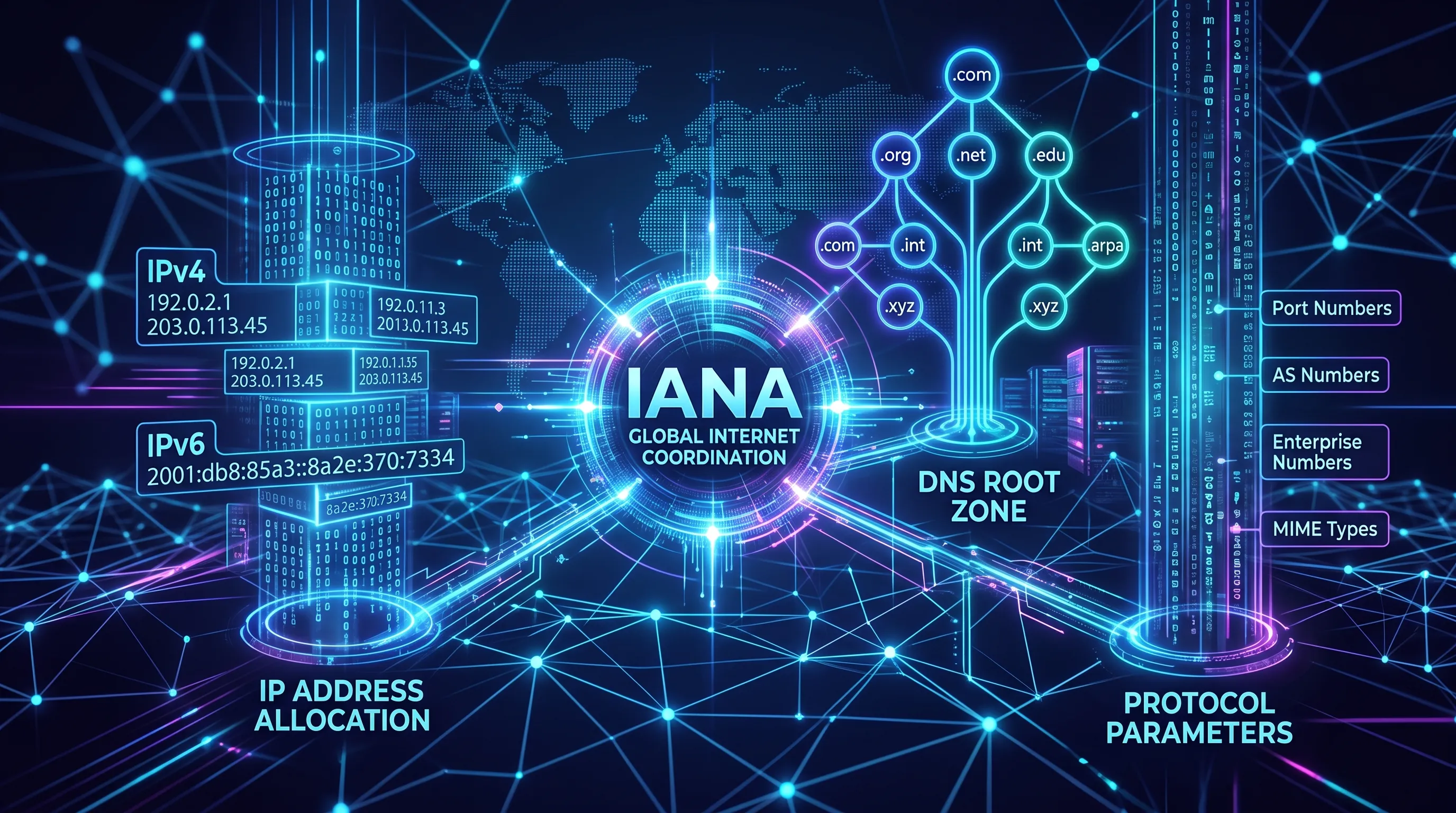
What is IANA?
The Internet Assigned Numbers Authority (IANA) coordinates some of the globally unique identifiers that allow the Internet to operate as one interconnected network.
Most Internet users will never interact with IANA directly. Yet when a device uses an IP address, a browser resolves a top-level domain, or Internet software relies on a standardized protocol value, IANA's registries and coordination functions may be somewhere behind the process.
The important word is coordination.
IANA does not own the Internet, control every Internet network, assign every individual IP address, or decide every technical standard. Instead, it maintains authoritative registries and carries out coordination functions according to policies and technical processes developed by the relevant Internet communities. Today, the IANA functions are provided by Public Technical Identifiers (PTI), an affiliate of the Internet Corporation for Assigned Names and Numbers (ICANN).
At a high level, IANA works across three critical areas:
- Internet number resources: IP addresses and Autonomous System Numbers (ASNs)
- Domain names: coordination of the DNS root zone and related domains
- Protocol parameters: authoritative registries of values used by Internet protocols
These functions may appear administrative, but global coordination is what prevents different networks and systems from using conflicting identifiers.
Why does the Internet need IANA?
The Internet is often described as a decentralized network, and that description is broadly correct. Thousands of independently operated networks connect to one another without a single company owning the entire system.
However, decentralization does not mean that everything can be duplicated.
Imagine two unrelated global networks both treating the same public IP address as uniquely belonging to different destinations. Or two different organizations independently deciding what the same protocol number should mean. The result would be ambiguity and interoperability problems.
Some technical identifiers therefore need to remain globally unique and consistently recorded.
IANA provides an important coordination layer for those identifiers. Its purpose is not to centrally operate the Internet, but to help independent networks, registries and technical systems work from compatible global records. IANA describes its role as coordinating the Internet's globally unique identifiers.
That distinction is fundamental to understanding how Internet governance works: global coordination can exist without centralized ownership of the Internet itself.
What does IANA do?
IANA's work can be understood through three main functions.
1. IANA coordinates Internet number resources
One of IANA's best-known roles involves IP addresses and Autonomous System Numbers.
Public IP addresses need to be globally unique. ASNs similarly identify autonomous systems participating in Internet routing.
However, IANA generally does not allocate an ordinary business or Internet user an IPv4 or IPv6 block directly.
Instead, IANA operates at the global level of the Internet Number Registry System. Its primary IP-address role is to allocate pools of unallocated address space to the Regional Internet Registries (RIRs) according to global policy.
The five RIRs then administer number resources within their respective service regions:
IANA → Regional Internet Registry → network operators / providers / organisations → Internet users and services
This hierarchy allows global uniqueness to be coordinated while regional communities maintain their own policy-development and resource-administration processes.
IANA also maintains authoritative registries showing the status of Internet number resources. For example, the IANA IPv4 Address Space Registry records the status of IPv4 /8 blocks, including space administered by the different RIRs and address space reserved for special purposes.
Does IANA decide who receives an IP address?
Not in the way the question is often understood.
IANA performs allocation and registry functions according to established global policies. Regional Internet Registries then operate their own regional allocation and registration systems.
This distinction matters because IANA should not be viewed as a global ISP or as an organization individually deciding which company is allowed to connect to the Internet.
Its role sits further upstream.
For readers wanting to understand the next part of this hierarchy, LARUS Foundation's What Is IP Allocation? explains how IP address space moves through the Internet registry system.
2. IANA coordinates the DNS root zone
IANA also performs important functions related to the Domain Name System (DNS).
The DNS turns human-readable names into information computers can use to locate Internet services. At the highest level of the DNS hierarchy is the root zone.
The root zone contains delegations for top-level domains such as:
.com.org.net.uk.jp
IANA manages important administrative aspects of this root zone.
According to IANA, its root-zone responsibilities include coordinating the managers of top-level domains, recording technical delegation information and publishing related registry information.
This is different from saying that IANA "runs every domain name."
For example, IANA maintains the delegation information for .com, but it does not directly register every .com domain purchased by an individual or business.
The hierarchy works at different layers.
DNS root → Top-level domain → domain registration → subdomains and services
IANA operates at the root coordination layer.
Does IANA operate the DNS root servers?
This requires an important distinction.
IANA manages information associated with the DNS root zone, but the global root server system is operated by multiple independent organizations.
The root hints information maintained through IANA contains the names and addresses needed for DNS resolvers to bootstrap the resolution process.
Therefore, saying simply that "IANA runs the root servers" would overstate its role.
A more accurate description is that IANA performs root-zone management and coordination functions within the wider DNS ecosystem.
That distinction is particularly important when discussing Internet governance because operational responsibility is distributed among multiple institutions rather than concentrated in one organization.
3. IANA maintains Internet protocol parameter registries
This third function receives less public attention but is fundamental to Internet interoperability.
Internet protocols contain many standardized numbers, names, codes and parameters. Different software implementations need to interpret those values in the same way.
IANA maintains authoritative protocol parameter registries containing many of those technical values. It performs this work in coordination with the Internet Engineering Task Force (IETF) and in accordance with the relevant technical standards and allocation policies.
A simplified example helps explain why this matters.
Suppose an Internet protocol contains a field where:
6 = one protocol
and
17 = another protocol
Software built by different companies needs a common authoritative reference for what those assigned values mean.
If developers could independently reuse standardized protocol identifiers for conflicting purposes, interoperability would become much harder.
IANA therefore acts as a record keeper and registry operator, while organizations such as the IETF develop the technical standards and policies that determine how many of those registries work.
This illustrates an important theme throughout Internet governance:
The organization maintaining a registry is not necessarily the organization making the underlying technical policy.
IANA vs ICANN: What is the difference?
IANA and ICANN are closely connected, but the terms are not interchangeable.
ICANN, the Internet Corporation for Assigned Names and Numbers, is the broader organization involved in coordinating Internet identifiers and supporting multistakeholder policy processes.
IANA refers to the operational functions and services that coordinate globally unique Internet identifiers.
Today, those IANA functions are operationally performed by Public Technical Identifiers (PTI), which was incorporated as an ICANN affiliate in 2016. PTI began performing the IANA functions on behalf of ICANN in October 2016.
A simple way to remember the relationship is:
ICANN = broader organization and governance framework
PTI = ICANN affiliate performing the IANA functions
IANA = the identifier-coordination functions and associated services
The distinction becomes especially useful when examining accountability. Different parts of the IANA functions interact with different communities and oversight mechanisms rather than being controlled through one single policy process.
IANA vs RIR: What is the difference?
IANA and the Regional Internet Registries also operate at different layers.
IANA coordinates the global pool and registries for Internet number resources.
RIRs administer number resources within their respective regions and develop resource policies through their community processes.
In simplified form:
IANA → RIR → network
For example, an RIR may request additional IPv6 address space according to the applicable global allocation policy. IANA processes such allocations using the defined procedures and updates the relevant global records.
The relationship is therefore not simply "IANA controls the RIRs."
It is better understood as a layered registry system in which global coordination and regional administration perform different functions.
This separation allows Internet number resources to remain globally unique while policy and operational responsibility can be distributed.
IANA vs IETF: Who creates Internet standards?
Another common source of confusion is the relationship between IANA and the Internet Engineering Task Force (IETF).
The IETF develops many of the technical standards used across the Internet.
IANA, by contrast, maintains many of the registries required by those standards.
An RFC produced through the IETF process may, for example, define a new protocol parameter and specify how values should be registered. IANA then maintains the relevant authoritative registry according to those instructions.
IANA's protocol registry service specifically states that it operates in coordination with the IETF.
So, in simplified terms:
IETF develops technical standards and associated policies → IANA maintains the required protocol registries.
This separation between standards development and registry operation is another example of the Internet's distributed governance structure.
A brief history of IANA
The origins of the IANA functions stretch back to the early development of the Internet.
Long before today's commercial Internet existed, researchers needed a reliable way to record protocol numbers, addresses and other technical identifiers. IANA traces these record-keeping functions back to Internet experiments in the 1970s.
Computer scientist Jon Postel played a central role in this early coordination work.
As the Internet expanded, these informal technical responsibilities gradually became part of a more formal institutional structure.
ICANN was established in 1998 as part of a broader transition toward a global, multistakeholder model for coordinating key Internet identifiers.
A second major change arrived in 2016.
Until then, the United States government's National Telecommunications and Information Administration had maintained a stewardship role connected to the IANA functions. On 1 October 2016, that stewardship transition was completed and the previous IANA functions contract expired.
PTI had been created as an ICANN affiliate and became the organization operationally performing the IANA functions after the transition.
The transition did not mean that one new organization suddenly gained control of the Internet. Rather, oversight and accountability arrangements were redistributed through the relevant Internet communities and established governance mechanisms.
Why is IANA important?
IANA's importance becomes clearer when we imagine the Internet without globally coordinated identifiers.
The Internet consists of many independently operated networks. These networks can use different hardware, software, commercial models and national regulatory environments.
Yet they still need to agree on certain fundamental technical references.
A public IP address cannot point to unrelated destinations because two different authorities independently treated it as globally unique.
Top-level domain delegations must have consistent authoritative records.
Protocol implementations need common meanings for standardized parameters.
IANA provides a neutral coordination and registry function across these areas.
This does not eliminate disagreements in Internet governance. It does, however, create a common technical reference layer that makes global interoperability possible.
Does IANA control the Internet?
No.
This is perhaps the most important misconception to avoid.
There is no single organization that controls every part of the global Internet.
IANA has significant responsibilities because it maintains globally important registries and coordination functions, but its authority is limited to defined technical and administrative roles.
Internet governance involves a much broader ecosystem including ICANN, the IETF, Regional Internet Registries, governments, network operators, civil society, businesses, technical communities and Internet users.
Different organizations exercise responsibility at different layers.
Understanding IANA therefore teaches a larger lesson about the Internet itself:
The Internet depends on coordination without requiring one central owner.
How does IANA affect ordinary Internet users?
Most people will never submit a request to IANA or interact directly with its staff.
Its work is nevertheless part of the infrastructure behind everyday Internet activity.
When you visit a website, your connection depends on globally coordinated naming, addressing, routing and protocol systems.
IANA does not perform every step involved in that connection, but it maintains some of the authoritative registries that allow different parts of the Internet ecosystem to use compatible identifiers.
This makes IANA similar to other parts of critical infrastructure that become almost invisible when they work correctly.
The better the coordination functions operate, the less an ordinary user needs to think about them.
IANA and Internet governance
IANA is also a useful example of why Internet governance is not the same as government regulation.
Some Internet governance questions concern laws, national policies or content.
Others concern deeply technical coordination: who maintains a registry, who develops the policy behind it, how changes are approved, how accountability works, and how different institutions cooperate without breaking global interoperability.
IANA sits directly inside this technical governance layer.
Its relationships with ICANN, PTI, the RIRs and the IETF demonstrate the multistakeholder and distributed nature of Internet coordination.
For LARUS Foundation, understanding these structures is important because meaningful participation in Internet governance begins with knowing which institution is responsible for which layer of the Internet.
Without that distinction, discussions about "who controls the Internet" quickly become misleading.
Conclusion
IANA is one of the Internet's most important coordination mechanisms, even though most users never encounter it directly.
Its job is not to control the Internet. It helps maintain the globally consistent identifiers that allow a decentralized Internet to remain interoperable.
Through Internet number resources, the DNS root zone and protocol parameter registries, the IANA functions connect several important layers of Internet infrastructure.
Understanding IANA also makes the wider Internet governance system easier to understand.
IANA coordinates at the global level. Regional Internet Registries administer number resources regionally. The IETF develops technical standards. ICANN provides a broader institutional and multistakeholder framework, while PTI operationally performs the IANA functions.
No single organization performs every role.
That separation of responsibilities is not an accident. It is one of the principles that allows thousands of independently operated networks to function together as one global Internet.
Frequently asked questions
What does IANA stand for?
IANA stands for Internet Assigned Numbers Authority.
What is the main purpose of IANA?
IANA coordinates globally unique Internet identifiers. Its major functions cover Internet number resources, DNS root-zone management and protocol parameter registries.
Is IANA part of ICANN?
The current IANA functions are provided by Public Technical Identifiers (PTI), an affiliate of ICANN. PTI has performed these operational functions on behalf of ICANN since October 2016.
Does IANA assign IP addresses to individuals?
Normally, no. At the global level, IANA allocates pools of IP address space to Regional Internet Registries according to global policy. Distribution and registration then occur through lower levels of the Internet number registry system.
What is the difference between IANA and an RIR?
IANA operates the global coordination layer for Internet number resources. RIRs administer resources within their service regions and operate regional policy and registration systems.
What is the difference between IANA and the IETF?
The IETF develops many Internet technical standards. IANA maintains protocol parameter registries associated with those standards and allocation policies.
Does IANA manage domain names?
IANA manages important aspects of the DNS root zone, including top-level-domain delegation records. It does not directly register ordinary domain names for Internet users.
Who controls IANA today?
It is more accurate to describe IANA through its accountability structure than to say one party simply "controls" it. The IANA functions are performed by PTI, an ICANN affiliate, while different communities and mechanisms provide oversight for the names, numbers and protocol-parameter functions.