
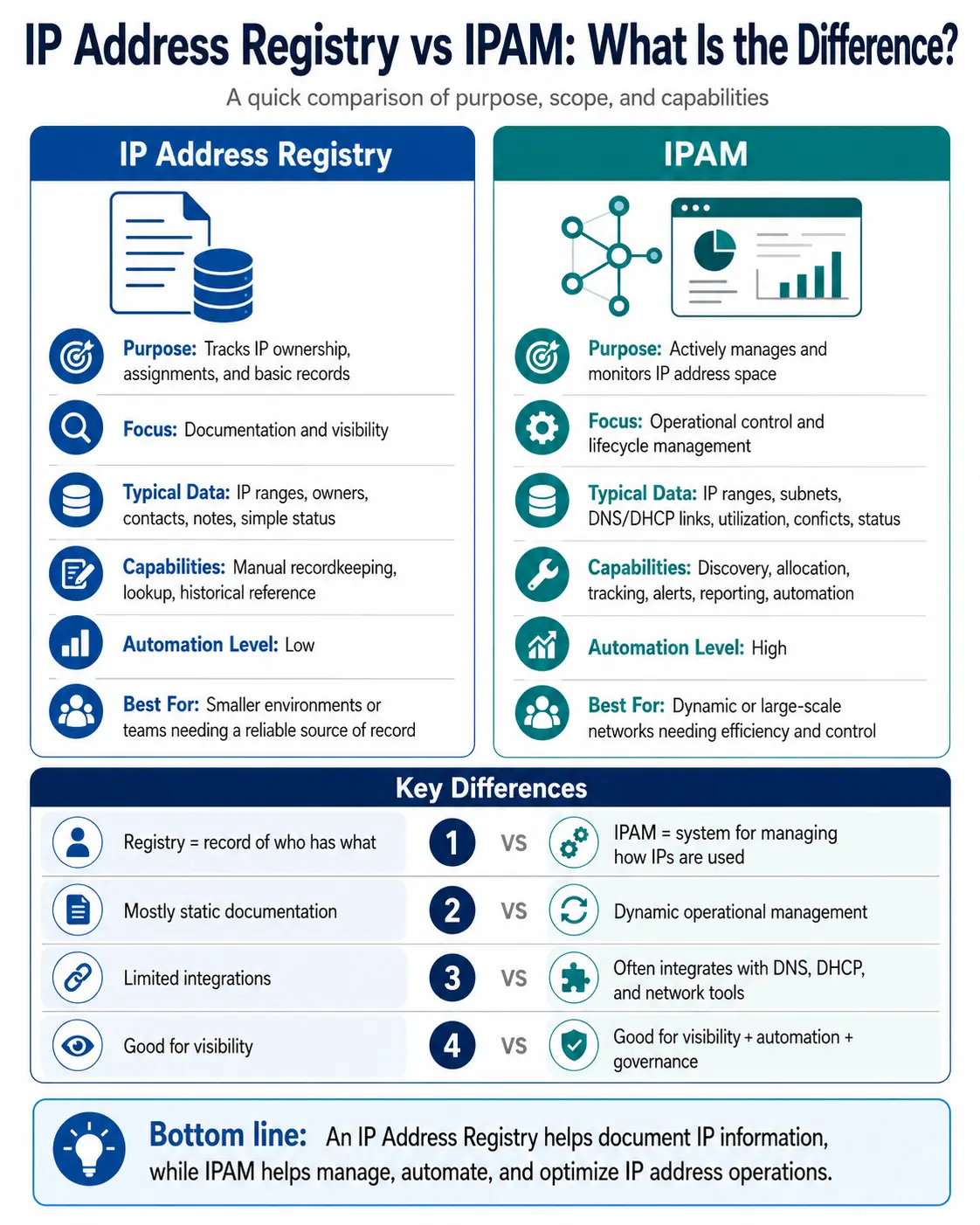
An IP address registry and an IP Address Management system (IPAM) both contain information about IP addresses, but they serve different purposes. An IP address registry helps coordinate Internet number resources and maintain registration information, while IPAM helps an organisation plan, assign, track, and manage the IP addresses used inside its own networks.
The two systems may describe the same address space from different perspectives.
A registry might show which organisation is associated with a public IPv4 or IPv6 block.
An IPAM system might show how that organisation has divided the block into subnets, which addresses are assigned to servers, which ranges remain available, and which team is responsible for each network.
Understanding this distinction matters because registry accuracy and internal address management are related, but they are not interchangeable.
A network can have accurate registry information while maintaining poor internal IPAM records.
It can also have excellent internal IPAM while its external registry information is incomplete or outdated.
Reliable network operations benefit from both.
What Is an IP Address Registry?
An IP address registry is a system used to maintain records associated with Internet number resources such as IPv4 addresses, IPv6 addresses, and Autonomous System Numbers (ASNs).
At the global level, the Internet Assigned Numbers Authority (IANA) coordinates global Internet number-resource registries and maintains authoritative information related to IPv4, IPv6, and ASNs.
Regional Internet Registries, commonly known as RIRs, administer Internet number resources within their respective service regions.
The five RIRs are:
- AFRINIC
- APNIC
- ARIN
- LACNIC
- RIPE NCC
For more background on how these organisations fit into the addressing system, see LARUS Foundation's guide to ICANN and Regional Internet Registries.
Registry information can help users understand which organisation is associated with an Internet number resource and provide information useful for coordination, administration, and troubleshooting.
Depending on the registry and resource, records may include:
- IP address range;
- CIDR prefix;
- organisation or resource-holder information;
- administrative contacts;
- technical contacts;
- abuse contacts;
- registration status;
- allocation or assignment information;
- registration dates; and
- related registry identifiers.
The exact fields and terminology can vary between registry systems.
What Is IPAM?
IPAM stands for IP Address Management.
IPAM refers to the processes and tools organisations use to plan, allocate, document, monitor, and manage IP addresses inside their own network environments.
While a registry may describe a public address block at a relatively high level, IPAM usually contains much more detailed operational information.
For example, an organisation may use:
203.0.113.0/24
At the registry level, the /24 may appear as one address resource associated with an organisation.
Internally, the organisation might divide that address space into smaller subnets:
203.0.113.0/27— application servers203.0.113.32/27— public services203.0.113.64/28— network infrastructure203.0.113.80/28— security systems- remaining space — reserved for future deployment
An IPAM system can keep track of those decisions.
It may record:
- individual IP assignments;
- IPv4 and IPv6 subnets;
- available addresses;
- reserved addresses;
- VLANs;
- devices;
- locations;
- DNS information;
- DHCP information;
- gateways;
- responsible teams;
- usage status; and
- historical changes.
LARUS Foundation explains this operational layer in more detail in What Is IP Address Management (IPAM)?.
IP Address Registry vs IPAM at a Glance
| Area | IP Address Registry | IPAM |
|---|---|---|
| Primary purpose | Internet number-resource registration and coordination | Internal IP address planning and management |
| Main scope | Public Internet number resources | Organisation's network environment |
| Typical resources | IPv4, IPv6, ASNs | IPv4, IPv6, subnets, devices |
| Typical users | Resource holders, registries, operators, researchers | Network, infrastructure and security teams |
| WHOIS/RDAP | Common methods for accessing registration data | Usually not the primary interface |
| Individual device tracking | Generally no | Yes |
| Subnet planning | Limited/high-level | Core function |
| Available address tracking | Generally no | Yes |
| DNS/DHCP integration | Not normally the main purpose | Common in IPAM systems |
| Operational network inventory | No | Yes |
| Global uniqueness coordination | Yes, for public resources | No |
| Internal source of truth | No | Often |
The simplest distinction is:
A registry helps answer questions about an Internet number resource at the shared coordination layer. IPAM helps answer questions about how address space is actually being used inside a network.
1. Registry Records Describe the Resource at a Coordination Level
Suppose a network operator wants to know which organisation is associated with a public IPv4 prefix.
That is generally a registry question.
Registration information can be useful during:
- network troubleshooting;
- resource auditing;
- transfer preparation;
- abuse contact identification;
- infrastructure due diligence; and
- number-resource administration.
The registry is therefore part of the shared information layer that helps independent networks coordinate around globally unique Internet number resources.
This is one reason registry accuracy matters.
If records no longer reflect current organisational or contact information, operational coordination may become more difficult.
LARUS Foundation explores this relationship in Why Accurate Registry Data Supports a Stable Internet.
2. IPAM Describes How the Network Actually Uses Addresses
IPAM operates at a much more detailed level.
Imagine that an enterprise has:
10.20.0.0/16
A public registry would not normally tell the organisation how that private network has been divided internally.
IPAM can.
For example:
| Subnet | Purpose |
|---|---|
10.20.10.0/24 | Employee network |
10.20.20.0/24 | Application servers |
10.20.30.0/24 | Database systems |
10.20.40.0/24 | Network management |
10.20.50.0/24 | Guest network |
10.20.60.0/24 | Development environment |
IPAM can then track individual assignments inside those networks.
It helps answer questions such as:
- Which addresses are available?
- Which subnet contains this server?
- Who manages this network?
- Is this address already in use?
- How much capacity remains?
- Which locations use this range?
- Are two networks overlapping?
- Which addresses are reserved?
- When was an assignment changed?
These are primarily operator-level questions, rather than global registry questions.
3. WHOIS and RDAP Are Not the Same as IPAM
One common source of confusion is treating WHOIS or RDAP as if they were IPAM systems.
They are not.
WHOIS and RDAP are used to access registration information.
WHOIS
WHOIS is a long-established query protocol used to retrieve registration data associated with Internet resources.
Different registry systems historically developed different WHOIS formats and practices, which can make the data less consistent for automated processing.
RDAP
Registration Data Access Protocol (RDAP) provides a modern and structured method of accessing registration data.
RDAP uses HTTP and structured responses, making it more suitable for modern applications and machine-readable workflows.
The technical standards include RFC 9082, which defines the RDAP query format, and RFC 9083, which defines JSON responses for RDAP.
An RDAP response may help an operator identify registration information associated with an IP block.
It does not normally tell the operator:
- which server uses a particular internal address;
- which addresses remain available inside a subnet;
- which VLAN contains an address;
- which application depends on it;
- which internal team manages the service; or
- when an internal system will be decommissioned.
Those are IPAM or broader network-inventory questions.
4. Registry Data Is Not the Same as Routing Data
Another important distinction is between registration and routing.
An address block appearing in a registry does not by itself tell you whether the prefix is currently being announced through BGP.
Likewise, registry information alone does not describe everything about:
- the current origin ASN;
- BGP reachability;
- route propagation;
- RPKI validation;
- ROA configuration; or
- how traffic actually reaches the network.
These layers are related but different.
A simplified model looks like this:
Registry layer
What registration information is associated with the number resource?
Routing layer
How is the prefix currently being announced?
Routing-security layer
What route-origin authorisations or validation information apply?
IPAM layer
How is the address space organised and used internally?
DNS layer
What naming and reverse-DNS relationships exist?
A reliable network source of truth should recognise these distinctions rather than treating one database as proof of every other layer.
NRS.help discusses this broader operational approach in The Complete Guide to Maintaining a Network Source of Truth.
5. Public and Private Address Space Highlight the Difference
Private IPv4 addressing provides a useful example of why IPAM and registries serve different roles.
The private ranges defined by RFC 1918 are:
10.0.0.0/8172.16.0.0/12192.168.0.0/16
Independent organisations can reuse these ranges inside their own networks.
A company may therefore operate thousands of private addresses that are critical to its infrastructure but do not have individual public Internet registry records.
An IPAM system may contain detailed information about all of them.
For example:
10.100.20.41
could identify an important database server inside one company.
Another organisation could use the exact same private address for an unrelated device.
IPAM keeps these local environments understandable.
The public Internet number-resource registry system, by contrast, helps coordinate globally unique public resources.
6. Registry Accuracy and IPAM Accuracy Solve Different Problems
Both systems depend on accurate information, but inaccuracies create different types of operational problems.
If Registry Records Are Inaccurate
Possible difficulties include:
- outdated contact information;
- slower operational coordination;
- difficulty identifying responsible organisations;
- additional work during resource audits;
- confusion during administrative changes; and
- inconsistencies between records and current organisational reality.
If IPAM Records Are Inaccurate
Possible difficulties include:
- duplicate internal IP assignments;
- unidentified devices;
- overlapping subnet plans;
- address exhaustion being discovered too late;
- unused ranges remaining reserved unnecessarily;
- troubleshooting delays;
- migration mistakes; and
- configuration automation relying on incorrect information.
Registry accuracy supports shared coordination.
IPAM accuracy supports local operational management.
Both matter.
7. Why IPAM Can Be Part of a Network Source of Truth
For larger networks, operators need a reliable answer to a basic question:
What addresses are we actually using?
A well-maintained IPAM system can become an important part of the organisation's network source of truth.
For each significant subnet, teams may need to know:
- prefix;
- address family;
- purpose;
- location;
- VLAN;
- gateway;
- owner;
- allocated addresses;
- free addresses;
- reserved addresses;
- DNS relationships;
- lifecycle status; and
- dependencies.
Without reliable records, teams may fall back on spreadsheets, old configuration files, ticket histories, or individual memory.
Those methods can work for smaller environments, but they become more difficult to maintain as infrastructure grows.
Structured IPAM reduces uncertainty.
That supports network continuity because important changes can be made using a clearer picture of the existing environment.
8. Why Registry Records Still Matter Even With Good IPAM
Strong IPAM does not eliminate the need for accurate external registry information.
Consider an ISP or enterprise with excellent internal documentation.
Its IPAM system may accurately record every subnet, router interface, server assignment, and infrastructure range.
But networks outside the organisation generally do not have access to that internal system.
Registry information serves a different purpose.
It provides shared information relevant to Internet number-resource coordination and administration.
Put simply:
IPAM helps an organisation understand its own network.
Registry information helps support coordination around shared Internet number resources.
The two functions complement each other.
9. Why Registry Records Cannot Replace IPAM
The reverse is also true.
A network should not depend on external registry records as its internal address inventory.
Registry systems generally do not contain enough information to answer everyday questions such as:
- Which IP belongs to this VM?
- Which subnet belongs to this office?
- Which addresses are reserved for a firewall pair?
- How much space remains in this VLAN?
- Which network will be retired next month?
- Who approved this internal assignment?
- Does this private network overlap with another environment?
- Which addresses are safe to reuse?
That level of detail belongs closer to the operator.
This reflects a broader technical principle: shared coordination can focus on essential common information, while detailed network architecture and address-management decisions remain close to the people operating the infrastructure.
10. Where IPv4 Subnet Planning Fits
Subnet design is primarily an IPAM and network-architecture activity.
Suppose an organisation has a /24.
It could use it as:
- one
/24; - two
/25s; - four
/26s; or - a combination of different prefix sizes.
The appropriate design depends on factors such as:
- host requirements;
- network segmentation;
- expected growth;
- routing;
- redundancy;
- service design;
- customer requirements; and
- migration planning.
The shared registry layer does not normally need to describe every internal subnet decision.
That belongs to the network operator's addressing architecture.
LARUS Foundation examines this in more detail in IPv4 Subnet Design: How Better Address Planning Supports Network Continuity.
11. Where IP Allocation Fits
Another source of confusion is the word allocation.
Allocation, registration, assignment, subnetting, and IPAM are related concepts, but they are not identical.
At a high level:
Allocation refers to making a block of number resources available within an addressing hierarchy or administrative process.
Registration records relevant information associated with a number resource.
Assignment can describe address space designated for a particular network or use, depending on the technical or administrative context.
Subnetting divides larger address blocks into smaller logical networks.
IPAM tracks how address space is planned and used operationally.
LARUS Foundation's guide to What Is IP Allocation? explains the allocation side in more detail.
Keeping these terms separate makes technical discussions much clearer.
12. Registry, IPAM, Routing and DNS Should Be Checked Together
For production IPv4 environments, relying on one information source can create blind spots.
A practical resource review might examine several layers.
Registry
Is the relevant registration information current?
IPAM
Does the organisation know how the address space is actually being used?
Routing
Are the expected prefixes being announced through the expected ASNs?
RPKI
Do route-origin authorisations reflect the intended routing configuration?
Reverse DNS
Are PTR delegations and records managed appropriately?
Internal Documentation
Do operational records reflect current infrastructure and responsibility?
NRS.help provides a practical resource-management perspective in How to Audit Your Company's Internet Number Resources.
The important lesson is:
One layer should not automatically be treated as proof of every other layer.
13. When Should an Organisation Use IPAM?
An organisation should consider structured IPAM when address management becomes difficult to handle reliably through simple documentation alone.
Common signals include:
- hundreds or thousands of addresses;
- multiple offices;
- multiple data centres;
- cloud and on-premises environments;
- frequent subnet changes;
- many VLANs;
- multiple network teams;
- IPv4 and IPv6 operating together;
- automation requirements;
- overlapping-address risks; or
- difficulty identifying free address space.
The more complex the network becomes, the more valuable it is to maintain a trustworthy internal representation of address use.
14. IP Address Registry and IPAM Best Practices
A strong workflow does not require trying to combine every network function into one database.
Instead, it keeps responsibilities clear.
Keep Registry Information Current
Review relevant registration and contact information when organisational or resource information changes.
Keep IPAM Operationally Accurate
Update internal assignments when infrastructure changes rather than allowing records to fall behind the network.
Define Ownership
Every important subnet should have a clear operational owner or responsible team.
Separate Registration From Routing
Check actual routing information independently where necessary.
Track Address Lifecycle
Know when addresses are:
- available;
- reserved;
- assigned;
- active;
- being migrated;
- temporarily unavailable for reuse; or
- ready for reassignment.
Maintain Auditability
Important changes should be traceable where operational requirements justify it.
Review Records Regularly
A source of truth is useful only when it reflects the network that actually exists.
Registry Layer vs Operator Layer
The distinction between registry systems and IPAM illustrates an important principle in Internet infrastructure.
Some information needs to be coordinated across independent networks.
Globally unique public number resources require shared mechanisms for registration and coordination.
But not every network-management decision needs to exist at that shared layer.
The operator still needs to determine:
- how networks are segmented;
- how addresses are assigned;
- which systems need stable addresses;
- how much growth capacity is appropriate;
- how infrastructure is routed;
- which addresses should be reserved; and
- how the network should evolve.
This allows the common coordination layer to remain focused on shared requirements while leaving detailed operational decisions with the networks that understand their own infrastructure.
That approach is consistent with Heng.lu's discussion of thin coordination, where essential functions such as uniqueness and accurate records remain part of the shared layer while many operational choices stay closer to operators.
IP Address Registry vs IPAM Checklist
| Question | Registry | IPAM |
|---|---|---|
| Which organisation is associated with this public block? | ✓ | |
| What is the registered prefix? | ✓ | |
| What contact information is associated with the resource? | ✓ | |
| Which server uses this IP internally? | ✓ | |
| How many addresses remain available? | ✓ | |
| What subnet contains this device? | ✓ | |
| Which team manages this VLAN? | ✓ | |
| Is this private address already assigned? | ✓ | |
| What space is reserved for future growth? | ✓ | |
| How has the organisation divided its address space? | ✓ | |
| Does registration data reflect current information? | ✓ | |
| Does the internal inventory reflect current deployment? | ✓ |
Many real-world operational questions eventually require checking both.
Frequently Asked Questions
Is IPAM the same as an IP address registry?
No. An IP address registry maintains registration information associated with Internet number resources, while IPAM helps organisations plan and manage their own IP address usage.
What is the main difference between an IP registry and IPAM?
The main difference is scope. A registry operates at a shared Internet number-resource coordination level. IPAM operates primarily within an individual organisation or network.
Is WHOIS an IPAM system?
No. WHOIS is a query protocol historically used to access registration information. It does not normally provide detailed subnet, device, assignment, and utilisation management.
Is RDAP an IPAM system?
No. RDAP is a standardised protocol for accessing registration data. It provides structured information about Internet resources but does not replace an organisation's internal IPAM system.
Can registry data tell me whether an IP address is being routed?
Not by itself. Registration data and routing state are different. BGP and relevant routing-security information may need to be checked separately.
Can IPAM track public IPv4 addresses?
Yes. IPAM can track public and private addresses used by an organisation. Maintaining an address in IPAM, however, does not replace applicable external registration information.
Why does registry accuracy matter?
Accurate registry information supports number-resource administration, contactability, coordination, auditing, and troubleshooting.
Why does IPAM accuracy matter?
Accurate IPAM data helps prevent duplicate assignments, identify available capacity, manage subnets, support automation, simplify troubleshooting, and plan network changes.
Should a company use both registry information and IPAM?
For organisations using public Internet number resources, the two functions are complementary. External registry information supports shared number-resource coordination, while internal IPAM supports day-to-day address management.
What is a network source of truth?
A network source of truth is a maintained set of information that describes the intended or operational state of a network. IPAM can form an important part of that source of truth for subnets, address assignments, ownership, and available capacity.
Conclusion
An IP address registry and IPAM may both contain information about IP addresses, but they solve different problems.
The registry layer helps answer:
What is this Internet number resource, and what registration information is associated with it?
The IPAM layer helps answer:
How is our network actually using this address space?
Registry systems support coordination across independent networks.
IPAM supports detailed management within an organisation.
Neither should be expected to replace the other.
Reliable network operations benefit from understanding the complete picture:
Registry accuracy for shared number-resource information.
IPAM accuracy for internal address management.
Routing visibility for actual network reachability.
Routing-security information where applicable.
DNS and reverse DNS for naming requirements.
Operational documentation for the infrastructure and teams that depend on the addresses.
The broader lesson is simple:
Good Internet infrastructure depends on keeping the right information at the right layer.
At LARUS Foundation, we support greater understanding of the technical systems and coordination mechanisms that help keep the Internet interoperable and resilient. Understanding the difference between an IP address registry and IPAM is one practical step toward better network planning, more accurate records, and stronger operational continuity.