
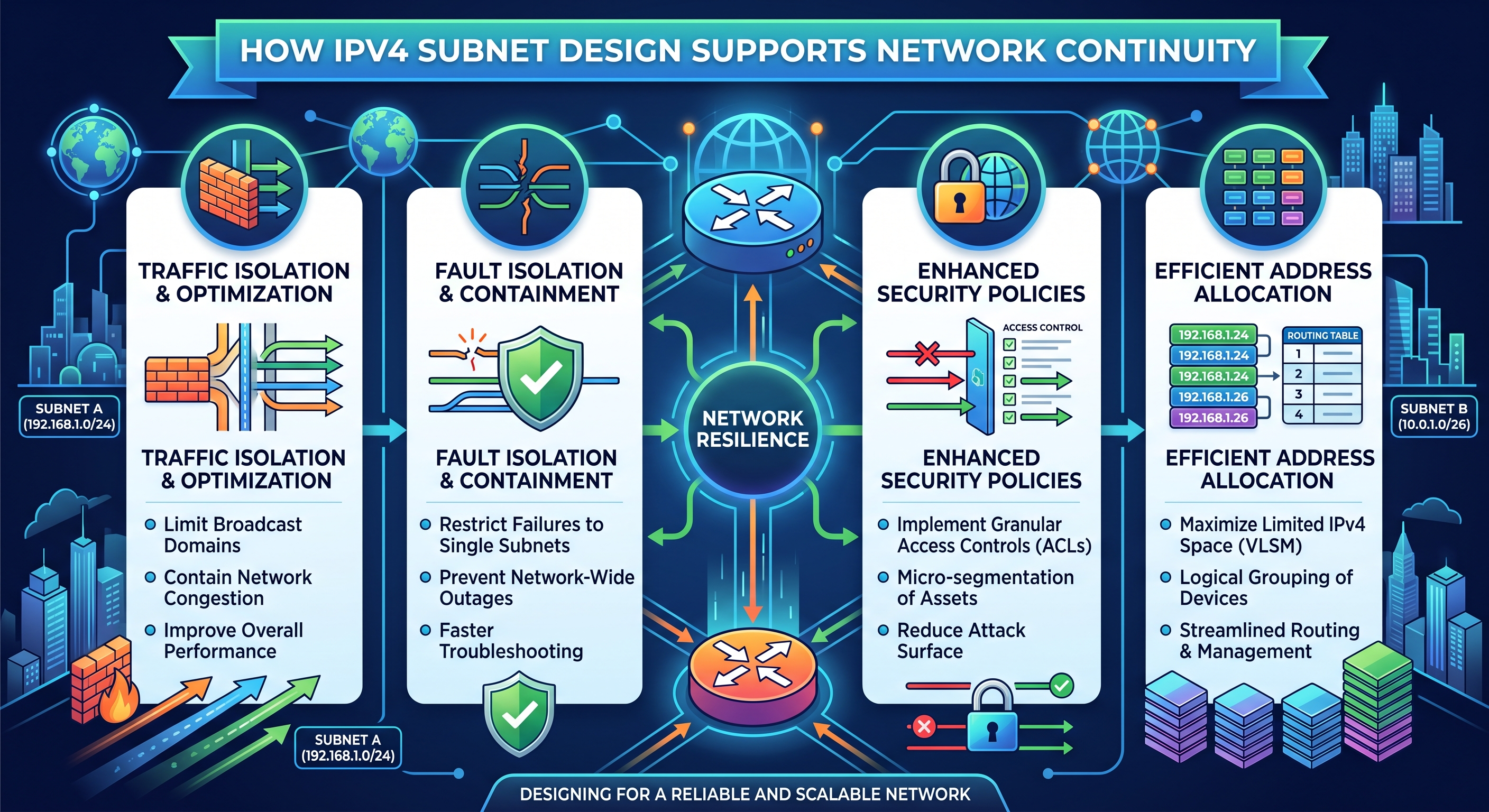
IPv4 subnet design supports network continuity by creating structured address boundaries, allowing room for realistic growth, simplifying routing, reducing address fragmentation, and lowering the risk of disruptive IP renumbering.
Subnetting is often introduced as a networking calculation: determine how many addresses are needed, choose a prefix length, and assign addresses to devices.
In real production environments, however, subnet design has much wider consequences.
An IPv4 subnet may eventually support servers, customer connections, applications, firewalls, DNS records, monitoring platforms, VPNs, cloud infrastructure, routing policies, and external integrations.
Once those dependencies develop, changing the addressing structure may become much more than a routine configuration task.
It can become a network continuity challenge.
Good IPv4 subnet planning therefore is not simply about fitting a certain number of addresses into a prefix.
It is about building an addressing structure that remains understandable, manageable, and adaptable while the network continues to operate.
For readers new to Internet addressing, start with LARUS Foundation's guide to What Is an IP Address and How Does It Work?.
What Is IPv4 Subnet Design?
An IPv4 subnet is a logical subdivision of an IPv4 network.
Consider this network:
192.168.10.0/24
A /24 contains 256 total IPv4 addresses.
The network could remain one /24, or an operator could divide it into smaller networks such as:
192.168.10.0/26192.168.10.64/26192.168.10.128/26192.168.10.192/26
Each /26 contains 64 total IPv4 addresses.
IPv4 subnet design is the process of deciding how those address ranges should be structured and used across a network.
A practical subnet plan may consider:
- current host requirements;
- expected future growth;
- physical locations;
- servers and applications;
- customer networks;
- security zones;
- routing architecture;
- redundancy;
- public and private addressing;
- migration requirements; and
- operational dependencies.
Modern IPv4 subnetting normally uses Classless Inter-Domain Routing (CIDR) notation such as /24, /27, or /30.
For a beginner-friendly explanation, see What Is CIDR?.
The technical basis of classless IPv4 addressing and routing is documented in RFC 4632.
What Is Network Continuity?
Network continuity is the ability of a network and the services that depend on it to continue operating through infrastructure changes, maintenance, migration, growth, and unexpected events.
Continuity does not mean a network should never change.
Networks change constantly.
Organisations may:
- replace routers;
- migrate data centres;
- expand cloud environments;
- change connectivity providers;
- deploy new applications;
- redesign security systems;
- open or close locations; or
- change routing architecture.
The objective is not to eliminate change.
The objective is to prevent change from causing unnecessary disruption to running services.
IPv4 addressing is important because addresses can gradually become embedded across many layers of infrastructure.
A well-structured subnet plan can make future changes easier.
A poorly planned one can make those changes considerably more difficult.
1. Good IPv4 Subnet Planning Can Reduce Unnecessary Renumbering
Renumbering means changing the IP addresses used by devices, applications, or networks.
At first glance, changing an IPv4 address may seem simple.
For example:
192.0.2.10
could become:
192.0.2.20
But the original address may also appear in:
- firewall rules;
- DNS records;
- API allowlists;
- VPN policies;
- application configurations;
- access-control lists;
- monitoring systems;
- security platforms;
- customer configurations; and
- partner systems.
The more dependencies associated with an address, the more coordination may be required to change it safely.
This makes subnet planning a continuity issue.
A network designed with almost no capacity for realistic growth may work today but require avoidable migration later.
The goal is not to allocate oversized subnets everywhere.
It is to avoid preventable redesign.
2. IPv4 Addresses Can Become Part of Network Identity
An IP address begins as a technical identifier.
Over time, however, it can become recognised by systems outside the local network.
For example:
A customer may whitelist it.
A security platform may associate it with a trusted environment.
A partner may reference it in an access-control policy.
An API provider may accept connections only from a defined range.
A monitoring platform may associate the address with a specific service or location.
At that point, the address is no longer only capacity.
It has become part of the network's operational identity.
This does not mean every IPv4 address needs to remain permanent.
Some addresses support temporary workloads and can change with little consequence.
Others become continuity-sensitive.
A useful subnet strategy therefore distinguishes between:
Flexible address space
Addresses supporting workloads that can move or change relatively easily.
Continuity-sensitive address space
Addresses referenced by customers, partners, security systems, applications, APIs, or other external infrastructure.
This distinction closely reflects the Heng.lu notes' broader idea that an IP address can become more operationally significant as external systems and running infrastructure begin depending on it.
For further reading, see On LARUS One — The Economics of Network Identity, Customer Continuity, and Provider Revenue.
3. Subnets Create Clear Operational Boundaries
Good subnet design makes infrastructure easier to understand.
For example:
| IPv4 Subnet | Function |
|---|---|
10.20.10.0/24 | Employee devices |
10.20.20.0/24 | Application servers |
10.20.30.0/24 | Database systems |
10.20.40.0/24 | Network infrastructure |
10.20.50.0/24 | Guest network |
This structure creates logical boundaries between different environments.
Operators can more easily understand:
- which systems belong together;
- how traffic should move;
- which security rules apply;
- where an incident is occurring; and
- which part of the infrastructure is affected by a planned change.
Subnetting by itself does not provide security or redundancy.
Instead, it creates boundaries upon which routing, firewall, access-control, monitoring, and resilience strategies can be built.
This makes addressing an important part of broader IP infrastructure.
4. Good Address Planning Helps Contain Change
One useful principle in resilient infrastructure is change containment.
A change affecting one part of the network should, where practical, avoid forcing changes across unrelated infrastructure.
For example, an organisation might separate:
- production networks;
- development networks;
- management networks;
- customer-facing networks;
- backup environments; and
- disaster-recovery systems.
If one environment requires migration or redesign, the others may continue operating without significant modification.
This leads to a useful continuity principle:
A local infrastructure change should remain as local as reasonably possible.
Well-designed subnet boundaries make that easier.
5. How to Choose the Right IPv4 Subnet Size
There is no universally correct IPv4 subnet size.
A /24 is not automatically better than a /27.
A /28 is not automatically more efficient than a /24.
The appropriate prefix depends on how the network will actually operate.
| Prefix | Total IPv4 Addresses |
/24 | 256 |
/25 | 128 |
/26 | 64 |
/27 | 32 |
/28 | 16 |
/29 | 8 |
/30 | 4 |
/31 | 2 |
/32 | 1 |
When choosing an IPv4 subnet size, operators should consider:
- current host count;
- realistic future growth;
- redundancy requirements;
- high-availability systems;
- routing architecture;
- service boundaries;
- customer needs;
- infrastructure location; and
- migration requirements.
The smallest technically possible subnet is not always the best operational choice.
An excessively large subnet may leave address capacity unused.
An excessively small subnet may force unnecessary restructuring later.
Good IPv4 subnet sizing balances both factors.
6. Plan for Reasonable Future Growth
Networks rarely stay the same size.
A subnet supporting 20 systems today might later need to accommodate 30, 40, or more.
Growth can come from:
- additional servers;
- new customers;
- redundant appliances;
- load balancers;
- firewalls;
- monitoring systems;
- backup infrastructure;
- migration environments; and
- new applications.
If every subnet is designed with no capacity for change, normal infrastructure growth may repeatedly force address-plan redesign.
This does not mean every service should receive a large unused allocation.
Instead, operators should consider the expected lifecycle of the service.
A temporary testing environment may require little expansion capacity.
A production platform expected to grow over several years may justify more flexibility.
7. Avoid Unnecessary IPv4 Address Fragmentation
Subnetting allows large address ranges to be divided into smaller blocks.
That flexibility is valuable.
But unmanaged subdivision can gradually create IPv4 address fragmentation.
Imagine an organisation assigning prefixes whenever a new requirement appears:
10.10.0.0/27
10.10.0.64/28
10.10.0.96/29
10.10.1.128/26
Each individual subnet may work correctly.
The problem may appear later when one service needs to expand but the adjacent address space has already been assigned elsewhere.
Structured subnet planning can reduce this problem.
Where practical, network operators can:
- group related services;
- preserve logical addressing hierarchies;
- maintain appropriate expansion space;
- document available ranges; and
- avoid assigning prefixes randomly.
8. IPv4 Subnet Design and Routing Are Closely Connected
Subnet planning should not be separated completely from routing architecture.
Routers make forwarding decisions using network prefixes.
The way addresses are structured therefore affects how easily routes can be organised.
CIDR supports variable-length prefixes and can enable route aggregation where address topology allows it.
A structured IPv4 addressing plan can therefore make routing easier to understand and maintain.
A fragmented address plan may instead lead to:
- more specific routes;
- additional routing complexity;
- harder troubleshooting; and
- more difficult expansion.
RFC 4632 describes CIDR in relation to both IPv4 address assignment and routing scalability:
https://www.rfc-editor.org/rfc/rfc4632
The broader lesson is:
Subnetting is not only address arithmetic. It is part of network architecture.
9. Public and Private IPv4 Subnets Have Different Continuity Risks
Private IPv4 networks commonly use ranges defined in RFC 1918:
10.0.0.0/8172.16.0.0/12192.168.0.0/16
Private address space can be reused by independent networks.
That provides flexibility, but it can also create an overlap problem.
Imagine two organisations that both use:
10.0.0.0/8
While their environments remain separate, there may be no issue.
But if they later need to connect because of:
- a merger;
- VPN integration;
- cloud migration;
- data-centre consolidation; or
- infrastructure partnership,
overlapping address space can complicate routing.
Public IPv4 addresses introduce different continuity considerations.
Public addresses may become referenced by:
- customers;
- partners;
- DNS;
- security platforms;
- Internet routing;
- applications; and
- external monitoring systems.
Changing them may therefore require wider coordination.
Both public and private subnet planning benefit from long-term thinking, but the dependencies are different.
10. IPv4 Subnet Design Best Practices
Several practical principles can improve IPv4 subnet planning without imposing one universal model on every network.
Size Subnets According to Real Requirements
Choose prefix lengths according to host requirements, growth, routing, redundancy, and migration needs.
Leave Reasonable Growth Capacity
Avoid designing production networks so tightly that predictable growth immediately requires renumbering.
Group Related Infrastructure Logically
Where practical, allocate related systems from related address ranges.
Avoid Unnecessary Fragmentation
Maintain a structured hierarchy instead of assigning available prefixes randomly.
Consider Routing Early
Address planning and routing architecture should be designed together.
Identify Continuity-Sensitive Addresses
Know which public addresses are referenced by customers, partners, security systems, APIs, or other external services.
Document Address Dependencies
Keep records of DNS, routing, firewall, monitoring, application, and external dependencies.
Use IPAM for Larger Environments
Track subnet utilisation and ownership in a consistent IP address management system.
Review the Address Plan Periodically
Infrastructure changes over time. Address planning should therefore be reviewed as the network evolves.\
11. Document the Purpose of Important Subnets
Even an excellent technical design can become difficult to operate if its purpose is unclear.
For each important subnet, organisations should ideally know:
- what the subnet supports;
- which systems use it;
- who is responsible for it;
- whether it is public or private;
- how it is routed;
- what security policies reference it;
- which external systems depend on it;
- how much capacity remains; and
- what would happen if it needed to change.
This information becomes especially important during:
- incidents;
- migrations;
- provider changes;
- infrastructure upgrades;
- cloud moves; and
- continuity planning.
Without documentation, teams may discover dependencies only after making a change.
12. IPAM Supports Long-Term Subnet Management
As networks grow, manually tracking addresses becomes increasingly difficult.
IP Address Management (IPAM) provides processes and tools for tracking the allocation and use of IP resources.
An IPAM environment may track:
- subnet allocations;
- assigned addresses;
- unused address space;
- reserved addresses;
- device assignments;
- locations;
- responsible teams;
- DNS relationships; and
- utilisation.
Good IPAM supports continuity because operators can understand their network before making changes.
For more information, see What Is IP Address Management (IPAM)?.
For larger public IPv4 environments, practical resource management may also include routing, reverse DNS, registry information, and lifecycle administration.
13. Think About Continuity Before a Subnet Becomes Critical
The best time to think about address continuity is before a subnet becomes deeply embedded in production.
Before deploying an important network, operators can ask:
How long is this subnet expected to exist?
How quickly could it grow?
Will customers or partners depend on these addresses?
Could these addresses appear in allowlists?
Might the network move to another data centre, cloud, or provider?
Which DNS, firewall, monitoring, and application systems will depend on it?
Would renumbering be simple or operationally expensive?
Is additional space required for migration or redundancy?
These questions turn subnetting from a mathematical exercise into infrastructure planning.
14. A /31 or /32 Is Not Simply a “Too Small” Subnet
Traditional IPv4 subnetting lessons often teach that two addresses are unavailable for hosts: one network address and one broadcast address.
That rule is useful for many conventional IPv4 networks, but it has exceptions.
For example, RFC 3021 describes the use of /31 prefixes on point-to-point IPv4 links.
A /32, meanwhile, represents a single IPv4 address and is commonly used in routing and interface configurations.
This illustrates another important subnet-design principle:
Prefix size should follow the function of the network rather than a memorised formula.
15. Network Continuity Depends on More Than Subnet Size
Subnet planning supports continuity, but subnetting alone cannot make a network resilient.
Continuity also depends on:
- routing design;
- redundancy;
- DNS;
- monitoring;
- configuration management;
- security controls;
- documentation;
- backups;
- disaster recovery; and
- operational processes.
Subnet design should therefore be treated as one layer of a broader network architecture.
A good address plan can make these other layers easier to organise and operate.
16. Why Operator-Level Decision Making Matters
Internet addressing depends on common technical coordination so public number resources remain unique and networks can interoperate.
IANA maintains global registries for Internet number resources, including IPv4, IPv6, and Autonomous System Numbers:
But the detailed architecture of a running network depends on local operational requirements.
Network operators understand:
- their applications;
- customers;
- routing architecture;
- security design;
- infrastructure;
- growth expectations; and
- acceptable operational risks.
Subnet design should therefore reflect the environment in which the addresses are actually used.
A university, cloud provider, data centre, enterprise network, ISP, and small office may all have very different requirements.
Good technical coordination allows those differences while maintaining interoperability.
This also aligns with a central idea in the Heng.lu notes: the common coordination layer should focus on essential technical functions, while routing strategy, infrastructure deployment, and other operational decisions remain close to the operators responsible for the running network.
For broader discussion about number-resource coordination and infrastructure resilience, see NRS.
17. IPv4 Resources Have an Operational Lifecycle
Subnet design is only one part of managing IPv4 resources.
An address block may move through several stages:
- allocation or acquisition;
- subnet planning;
- assignment;
- deployment;
- routing;
- monitoring;
- expansion;
- reorganisation; and
- eventual transfer or redeployment.
Understanding this lifecycle helps organisations avoid treating IPv4 subnet planning as a one-time activity.
As infrastructure changes, the address plan may need to evolve as well.
For organisations dealing with transferable or leased IPv4 resources, i.LEASE provides additional information about IPv4 transfer, leasing, and resource lifecycle topics.
The central continuity principle remains:
Address resources should be managed according to the operational reality of the networks using them.
IPv4 Subnet Continuity Checklist
Before deploying an important IPv4 subnet, ask:
- Is the subnet large enough for realistic growth?
- Is it unnecessarily large?
- Is its purpose clearly documented?
- Are related systems grouped logically?
- Does the addressing structure support straightforward routing?
- Is there a risk of future private-address overlap?
- Are public addresses referenced by customers or partners?
- Are firewall dependencies documented?
- Are DNS dependencies documented?
- Are application dependencies known?
- Is migration capacity required?
- Would renumbering create significant operational work?
- Is the subnet recorded in IPAM?
- Can one part of the network change without unnecessarily affecting unrelated systems?
- Are continuity-sensitive addresses identified separately from temporary workloads?
There is no universal answer to every question.
The value of the checklist is identifying dependencies before they become continuity problems.
Conclusion
IPv4 subnet design is about more than calculating how many addresses fit inside a prefix.
It is part of the architecture supporting a running network.
Thoughtful IPv4 subnet planning can help organisations:
- reduce unnecessary renumbering;
- create clearer operational boundaries;
- accommodate realistic growth;
- simplify routing;
- reduce address fragmentation;
- improve IP address management;
- document dependencies; and
- make infrastructure changes easier to control.
The central principle is continuity through good architecture.
Networks will change.
Applications will move.
Cloud environments will evolve.
Providers may change.
Infrastructure will expand.
But an IPv4 addressing structure designed around real operational requirements can make those changes much easier to manage.
For network operators, the objective should not simply be to create a subnet that works today.
It should be to build an addressing structure that remains understandable, manageable, and adaptable while the network continues to run.
At LARUS Foundation, we support greater understanding of the technical systems and coordination principles that help keep the Internet interoperable and resilient. IPv4 subnet design is one practical example of how everyday engineering decisions can contribute to long-term network continuity.
Frequently Asked Questions
What is IPv4 subnet design?
IPv4 subnet design is the process of dividing and organising IPv4 address space into logical prefixes based on requirements such as device count, routing, growth, security segmentation, redundancy, and infrastructure design.
How does IPv4 subnet design support network continuity?
Thoughtful subnet design creates clear addressing boundaries, provides appropriate capacity for growth, simplifies routing, reduces fragmentation, and lowers the need for disruptive renumbering.
How do I choose the right IPv4 subnet size?
Start with the number of addresses required today, then consider realistic growth, redundancy, routing architecture, service boundaries, migration requirements, and operational dependencies. The smallest possible subnet is not always the best operational choice.
What is the best subnet size for a network?
There is no universal best subnet size. The correct CIDR prefix depends on the network's host requirements, expected growth, routing architecture, redundancy needs, and operational purpose.
Why can IPv4 renumbering be difficult?
An IP address may be referenced by firewalls, DNS, applications, APIs, VPNs, monitoring tools, customers, security systems, and partner configurations. Changing it may therefore require coordination across multiple systems.
Is a /24 always the best IPv4 subnet?
No.
A /24 contains 256 total IPv4 addresses, but different environments may require /25, /27, /28, /30, /31, /32, or other prefix sizes.
Subnet size should follow the actual function of the network.
Should subnet planning always minimise unused addresses?
Address efficiency matters, but minimising unused addresses should not be the only objective.
Operators should also consider future growth, routing design, redundancy, migration needs, and continuity risk.
How does CIDR relate to subnet design?
CIDR uses prefix lengths such as /24, /27, and /30 to define address blocks. It allows variable-sized IPv4 prefixes rather than relying on older fixed address classes.
What is the difference between public and private subnet planning?
Private IPv4 space can be reused by different organisations but may create overlap issues when networks later connect.
Public IPv4 space must remain globally unique and may develop external dependencies through DNS, routing, customers, applications, and security systems.
Can subnet design prevent network outages?
No subnet architecture can prevent every outage.
However, clear, structured, and well-documented addressing can reduce unnecessary complexity and make migrations, troubleshooting, and infrastructure changes easier to manage.
Who should determine the appropriate subnet size?
Subnet size should primarily be based on the technical and operational requirements of the network, including routing, growth, infrastructure, redundancy, security, and continuity considerations.