
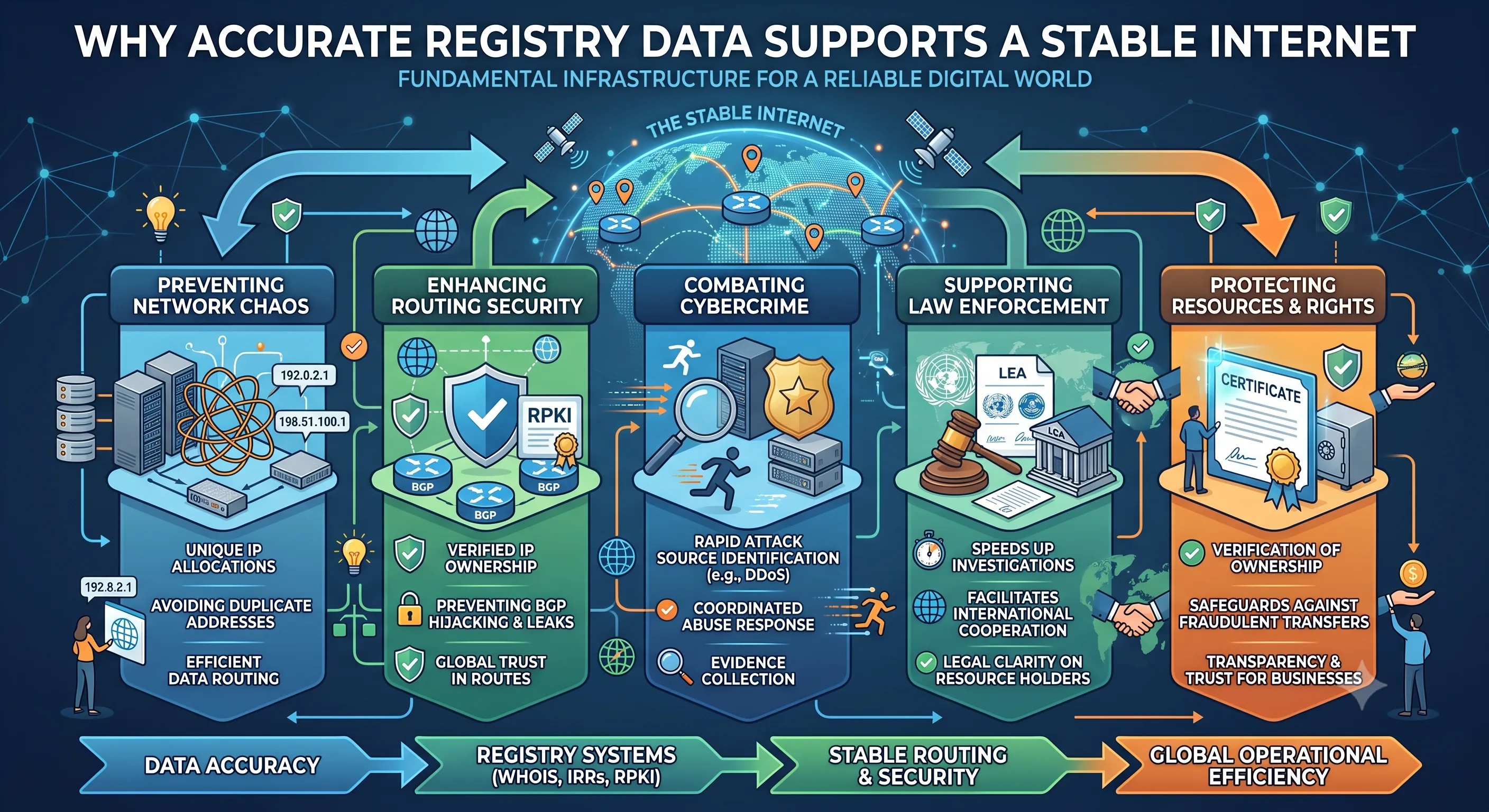
The Internet operates through layers of technical coordination. Networks must know where traffic should go, which organisation is responsible for an address block, and whom to contact when something goes wrong.
Behind this coordination is an often-overlooked layer of infrastructure: registry data.
Internet registries maintain records associated with IP addresses, Autonomous System Numbers, domain names, organisations, and operational contacts. These records help network operators identify the organisations responsible for Internet resources and coordinate routing, security, transfers, and incident response.
When registry information is accurate, the system becomes easier to operate and verify. When records are incomplete, outdated, or inconsistent, routine technical issues can develop into operational, security, and governance risks.
Accurate registry data is therefore not simply an administrative requirement. It is part of the trust infrastructure that supports a stable Internet.
What Is Internet Registry Data?
Internet registry data describes the organisations and contacts associated with Internet resources.
For Internet number resources, such as IPv4 addresses, IPv6 addresses, and Autonomous System Numbers, records may include:
- The registered organisation
- The address range or network prefix
- Administrative and technical contacts
- Abuse-reporting contacts
- Routing or Network Operations Centre contacts
- Registration and modification dates
- Resource status
- Parent and subordinate network relationships
This information is commonly accessed through WHOIS or the Registration Data Access Protocol, known as RDAP.
RDAP provides structured registration data and supports standardised responses, authoritative service discovery, internationalisation, and more secure access models. It is increasingly important across the Internet’s naming and numbering systems. ICANN describes RDAP as the replacement for traditional WHOIS services for generic top-level domain registration data.
For IP addresses and ASNs, Regional Internet Registries maintain the authoritative registration systems for their respective service regions.
These registries include:
- APNIC
- ARIN
- AFRINIC
- LACNIC
- RIPE NCC
The role of an RIR extends beyond distributing number resources. Registries also maintain the records that allow the Internet community to identify resource holders, coordinate operations, and preserve the uniqueness of Internet numbers.
Learn more about this governance function in the LARUS Foundation guide to the role of RIRs in Internet governance.
Accurate Data Helps Operators Reach the Right People
Internet incidents are time-sensitive.
A routing leak, abusive traffic pattern, configuration error, or compromised server may require two or more independent networks to coordinate quickly. The organisation investigating the problem must first determine which party is responsible for the affected resource.
Accurate technical, routing, and abuse contacts make that possible.
Outdated records can instead direct reports to:
- Employees who have left the organisation
- Mailboxes that are no longer monitored
- External providers that no longer manage the network
- Subsidiaries that have been renamed or dissolved
- Generic addresses without a defined response process
Every failed contact attempt delays investigation.
ARIN explains that network operators, cybersecurity teams, researchers, anti-abuse specialists, and other members of the Internet community rely on accurate registry information. Its WHOIS and RDAP services contain details used for routing, abuse handling, and operational coordination.
Data accuracy does not guarantee that every incident will be resolved immediately. It does, however, ensure that other participants have a reliable starting point for communication.
Registry Accuracy Protects the Chain of Responsibility
An IP address may remain technically reachable even when its registry information is outdated.
This can create a dangerous gap between operational use and administrative recognition.
For example, a network may still announce an IPv4 prefix while its registry record refers to a former company name or an invalid administrative contact. The address block continues to operate, but the public record no longer clearly reflects the organisation responsible for it.
This weakens the chain of responsibility.
In extreme situations, abandoned domains, obsolete contact accounts, or poorly maintained organisational records may be exploited by parties attempting to impersonate a legitimate resource holder. ARIN has warned that stale registration records may attract hijacking attempts, especially when the legitimate organisation appears inactive or unreachable.
Maintaining accurate records therefore helps organisations demonstrate continuity between:
- The registered resource holder
- The operating network
- The authorised contacts
- The supporting documentation
- The current use of the resource
This continuity becomes particularly important during audits, disputes, corporate restructuring, and IPv4 transfers.
Accurate Registry Data Supports Safer IPv4 Transfers
IPv4 transfers involve more than an agreement between a buyer and a seller.
The relevant registry may need to verify the parties, review the address block, confirm authority over the resource, examine supporting documents, and update the registry record according to applicable policy.
Inaccurate data can slow this process significantly.
Common problems include:
- The seller’s legal name does not match the registry record
- The registered contact is no longer employed
- The organisation has changed ownership without updating its account
- Historical transfers are not properly documented
- A parent company controls resources registered to a subsidiary
- Registry credentials are held by an unknown former administrator
- The routing organisation differs from the registered organisation without explanation
These discrepancies do not necessarily mean that a transaction is illegitimate. However, they create additional questions that must be resolved before a registry can confidently update the chain of registration.
For organisations entering the IPv4 market, i.lease provides information about the operational and registry considerations surrounding IPv4 transactions. Its analysis of why IPv4 deals stall after an initial agreement explains how incomplete authority, inconsistent records, and documentation problems can delay execution.
Clean registry data reduces ambiguity before a transaction begins. It also helps ensure that the updated record accurately reflects the new operational arrangement after the transfer is completed.
Registry Data and Routing Data Must Remain Aligned
Registry records do not directly control how Internet traffic is routed.
The Border Gateway Protocol, or BGP, distributes routing information between networks. Separate systems such as Internet Routing Registries and the Resource Public Key Infrastructure help operators publish or verify routing authorisations.
However, registry information remains an important part of the broader verification environment.
Operators may compare several sources when investigating a network:
- WHOIS or RDAP registration records
- Live BGP announcements
- Internet Routing Registry route objects
- RPKI certificates and Route Origin Authorisations
- Reverse DNS information
- Network geolocation data
- Letters of Authorisation
- Internal IP address management records
When these sources point to different organisations, ASNs, or operational contacts, uncertainty increases.
A registry record may identify one organisation while BGP shows another ASN originating the prefix. This may be a legitimate leasing or customer arrangement, but the relationship should be documented and supported by appropriate routing authorisation.
RIPE NCC’s database requirements emphasise that registration data should help identify the organisation holding an assignment and support operational contact. The same framework recognises the importance of routing information and RPKI in improving Internet-wide routing consistency.
Registry accuracy should therefore be treated as one component of a wider resource-management system. It complements routing security rather than replacing it.
Accurate Records Improve Abuse Management
Abuse contacts are among the most operationally important fields in an Internet number registry.
They provide a channel for reporting issues such as:
- Spam
- Malware distribution
- Phishing
- Credential attacks
- Botnet activity
- Unauthorised scanning
- Denial-of-service attacks
- Fraudulent hosting activity
An accurate abuse contact helps reports reach the organisation capable of investigating the relevant systems.
A valid email address alone is not enough. The receiving organisation also needs an internal process for reviewing, prioritising, and responding to reports.
Effective abuse management generally requires:
- A monitored, role-based abuse mailbox
- Clear ownership within the security or network team
- A ticketing or case-management process
- Escalation procedures for urgent incidents
- Accurate links between customer assignments and address ranges
- Periodic testing of the published contact channel
Registries can validate whether contact information appears reachable, but the resource holder remains responsible for ensuring that reports are handled appropriately.
Accurate Registry Data Supports Better Research and Policy
Public registry data is also used for purposes beyond daily network operations.
Researchers, policymakers, security organisations, and infrastructure planners use registry information to study:
- IPv4 and IPv6 deployment
- Address concentration
- Routing incidents
- Network interconnection
- Resource transfers
- Internet market development
- Cybersecurity activity
- Regional infrastructure growth
If registry records contain outdated company names, incorrect countries, abandoned contacts, or unclear resource relationships, research based on that data may produce misleading conclusions.
Accurate data helps decision-makers understand how Internet resources are distributed and used. It also makes governance discussions more evidence-based.
This matters because Internet policy can affect network operators, businesses, governments, technical communities, and end users. Reliable policy requires reliable information.
The LARUS Foundation promotes education, participation, and informed discussion around Internet governance. Improving understanding of the registry layer helps more stakeholders participate meaningfully in decisions affecting global Internet infrastructure.
Why Registry Records Become Outdated
Most inaccurate registry records are not created through deliberate misconduct. They become outdated because organisations change.
Common triggers include:
- Staff turnover
- Mergers and acquisitions
- Corporate rebranding
- Changes in legal entities
- New upstream providers
- Data-centre migrations
- Network outsourcing
- Account consolidation
- IPv4 leasing arrangements
- Address transfers
- Expired domains
- Lost registry credentials
Registry updates are often overlooked because the network continues to function.
An address block may remain routed, servers may remain online, and customers may experience no immediate disruption. This creates the impression that administrative records can be corrected later.
The problem appears when the organisation needs to prove authority, respond to an incident, complete a transfer, update routing authorisations, or recover a registry account.
By that stage, the employee who understood the original arrangement may no longer be available.
How Organisations Can Improve Registry Data Accuracy
Registry-data management should be part of normal network governance rather than a one-time compliance exercise.
Organisations can begin with the following practices.
1. Conduct Regular Number Resource Audits
Review all IPv4 addresses, IPv6 addresses, ASNs, registry accounts, contacts, and related authorisations.
An audit should compare registry data with actual network use and internal asset records. NRS.help’s guide to Internet number resource audits and continuity planning provides additional context on reviewing registry, routing, documentation, and operational controls.
2. Use Role-Based Contact Addresses
Avoid depending entirely on individual employee email accounts.
Addresses such as noc@, abuse@, or ipadmin@ can remain stable when team members change. Access to these mailboxes should be reviewed regularly.
3. Align Legal and Registry Records
Ensure that the organisation name in the registry reflects the correct legal entity.
When a merger, acquisition, restructuring, or rebranding occurs, determine whether the registry record and supporting documents must also be updated.
4. Review Routing Authorisations
Compare registered resources with live BGP announcements, IRR route objects, RPKI Route Origin Authorisations, and Letters of Authorisation.
Investigate unexplained differences rather than assuming they are harmless.
5. Document Leasing and Customer Assignments
Where another organisation originates or uses an address range, maintain clear records of the relationship.
Documentation should explain who holds the resource, who may announce it, which ASN is authorised, and who handles abuse or operational incidents.
6. Protect Registry Accounts
Use strong authentication, controlled access, and documented recovery procedures.
Registry credentials should not remain tied to former employees, unknown consultants, or unmonitored email domains.
7. Update Records After Every Material Change
Registry review should be included in change-management procedures for:
- Corporate acquisitions
- Provider migrations
- IPv4 transfers
- Leasing arrangements
- Legal-entity changes
- Staff departures
- Network restructuring
The best time to correct registry information is when the underlying change occurs.
Registry Accuracy Is a Shared Responsibility
A stable registry system depends on cooperation.
Regional Internet Registries provide databases, policies, validation procedures, and resource-management services. Network operators maintain routing and operational information. Resource holders must keep organisational and contact data current. Service providers and transaction platforms must avoid creating arrangements that obscure responsibility.
No single party can maintain accuracy alone.
Registries may check whether an email address is valid, but they cannot always know whether the organisation’s internal structure has changed. Operators may know who uses a prefix, but they may not control the registry account. Legal teams may hold transaction documents without understanding how those documents relate to BGP, RPKI, or RDAP.
Effective resource governance requires these functions to work together.
Conclusion: Reliable Data Creates Reliable Coordination
The Internet does not depend on registry data because databases route packets. It depends on registry data because people and organisations must coordinate the systems that route those packets.
Accurate records help operators identify responsible parties, respond to abuse, investigate routing problems, complete IPv4 transfers, verify authorisations, and maintain continuity during organisational change.
Registry accuracy cannot eliminate every routing incident or security threat. It can, however, reduce uncertainty and make the Internet easier to operate, investigate, and govern.
A stable Internet requires more than functioning cables, routers, protocols, and data centres. It also requires reliable information about who is responsible for the resources connecting them.
That makes accurate registry data a fundamental part of Internet stability.
Frequently Asked Questions
What is registry data on the Internet?
Registry data is information associated with Internet resources such as IP address blocks, Autonomous System Numbers, and domain names. It may include the registered organisation, resource status, and administrative, technical, routing, or abuse contacts.
What is the difference between WHOIS and RDAP?
WHOIS is an older text-based system for accessing registration information. RDAP provides structured responses, typically using JSON, and supports features such as authoritative service discovery, internationalisation, and differentiated access.
Can inaccurate registry data affect routing?
Registry data does not directly control BGP routing. However, inaccurate records can make it harder to verify responsibility, investigate route announcements, obtain authorisation, or contact the correct operator during a routing incident.
Why is registry accuracy important during an IPv4 transfer?
Registries may need to verify the organisations, contacts, authority, and documentation involved in a transfer. Incorrect or outdated records can create uncertainty, delay approval, or require additional evidence.
How often should registry information be reviewed?
Organisations should review registry records periodically and after every material change, including staff departures, mergers, acquisitions, address transfers, leasing agreements, provider migrations, and changes to routing arrangements.
Who is responsible for keeping registry data accurate?
Responsibility is shared. Registries maintain the registration systems and validation procedures, while resource holders and network operators must ensure that their organisational, contact, assignment, and authorisation information remains current.