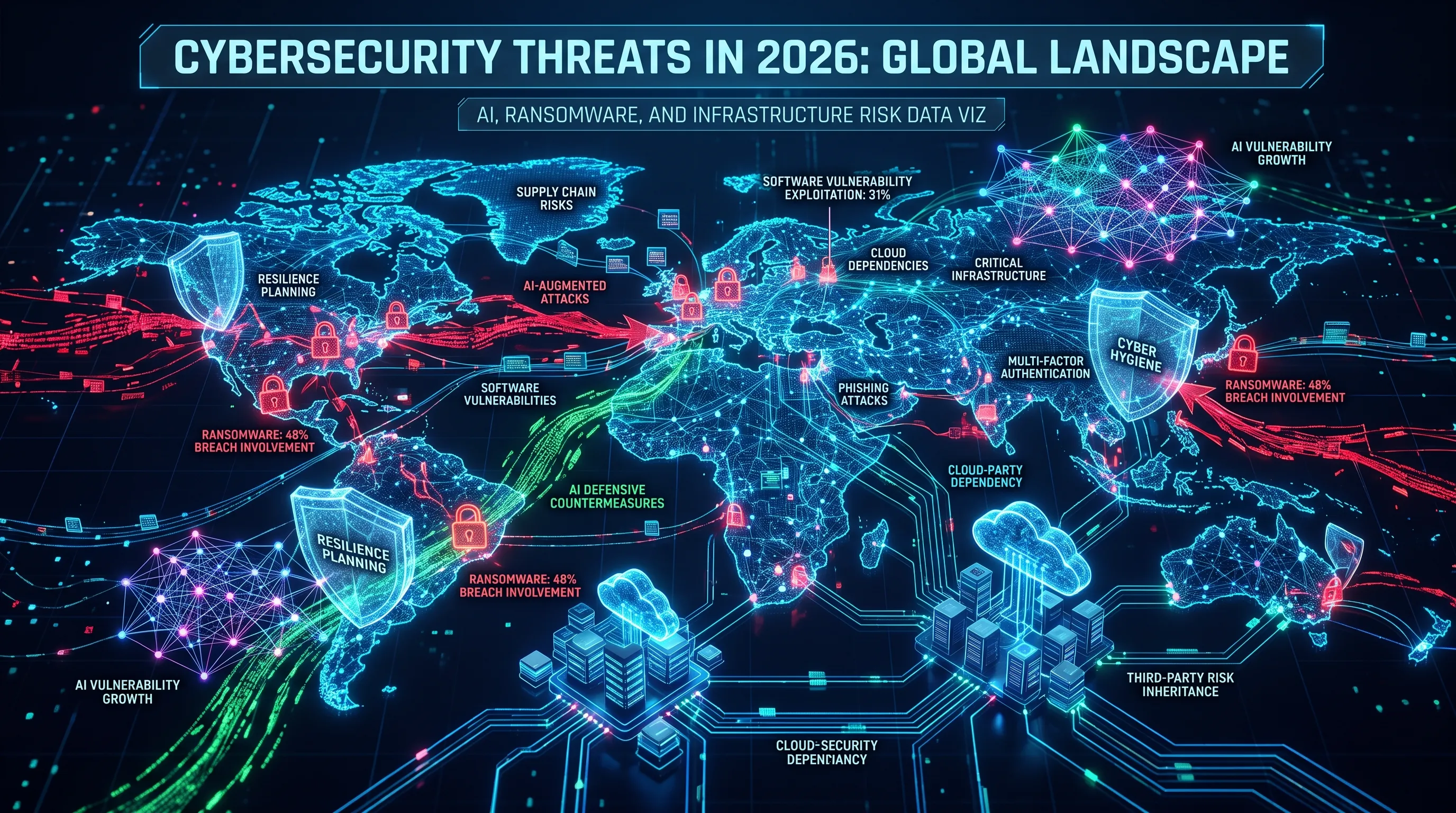
Cybersecurity threats in 2026 are becoming harder to understand through a simple list of malware, phishing and ransomware.
The latest evidence points to a more important change: attackers are increasingly exploiting the connections between people, software, identity systems, cloud platforms, third parties and Internet infrastructure. Verizon’s 2026 Data Breach Investigations Report analysed more than 31,000 real-world security incidents, including more than 22,000 confirmed data breaches across 145 countries. Its findings show software vulnerabilities becoming a leading path into organisations, while ransomware and third-party involvement remain widespread. At the same time, the World Economic Forum’s Global Cybersecurity Outlook 2026 finds artificial intelligence, cyber-enabled fraud, geopolitical instability and supply-chain dependencies reshaping how organisations perceive cyber risk.
The picture emerging in 2026 is therefore not simply “more cyberattacks.”
It is a shift toward faster exploitation, identity abuse, AI-assisted operations and cascading failures across connected infrastructure.
Cybersecurity Threats in 2026: Key Facts at a Glance
| Cybersecurity issue | Latest finding | What it tells us |
| Software vulnerability exploitation | 31% of breaches began with software vulnerabilities in Verizon’s 2026 DBIR | Exploiting systems has overtaken stolen passwords as Verizon’s leading initial-access route |
| Ransomware | Involved in 48% of breaches in Verizon’s dataset | Ransomware remains a major operational threat |
| Third-party involvement | Reached 48% of breaches in Verizon’s dataset | Organisations increasingly inherit risk from suppliers and technology partners |
| Generative AI | 15% of attack techniques studied by Verizon were being augmented by GenAI | AI is accelerating existing attack methods rather than creating an entirely separate cybercrime ecosystem |
| AI-related risk | 94% of WEF respondents expect AI to be the biggest force shaping cybersecurity in 2026 | Organisations see AI as both a defensive opportunity and a source of new risk |
| AI vulnerabilities | 87% reported AI-related vulnerabilities as the fastest-growing cyber risk during 2025 | Security governance is struggling to keep pace with AI adoption |
| Cyber-enabled fraud | 73% said they or someone in their network had been affected during 2025 | Fraud has become a mainstream cyber risk, not a niche security issue |
| Supply-chain resilience | 65% of large companies identified third-party and supply-chain vulnerabilities as their biggest cyber-resilience challenge | Security increasingly depends on organisations outside your direct control |
| Phishing | About 60% of observed initial intrusion cases in ENISA’s dataset | Human manipulation remains highly effective |
| DDoS | 77% of incidents analysed by ENISA | DDoS was extremely frequent, although frequency does not equal impact |
The figures come from different datasets and should not be combined as though they represent one global sample. Verizon examines breach and incident data internationally, ENISA focuses primarily on the EU threat landscape, while the World Economic Forum reports survey perceptions and organisational preparedness.
That distinction matters when interpreting cybersecurity statistics.
1. Software Vulnerabilities vs Stolen Credentials
One of the clearest changes visible in 2026 is how attackers are getting into systems. For years, cybersecurity discussions have heavily emphasised weak passwords and stolen credentials. Those risks remain important, but vulnerability exploitation has moved sharply upward.
How Initial Access Is Changing
| Initial-access issue | What the evidence shows | Example |
| Software vulnerability | Verizon reports 31% of breaches now begin with vulnerability exploitation | An Internet-facing application contains an exploitable flaw |
| Stolen credentials | Still important, but no longer Verizon’s leading overall entry point | Attacker purchases or steals an employee password |
| Misconfiguration | Particularly relevant in cloud environments | Publicly exposed API, storage bucket or administrative interface |
| Social engineering | Human element remained present in 62% of breaches in Verizon’s dataset | Fake IT support call convinces an employee to reset MFA |
| Third-party access | Attackers can inherit trusted access through suppliers | Compromised SaaS integration provides access to customer data |
Google Cloud observed a similar shift in its own cloud data.
In H2 2025, software-based initial access accounted for 44.5% of the activity Google analysed, compared with 27.2% involving weak or absent credentials. Google notes that this represents a specific subset of observed Google Cloud activity and should not be treated as representative of every organisation.
Real Example: Exploitation Within About 48 Hours
Google Cloud reported that after CVE-2025-55182, a critical React Server Components vulnerability commonly called React2Shell, was publicly disclosed, it observed attackers deploying cryptocurrency miners within approximately 48 hours.
This demonstrates why the vulnerability problem is increasingly about time.
The traditional cycle might look like:
Vulnerability discovered → disclosed → security team assesses → patch scheduled → system updated
Attack automation can compress the attacker side of that cycle:
Vulnerability disclosed → Internet scanning → vulnerable system found → exploit launched
Google says the window between vulnerability disclosure and mass exploitation in some cases contracted from weeks to days.
CISA’s Known Exploited Vulnerabilities Catalog provides another useful reality check. Rather than listing every theoretical vulnerability, the catalog tracks vulnerabilities for which there is evidence of exploitation in the wild. CISA continued adding actively exploited vulnerabilities to the catalog throughout 2026.
The lesson is straightforward: A vulnerability is not only a software problem. Once active exploitation begins, patching speed becomes a continuity issue.
2. Ransomware vs Cyber-Enabled Fraud
Which is the biggest cybersecurity threat in 2026? The World Economic Forum found a notable difference between CEOs and CISOs.
CEO vs CISO Cybersecurity Concerns
| Business perspective | Leading concern in 2026 | Why priorities differ |
| CEOs | Cyber-enabled fraud and phishing | Direct financial loss, customer trust, impersonation and reputational damage |
| CISOs | Ransomware | Operational disruption, data compromise and recovery complexity |
| CISOs | Supply-chain resilience also ranks highly | Security teams must defend dependencies they do not fully control |
This is a useful reminder that there is no single measure of “biggest cyber threat.”
Those are different measurements. Verizon reports that ransomware appeared in 48% of breaches in its 2026 dataset, compared with 44% previously.
However, ransomware payment behaviour is also changing. Among the ransomware victims in Verizon’s dataset, 69% did not pay a ransom. The median ransom payment among those that did pay fell to approximately $139,875, from $150,000 in the previous dataset.
Consider the difference between the ransom and the actual business impact:
| Ransom demand | Wider operational impact |
| Payment demanded by attacker | Production systems unavailable |
| Data decryption | Customer services interrupted |
| Threat of data publication | Legal and regulatory response |
| Extortion negotiation | Incident-response costs |
| Recovery of files | Restoring identities, systems and networks |
| Attacker payment | Reputation and customer trust |
The ransom is therefore only one possible cost.
Verizon’s separate 2026 Breach Impact Study found that business interruption was an important contributor to high-impact claims. Its analysis also found that supply-chain and third-party incidents can create significant financial consequences even when they are less visible than ransomware.
3. AI-Powered Cyberattacks vs Traditional Cyberattacks
The phrase “AI cyberattack” can be misleading. Much of the evidence in 2026 does not show AI replacing traditional attack techniques. Instead, AI is increasingly being used to make familiar attacks faster, cheaper or easier to scale.
Traditional Attack vs AI-Augmented Attack
| Attack stage | Traditional approach | AI-augmented possibility |
| Reconnaissance | Manually research targets | Rapidly analyse public information about many targets |
| Phishing | Reuse generic templates | Generate personalised and fluent messages |
| Translation | Attacker needs language ability | Produce convincing messages across languages |
| Impersonation | Fake email or basic spoofing | Synthetic voice or AI-generated content |
| Vulnerability research | Manual technical analysis | Assist with code analysis and vulnerability research |
| Malware development | Human-written tools | Assist with code generation or modification |
| Social engineering | Scripted phone call | More adaptive conversational interaction |
Verizon says 15% of attack techniques in its 2026 analysis were being bolstered by generative AI. The World Economic Forum provides a different type of evidence: organisational perception.
Its 2026 survey found:
· 94% expect AI to be the most significant force shaping cybersecurity in 2026.
· 87% identified AI-related vulnerabilities as the fastest-growing cyber risk during 2025.
· The proportion of organisations with processes for assessing AI-tool security increased from 37% in 2025 to 64% in 2026.
Those numbers should not be interpreted as “94% of cyberattacks now use AI.” They measure what surveyed organisations expect and perceive, not the proportion of attacks directly caused by artificial intelligence. That distinction is essential for accurate cybersecurity reporting.
4. Phishing Email vs Vishing and Mobile Social Engineering
Phishing has not disappeared. The delivery channel is changing.
ENISA found phishing including related techniques such as vishing, malspam and malvertising—accounted for approximately 60% of observed initial intrusion vectors in its threat-landscape dataset. Verizon, meanwhile, found simulated mobile-centric social attacks achieved 40% higher successful click rates than email-based simulations in its dataset.
How Social Engineering Is Evolving
| Traditional phishing | Emerging social engineering |
| Email link | SMS message |
| Fake login page | QR-code or mobile flow |
| Generic message | Highly personalised message |
| Obvious spelling mistakes | Fluent AI-assisted text |
| Fake email from IT | Voice call impersonating IT support |
| Password theft | Convince support staff to reset MFA |
Real Example: Attacking the Help Desk
Google Cloud documented financially motivated threat groups using voice phishing, or vishing, to impersonate employees or IT support.
In some observed cases, attackers attempted to convince help-desk staff to reset credentials or multi-factor authentication. In others, victims were persuaded to authorise legitimate tools that could later facilitate data collection.
This illustrates a larger security principle.
An organisation can deploy sophisticated technical controls and still have a failure path that looks like:
Attacker → employee impersonation → help desk → credential reset → legitimate account → cloud access
The attacker does not necessarily need to “break” encryption or defeat the cloud platform.
They can attack the process surrounding the technology.
5. Direct Cyberattack vs Supply-Chain Attack
Third-party risk is one of the most important cybersecurity issues in 2026.
The traditional security model imagines an attacker targeting an organisation directly:
Attacker → Company
Modern digital infrastructure looks more like:
Attacker → Software supplier → Cloud service → Business → Customer
or:
Attacker → SaaS integration → OAuth token → Customer environment → Data
This difference matters because an organisation may be affected by a security failure that occurs outside its own network.
Direct Attack vs Supply-Chain Attack
| Direct cyberattack | Supply-chain or third-party attack |
| Attacker targets your organisation | Attacker targets something you trust |
| Your security controls are the main defence | Supplier controls also become part of your defence |
| Failure may affect one organisation | One failure can reach many customers |
| Visibility may be relatively direct | Dependency can be difficult to see |
| Internal remediation may be enough | Remediation may depend on another company |
Verizon reports that breaches involving third parties increased by 60% from the previous dataset, reaching 48% of breaches in the 2026 DBIR. The World Economic Forum similarly found 65% of large companies by revenue identified third-party and supply-chain vulnerabilities as their greatest cyber-resilience challenge, up from 54% the previous year.
Real Example: Trusted OAuth Access
Google Cloud documented incidents in which attackers abused compromised OAuth tokens associated with trusted third-party applications to access customer environments and extract data.
The significance of this example is not the individual product involved.
It is the dependency structure:
Trusted application → authorised token → customer platform → sensitive data
A legitimate integration can become an attack path when the upstream trust relationship is compromised.
This is why third-party security is increasingly a continuity problem, not merely a procurement checklist.
6. Cybercrime vs Geopolitically Motivated Cyberattacks
Threat Actor Comparison
| Threat motivation | Typical objective | Possible target |
| Financial cybercrime | Money | Businesses, consumers, banks |
| Ransomware/extortion | Payment and leverage | Enterprises, healthcare, infrastructure |
| Cyberespionage | Information | Government, technology, defence |
| Hacktivism | Political or ideological visibility | Government and public-facing services |
| State-aligned disruption | Strategic impact | Critical infrastructure |
| Fraud | Financial gain through deception | Individuals and businesses |
Not every attacker has the same objective.
Geopolitics has become sufficiently significant that 64% of organisations surveyed by WEF said they account for geopolitically motivated cyberattacks in their risk strategies. Among the largest organisations surveyed, 91% had changed their cybersecurity strategies because of geopolitical volatility.
Hacktivism represented almost 80% of the incidents in its dataset, largely because of high volumes of DDoS activity. Yet only a small share caused service disruption. State-linked actors, meanwhile, were associated with espionage activity against strategically significant targets.
What Makes Cybersecurity Different in 2026?
The individual attack techniques are not all new. What is changing is the interaction between them.
Consider this illustrative scenario:
A company depends on a SaaS platform. An attacker discovers a vulnerability in software used by the provider. Automated scanning identifies an exposed instance shortly after disclosure. The attacker gains access, steals an authentication token and uses the trusted relationship to enter customer environments. AI helps analyse stolen data and generate convincing messages impersonating customer employees. The incident then becomes an extortion campaign.
No single stage represents the entire threat. The complete failure path is:
Software vulnerability → Third party → Identity → Cloud → Data → Social engineering → Extortion
This example is illustrative, but each individual technique is reflected in threat activity documented by Verizon, Google Cloud, ENISA or CISA. That interconnectedness may be the defining cybersecurity issue of 2026.
Frequently Asked Questions
1. What are the biggest cybersecurity threats in 2026?
Major cybersecurity threats in 2026 include software vulnerability exploitation, ransomware, cyber-enabled fraud, phishing and social engineering, identity compromise, supply-chain attacks, AI-assisted attacks, DDoS and geopolitically motivated attacks. Current evidence particularly highlights the rise of vulnerability exploitation and third-party risk alongside persistent ransomware and social-engineering threats.
2. Is AI the biggest cybersecurity threat in 2026?
AI is better described as a risk multiplier than as one single cyber threat. The World Economic Forum reports that 94% of respondents expect AI to be the most significant force shaping cybersecurity in 2026. Verizon separately reports generative AI augmenting 15% of the attack techniques it analysed. These measurements describe different things and should not be conflated.
3. Is Ransomware still a major threat in 2026?
Yes. Ransomware was involved in 48% of breaches in Verizon’s 2026 dataset, increasing from 44% in the previous year. However, 69% of ransomware victims in Verizon’s dataset did not pay a ransom.
4. Are hackers using AI for phishing?
AI can help attackers create more convincing, personalised and multilingual social-engineering content. However, phishing itself remains an established attack technique. The important 2026 development is that AI can increase its speed and scalability rather than creating phishing from scratch.
5. Why are supply-chain attacks dangerous?
A supply-chain compromise can allow an attacker to reach organisations through software, services or identities that those organisations already trust. One compromised provider can therefore create risks for multiple downstream customers.
6. What is the difference between cybersecurity and cyber resilience?
Cybersecurity focuses on protecting systems, information and services from cyber threats. Cyber resilience goes further by asking whether an organisation can continue essential operations, limit damage and recover when an attack or failure still occurs. Both are necessary because no security system can guarantee that every cyberattack will be prevented.