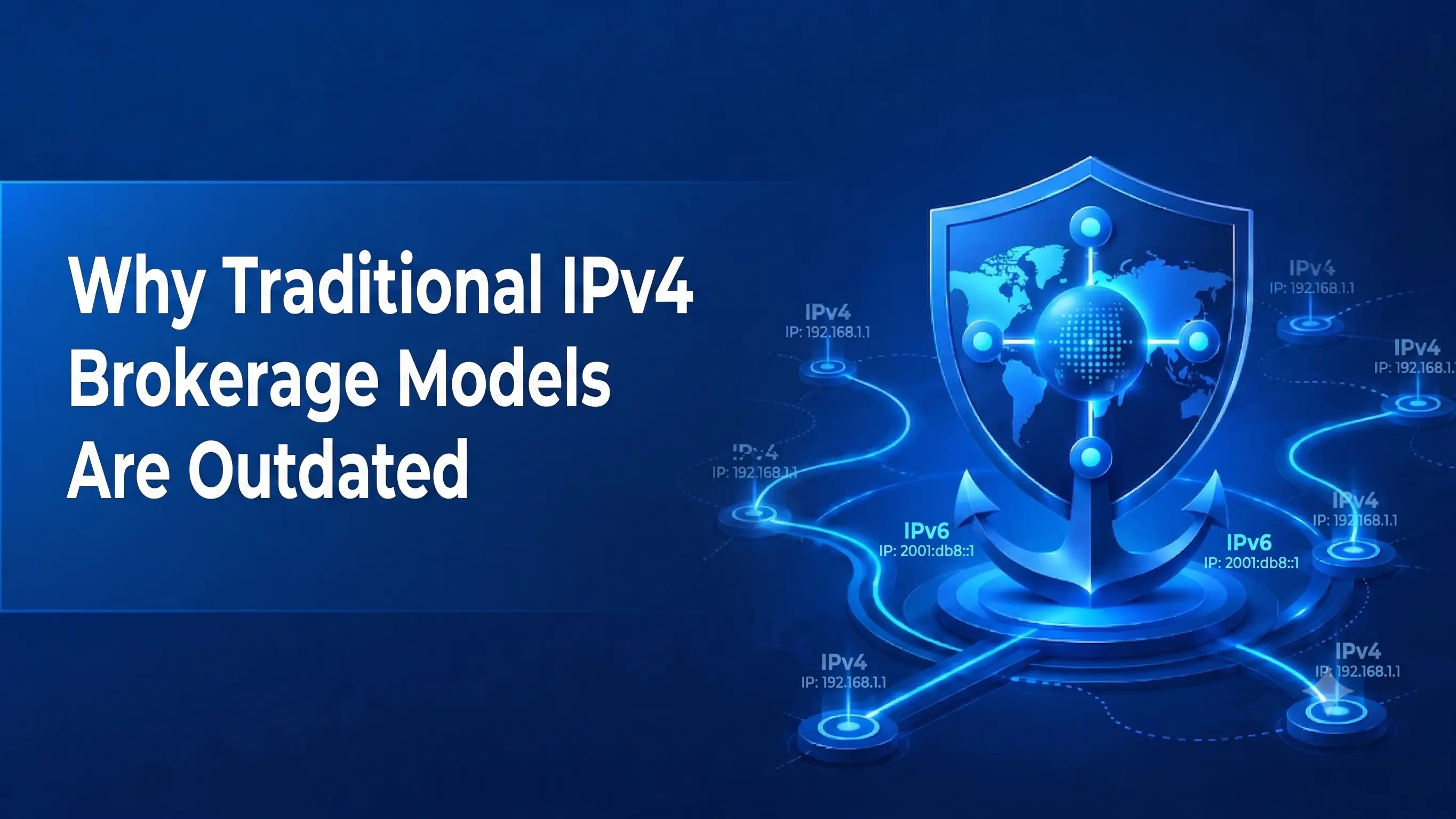
For years, IPv4 brokerage has served as a practical response to a simple constraint: there are not enough IPv4 addresses to go around.
As exhaustion became reality, a secondary market emerged. Brokers facilitated transfers, matched supply with demand, and helped organizations extend the life of IPv4-based infrastructure.
That model was useful in a transitional phase of the internet.
But it is increasingly clear that it no longer reflects how modern infrastructure is built—or where it is heading.
IPv4 brokerage was built for scarcity, not strategy
At its core, IPv4 brokerage treats IP addresses as static commodities:
- A limited resource to be acquired
- A tradable asset with fluctuating market value
- A transactional requirement for scaling infrastructure
This made sense when infrastructure was mostly on-premise, relatively static, and regionally contained.
Today, none of those assumptions hold.
Modern infrastructure is:
- Distributed across multiple clouds
- Continuously scaling up and down
- Built on ephemeral workloads and automation
- Global by default, not exception
In this environment, IP address management is no longer a procurement problem—it is an architectural one.
The hidden cost of IPv4 dependence
Even when IPv4 brokerage successfully delivers address space, it introduces long-term structural friction:
- Increasing operational complexity across networks
- Fragmentation of address ownership and control
- High switching and renumbering costs
- Dependency on NAT-heavy architectures
- Growing compliance and coordination overhead during transfers
The more distributed an organization becomes, the more painful these constraints become.
Instead of enabling growth, IPv4 dependency often forces engineering teams to design around limitations that no longer match modern workloads.
The industry is already moving beyond IPv4 thinking
The broader internet is steadily transitioning toward IPv6 and cloud-native networking models. Large-scale platforms, mobile networks, and hyperscalers are leading this shift, driven by the need for scalability, automation, and simplification.
As this transition accelerates, IPv4 is increasingly becoming a compatibility layer rather than a foundation for growth.
That shift changes the role of brokerage entirely. What was once a growth enabler is now largely a maintenance mechanism for legacy dependencies.
A different approach: identity instead of inventory
The real limitation of traditional IPv4 models is not just scarcity—it is the assumption that networking is about owning and managing discrete blocks of addresses.
Modern infrastructure requires something different:
A stable, consistent, and portable identity layer that follows the organization—not the underlying address pool.
This is where LARUS ONE introduces a new direction.
One public network identity for the infrastructure your business cannot renumber.
Instead of treating IP space as fragmented assets that must be constantly acquired and reallocated, LARUS ONE focuses on continuity of identity across infrastructure.
It enables organizations to:
- Assign a stable public identity to employees, regardless of where they connect from
- Maintain consistent identity for servers and services across hybrid and multi-cloud environments
- Provide trusted, persistent identity for critical business locations
- Ensure customers and partners always connect to a recognizable and stable network presence
From renumbering risk to identity stability
One of the most expensive and disruptive challenges in traditional networking is renumbering.
Whether driven by provider changes, mergers, cloud migrations, or architectural redesigns, renumbering introduces:
- Service disruption risk
- Operational overhead
- Security reconfiguration effort
- Downtime planning complexity
In modern distributed systems, renumbering is no longer a rare event—it is an ongoing operational risk.
LARUS ONE reframes this problem by shifting focus away from constantly changing IP allocations and toward a stable public network identity that does not need to be rewritten as infrastructure evolves.
The future beyond IPv4 brokerage
IPv4 brokerage will not disappear overnight. It still plays a role in maintaining legacy systems.
But its strategic importance is fading.
The future of networking is not about trading scarcity more efficiently—it is about eliminating dependency on scarcity altogether.
Organizations that continue to rely on IPv4 brokerage as a long-term strategy risk locking themselves into an increasingly rigid and expensive model of infrastructure design.
The alternative is to move toward identity-centric networking models that align with how modern systems actually operate.
Conclusion
Traditional IPv4 brokerage models were designed for a different era—one defined by scarcity, static infrastructure, and limited alternatives.
That era is ending.
Modern infrastructure demands something more resilient:
- Continuity over fragmentation
- Identity over inventory
- Stability over constant renumbering
This is the shift that LARUS ONE is built for.
One public network identity for the infrastructure your business cannot renumber. Assign stable public identity to employees, servers, services, clouds, and critical locations your customers and partners trust.
As networking moves beyond IPv4 constraints, the organizations that thrive will be those that stop managing addresses—and start managing identity.