
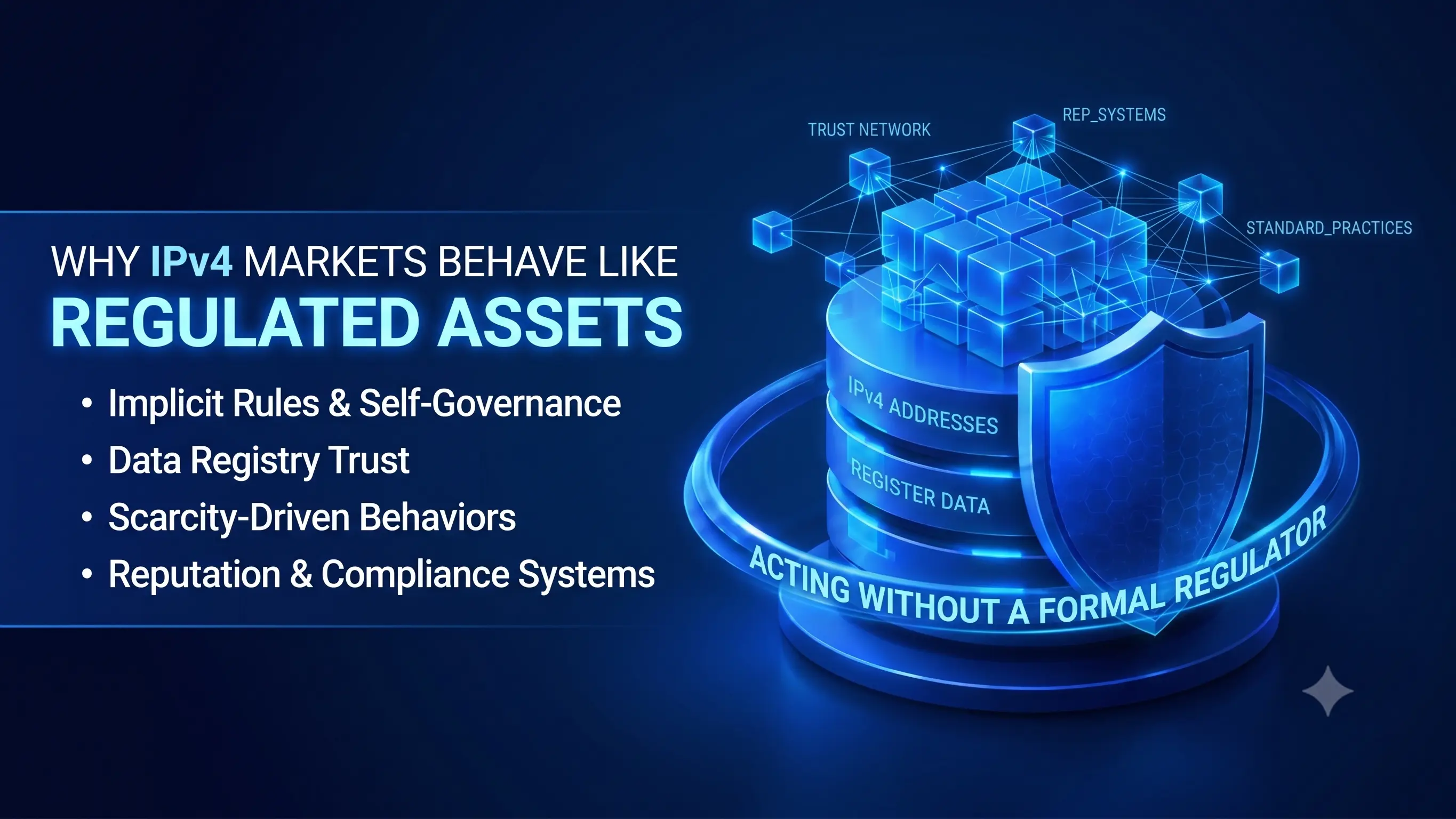
IPv4 address markets occupy a strange position in global infrastructure economics. Formally, they are not securities, not commodities in a regulated exchange system, and not governed by any unified financial authority. Yet in practice, they behave as if they are tightly regulated assets—subject to constraints, approval mechanisms, transfer rules, and institutional gatekeeping that closely resemble formal regulatory regimes.
This paradox raises a deeper structural question: how can an asset class function like a regulated market without being formally regulated as one?
The answer lies not in finance law, but in Internet infrastructure governance—specifically the layered authority of Internet number registries and the institutional legacy of global coordination systems such as ARIN, RIPE NCC, APNIC, LACNIC, and AFRINIC.
These institutions do not “own” IPv4 space in a legal sense. But they define the conditions under which IPv4 space can exist, move, and be recognized.
And in practice, that is enough to produce regulation-like behavior.
1. The Hidden Asset Class: IPv4 as Scarce Infrastructure Capital
IPv4 addresses are not designed as financial instruments. They were originally technical identifiers, created under the assumption of abundance. That assumption collapsed long ago.
Once IPv4 exhaustion became structural, addresses transformed into scarce infrastructure capital:
- They have fixed global supply
- They are transferable under conditions
- They are required for operational continuity
- They are embedded in network identity and routing
This combination creates a property-like instrument without a property-rights framework that is fully conventional.
The result is a hybrid category: not formally financial, but economically priced; not legally commodified, but behaviorally traded.
2. Why “Free Allocation” Became Conditional Allocation
In early Internet architecture, IPv4 distribution was framed as administrative allocation rather than ownership transfer. But scarcity changed the underlying logic.
As demand exceeded available pools, allocation systems evolved into conditional approval systems:
- Justification requirements emerged
- Transfer policies were introduced
- Historical usage verification became necessary
- Regional compliance rules began to diverge
This shift is critical: once allocation becomes conditional, it stops being purely administrative and starts resembling regulatory authorization.
The registry layer effectively became a gatekeeper of legitimacy, even if it never formally declared itself a regulator.
3. The Role of Registry Institutions as De Facto Market Infrastructure
IPv4 transfers are not executed on open exchanges. They are mediated through registry-validated processes.
RIRs such as ARIN, RIPE NCC, APNIC, LACNIC, and AFRINIC perform several functions that resemble financial market infrastructure:
- Verification of asset legitimacy (who holds what)
- Authorization of transfers (who is allowed to receive what)
- Maintenance of authoritative registries (the “source of truth”)
- Enforcement of policy compliance (eligibility constraints)
- Resolution of disputes (administrative adjudication)
In a formal financial system, these functions would be distributed across regulators, clearing houses, and central registries.
In IPv4 markets, they are embedded within infrastructure institutions that were not originally designed as financial regulators—but functionally act like them.
4. The Illusion of “Unregulated Markets”
At surface level, IPv4 trading appears decentralized. Brokers facilitate deals. Organizations negotiate pricing. Transactions occur globally.
But this surface hides a deeper dependency structure:
No IPv4 transfer is final until it is recognized by a registry.
This single dependency creates an implicit regulatory layer:
- If the registry does not approve, the transaction is invalid in operational terms
- If the registry policy changes, eligibility shifts retroactively
- If interpretation changes, transfer viability changes
This is not market freedom. It is conditional settlement.
And conditional settlement is a defining feature of regulated markets.
5. Structural Constraint Without Legal Classification
The most interesting aspect of IPv4 markets is not that they are regulated—it is that they behave as if they are, without being legally defined as such.
This produces a structural gap:
- No unified financial regulator
- No securities classification
- No standardized market law
- Yet strong operational constraints on transferability and legitimacy
This gap is filled by registry governance frameworks, which operate across jurisdictional boundaries but produce globally consistent effects.
In effect, the system substitutes formal regulation with infrastructural enforcement.
6. Why Registry Authority Creates Market-Like Regulation
The regulatory behavior of IPv4 markets is not accidental. It emerges from the architecture of the system itself.
Three structural properties explain it:
1. Scarcity enforcement is embedded in infrastructure
IPv4 exhaustion is not theoretical—it is enforced at the allocation layer.
2. Identity and usage are coupled
An IPv4 block is not just ownership; it is operational routing identity.
3. Recognition is centralized
Regardless of where transactions occur, recognition is anchored in registry systems.
These properties create a system where enforcement does not require legal coercion. It is enforced through dependency.
7. Why Decentralized Markets Still Need Central Validation
Even in secondary markets, IPv4 transfers ultimately depend on registry validation. This creates a paradox:
- Trading is decentralized
- Validation is centralized
- Enforcement is infrastructural
This structure resembles financial markets before full dematerialization of securities, where central registrars determined settlement validity.
The difference is that IPv4 markets never formally underwent financialization—but inherited its structural consequences through infrastructure design.
8. The Quiet Expansion of Governance Through Technical Layers
What makes IPv4 markets particularly interesting is that regulatory behavior is not introduced through explicit lawmaking. It emerges through technical governance evolution:
- Policy refinement becomes eligibility control
- Recordkeeping becomes asset validation
- Administrative review becomes market gatekeeping
- Coordination becomes conditional authority
This is where institutions like RIPE NCC and others play a structural role—not as market regulators in name, but as infrastructure-defined arbiters of legitimacy.
9. Why This System Persists Without Formal Regulation
IPv4 markets remain outside formal regulatory classification for several reasons:
- They originate from technical coordination systems, not financial law
- Jurisdictions differ in how they interpret digital asset status
- Formal regulation would require global harmonization
- Existing infrastructure already provides functional stability
“Scarcity that does not constrain usage is not scarcity. It is narrative.” - Note:45 On the Manufactured Narrative of IPv4 Scarcity
As a result, the system persists in a hybrid state: economically regulated, legally ambiguous, and operationally enforced.
10. Conclusion: Regulation Without Recognition
IPv4 markets demonstrate a rare institutional phenomenon: regulation without formal regulatory designation.
They behave like regulated assets because they depend on centralized validation, conditional transfer rules, and institutional gatekeeping. Yet they are not formally classified within any unified regulatory framework.
This is not a contradiction in practice. It is a reflection of how infrastructure governance can evolve beyond its original technical purpose.
The key insight is simple:
Regulation is not only a legal category. It can also emerge as a structural property of dependency.
IPv4 markets are not unregulated. They are structurally regulated through infrastructure rather than law.
And that distinction explains why they behave like regulated assets—even when no regulator officially exists.
FAQ
1. Why do IPv4 addresses behave like regulated assets?
IPv4 addresses are scarce, non-reproducible resources with global demand and limited supply. Even without formal government regulation, market forces like allocation rules, transfer restrictions, and registry policies create behavior similar to regulated commodities.
2. What makes IPv4 a scarce asset in the first place?
The IPv4 system supports about 4.3 billion unique addresses, and that pool is effectively exhausted. As a result, remaining supply is only redistributed through transfers and secondary markets rather than new issuance.
3. Who controls or influences the IPv4 market if it’s not regulated?
While there is no central “price regulator,” organizations like Regional Internet Registries (RIRs) set transfer policies. Market intermediaries, brokers, and large network operators also strongly influence pricing and liquidity.
4. Why do IPv4 prices behave like financial assets?
IPv4 blocks are traded, leased, and held for long-term value appreciation. Prices fluctuate based on scarcity, demand from cloud providers, and expectations about IPv6 adoption—similar to commodities or real estate markets.
5. Will IPv6 eventually eliminate the IPv4 market?
Not entirely in the near term. IPv6 adoption is growing, but legacy systems, compatibility requirements, and transition costs mean IPv4 will likely remain valuable and actively traded for years, even decades.