
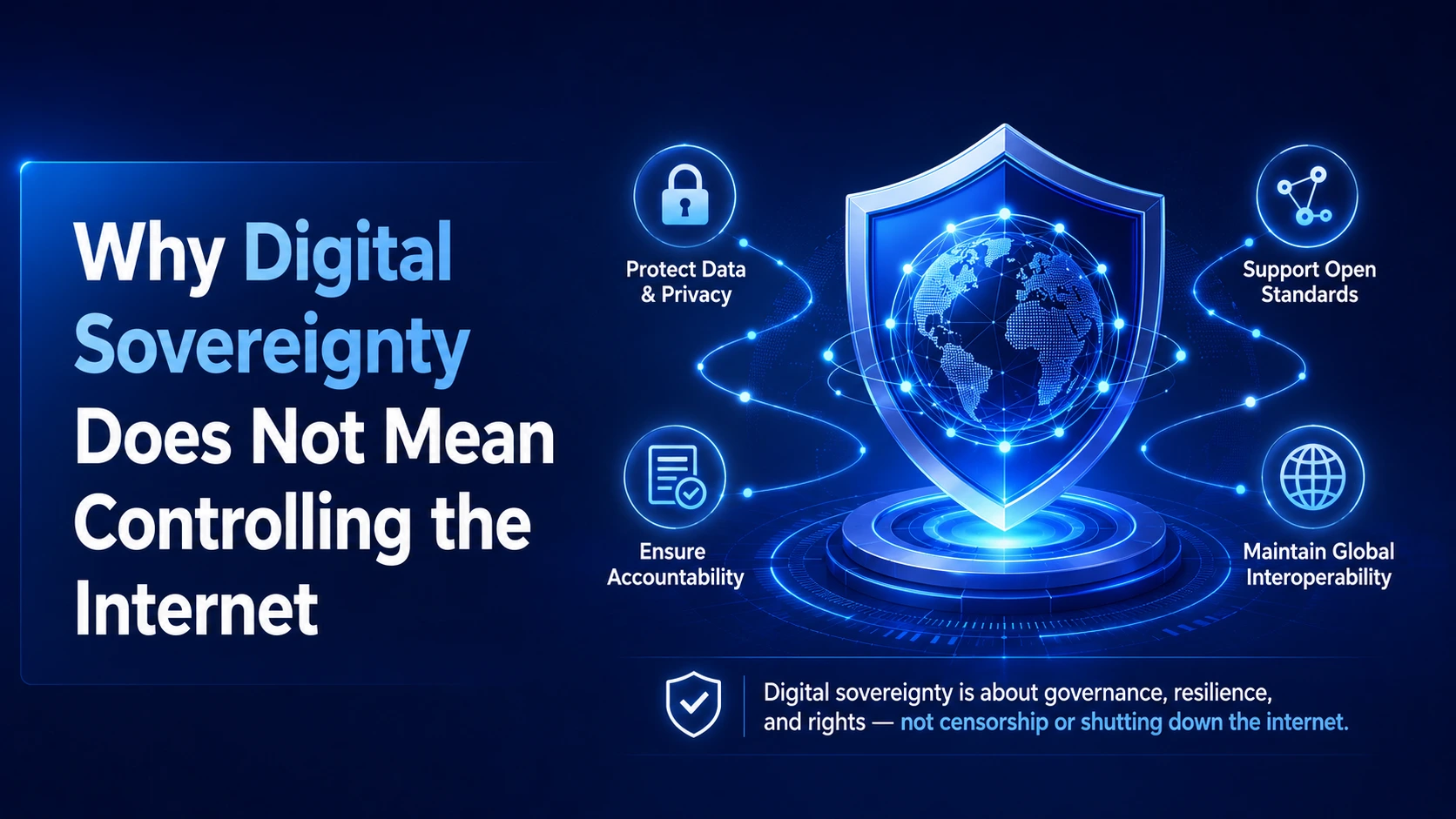
The term digital sovereignty has become increasingly common in discussions about Internet governance, national security, and technology policy. It is often presented as a pathway toward greater independence, stronger control over digital infrastructure, and protection from external influence.
Yet the concept is frequently misunderstood.
One of the most common misconceptions is the belief that controlling key Internet institutions somehow translates into controlling the Internet itself. This misunderstanding becomes particularly visible in debates surrounding Regional Internet Registries (RIRs) and, in Africa's case, AFRINIC.
To understand why this assumption is flawed, it helps to begin with a simple analogy.
The Internet Is Not a Territory
The Internet is often discussed as if it were a territory that can be owned, controlled, or conquered.
This is a fundamental misunderstanding.
A better analogy is a city.
Every house needs an address so that people, mail, emergency services, and businesses can find it. Without addresses, the city could not function efficiently.
On the Internet, computers, servers, and networks are the houses. IP addresses are the addresses.
As the city grows, somebody must maintain an accurate directory that records which address belongs to whom. That directory does not govern the city. It simply helps everyone find the correct destination.
This is precisely the role of a Regional Internet Registry.
AFRINIC Is an Address Book
AFRINIC is the Regional Internet Registry responsible for managing Internet number resources across Africa and the Indian Ocean region.
Its role is administrative and technical.
It maintains records.
It allocates Internet number resources according to community-developed policies.
It helps ensure that Internet traffic can find its destination.
In practical terms, AFRINIC is an address book.
Nothing more.
The keeper of an address book does not own the houses.
He does not control the streets.
He does not command the residents.
He records numbers.
This distinction is critical because many debates surrounding Internet governance begin with the mistaken assumption that administrative coordination is equivalent to political authority.
It is not.
Why Control of AFRINIC Does Not Mean Control of the Internet
Once the role of a registry is properly understood, many claims made under the banner of digital sovereignty begin to unravel.
The idea that one could control the African Internet by controlling AFRINIC is equivalent to believing that possessing a telephone directory grants power over every telephone conversation.
The logic simply does not hold.
AFRINIC does not run the Internet.
It does not operate networks.
It does not control Internet service providers.
It does not govern countries.
It does not dictate how users communicate online.
The Internet functions because thousands of independent networks voluntarily cooperate with one another through shared technical standards and mutual trust.
No registry can command that cooperation.
It can only support it.
The Importance of Neutrality
Regional Internet Registries exist because network operators need a trusted and neutral source of coordination.
Their authority is not based on political power.
It is based on credibility.
The moment a registry is perceived as serving political interests rather than technical coordination, its legitimacy begins to weaken.
Networks cooperate because they trust the registry to apply policies fairly and consistently.
If that trust disappears, the registry's effectiveness disappears with it.
Neutrality is therefore not merely desirable.
It is essential.
Without neutrality, the registry ceases to function as a trusted coordinator and becomes another political actor competing for influence.
That outcome benefits nobody.
The Limits of Digital Sovereignty
Digital sovereignty can be a legitimate policy objective.
Governments have valid interests in securing critical infrastructure, protecting sensitive data, strengthening cybersecurity, and developing domestic digital capabilities.
However, these goals should not be confused with ownership of the Internet.
The Internet was deliberately designed to be decentralized, permissionless, and resilient. Its architecture prevents any single actor from exercising complete control.
Attempts to centralize authority over technical coordination mechanisms do not create sovereignty. They create instability.
This reality is particularly important in Africa.
Africa is not a single political entity. It consists of 54 sovereign states with different legal systems, priorities, economic interests, and geopolitical relationships.
The notion that a single institution could serve as a supreme digital authority for an entire continent is difficult to reconcile with political reality.
More importantly, it is incompatible with the design principles of the Internet itself.
Governance Is About Trust, Not Power
Recent debates surrounding AFRINIC have often been framed in terms of influence, control, and sovereignty.
But the more important question is governance.
When Internet number resources serving millions of users are threatened without clear legal justification, the issue is not geopolitical strategy. It is operational stability.
When governance failures create uncertainty, the issue is not power. It is institutional survival.
When political considerations begin to interfere with neutrality, the issue becomes credibility.
Internet governance institutions derive their legitimacy from trust.
That trust depends on transparency, consistency, accountability, and respect for established processes.
Without these principles, confidence in the institution deteriorates.
And without confidence, coordination becomes increasingly difficult.
AFRINIC's Proper Role
AFRINIC can only fulfill its purpose as a neutral coordinator.
Its role is comparable to that of a librarian maintaining a catalogue or a registrar maintaining records.
Its value lies in accuracy, transparency, and impartiality.
The moment it is transformed into an instrument of political ambition, state influence, or regional dominance, it loses the qualities that make it useful to the networks it serves.
An address registry is not a government.
A database is not a sovereign authority.
A registry cannot create digital sovereignty simply because it manages Internet number resources.
Conclusion
Digital sovereignty does not mean controlling the Internet.
Nor does it mean controlling the institutions that help coordinate Internet resources.
Regional Internet Registries such as AFRINIC perform a narrow but essential function: maintaining the address records that allow the global Internet to operate smoothly.
They are coordinators, not rulers.
Record keepers, not governments.
The Internet works because no one owns it, no single actor commands it, and no institution possesses ultimate authority over it.
You do not rule the Internet by command.
You do not build it through force.
And you do not achieve digital sovereignty by politicizing an address book.
The Internet works because independent networks choose to cooperate.
AFRINIC works only when it remains a trusted and neutral steward of that cooperation.
Reference:
The Internet’s Address Book and Why Digital Sovereignty is a Dangerous Fantasy
Frequently Asked Questions (FAQ)
1. What is digital sovereignty?
Digital sovereignty refers to a country or region’s ability to control its digital infrastructure, data policies, cybersecurity systems, and technological development. It is often linked to national independence in the digital space, but it does not mean control over the global Internet itself.
2. Does controlling AFRINIC mean controlling the Internet in Africa?
No. AFRINIC only manages Internet number resources like IP addresses. It does not operate the Internet, control networks, or govern users. Its role is administrative, not political or authoritative.
3. What does AFRINIC actually do?
AFRINIC allocates and manages IP address space and Autonomous System Numbers (ASNs) in its region. It maintains accurate records to ensure global Internet routing works properly. It functions as a neutral registry, not a governing body.
4. Why is neutrality important for Internet registries?
Neutrality ensures that IP address allocation is fair, consistent, and trusted by all network operators. If a registry is perceived as politically biased, trust breaks down, which can disrupt Internet coordination and stability.
5. Can any organization control the Internet?
No single organization can control the Internet. It is a decentralized system made up of thousands of independent networks that voluntarily cooperate using shared technical standards. This decentralization is what makes the Internet stable and resilient.