
Introduction
Every organization, network, device, and online service needs a way to be recognized on the internet. Most people think of digital identity as usernames, passwords, email accounts, or domain names. But beneath these familiar layers is a deeper form of identity that makes global connectivity possible: network identity.
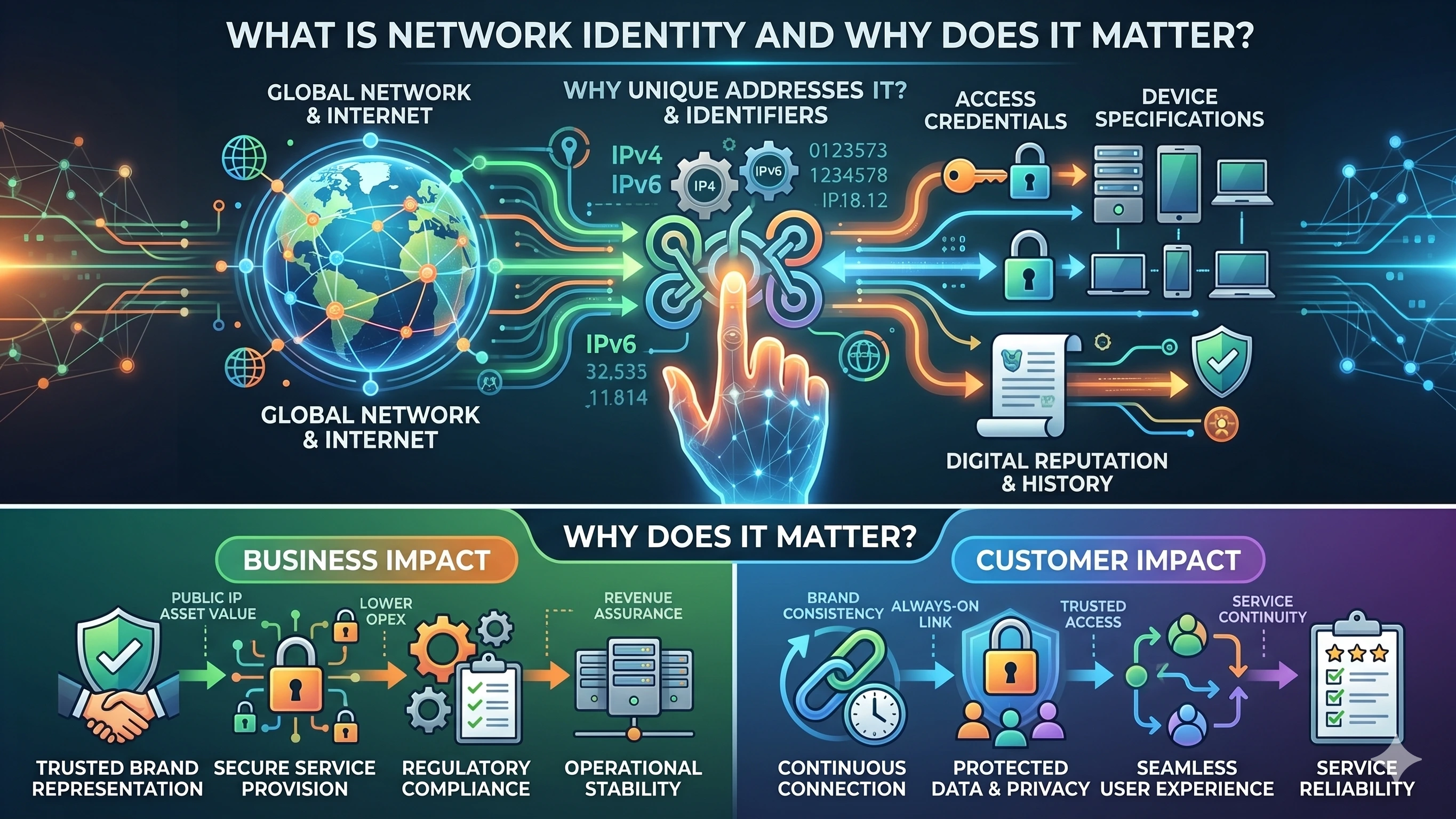
Network identity is the technical identity a network uses to connect, route traffic, prove legitimacy, and build trust across the internet. It is shaped by IP addresses, Autonomous System Numbers, routing records, registry information, security practices, and operational reputation.
In simple terms, network identity answers an important question: who is this network, and can other networks trust it?
As digital services become more dependent on stable connectivity, network identity is no longer just an engineering topic. It affects cybersecurity, business continuity, compliance, cloud migration, internet governance, and customer trust. As discussed in Why Network Identity Is Becoming a Board-Level Infrastructure Concern, network identity is increasingly becoming a strategic infrastructure issue, not merely a technical configuration.
What Is Network Identity?
Network identity refers to the set of technical identifiers, records, and practices that define how a network appears and operates on the public internet.
It includes questions such as:
- Who operates this network?
- What IP addresses does it use?
- Which ASN announces its routes?
- Are its registry records accurate?
- Can other networks trust its routing information?
- Does it follow responsible security and governance practices?
- What reputation has the network built over time?
Network identity is not a single number or record. It is a combination of resources, behavior, and trust. Just as a person may be identified by a name, passport, address, and history, a network is identified by its IP resources, ASN, routing behavior, registry data, security posture, and operational record.
The Core Components of Network Identity
1. IP Addresses
An IP address is one of the most visible parts of network identity. It allows devices, servers, websites, and applications to send and receive data across the internet.
When someone visits a website, uses a cloud application, sends an email, or connects to a remote service, IP addresses help direct traffic to the right destination. They are not only technical labels; in many business environments, they become trust signals.
For example, banks, SaaS platforms, security systems, API partners, and enterprise firewalls may rely on known IP addresses to identify trusted traffic. Over time, an IP address can become part of how an organization is recognized online.
This is why IP address management is closely connected to network identity.
2. Autonomous System Numbers
An Autonomous System Number, or ASN, identifies a network that controls its own routing policies.
Internet service providers, cloud providers, universities, large enterprises, data centers, content networks, and infrastructure operators may use ASNs to exchange routing information with other networks.
ASNs are important because they allow networks to participate in BGP, the Border Gateway Protocol. BGP helps the internet decide how traffic should move from one network to another.
In this sense, an ASN acts like a network’s public routing identity. It tells the global internet: this network exists, and these are the routes it can reach.
3. Routing Information
Routing information shows how internet traffic moves between networks. A network may announce that it can reach specific IP address blocks, and other networks use that information to decide where to send traffic.
Accurate routing information keeps the internet stable. Incorrect or unauthorized routing information can cause outages, misdirected traffic, security risks, or route hijacking.
This is why routing security is a major part of responsible network identity. A network is not only judged by the resources it holds, but also by how responsibly it announces and protects those resources.
4. Registry Records
IP addresses and ASNs are managed through internet number registries. Registry records show who is responsible for specific number resources and how they can be contacted.
Accurate registry information supports transparency and accountability. It helps network operators resolve technical problems, investigate abuse, coordinate during incidents, and verify legitimate resource use.
When registry records are incomplete, outdated, or unclear, trust becomes harder to maintain. Poor registry data can slow incident response, increase abuse risk, and weaken confidence in the network’s identity.
5. Reputation and Operational History
Network identity is also shaped by behavior.
A network that manages its IP addresses responsibly, maintains accurate records, secures its routes, responds to abuse reports, and follows good operational practices builds trust over time.
By contrast, networks associated with spam, malware, route hijacking, poor coordination, or unclear ownership may face reputational damage. This can affect email deliverability, traffic filtering, customer access, business relationships, and security reviews.
In other words, network identity is both technical and reputational.
Why Network Identity Matters
It Keeps the Internet Connected
The internet is often described as a “network of networks.” These networks must identify each other, exchange routing information, and cooperate to move data around the world.
Network identity makes this cooperation possible. It allows networks to recognize one another, decide where traffic should go, and maintain reliable connectivity.
Without trusted network identifiers, the internet would become less stable, less secure, and more fragmented.
It Supports Internet Security
Many cybersecurity risks are connected to weak or unclear network identity.
Attackers may attempt to hijack IP address space, announce false routes, hide behind poor registration records, or abuse networks with weak oversight. These risks can affect websites, cloud services, email systems, payment platforms, and critical infrastructure.
Strong network identity helps reduce these risks. Accurate records, routing security, responsible IP address management, and clear accountability make it easier to identify legitimate operators and respond to suspicious activity.
It Builds Digital Trust
Trust is essential to the internet.
Users trust that websites will load correctly. Businesses trust that customers can reach their services. Partners trust that API traffic is coming from approved sources. Security teams trust that known network origins are legitimate.
Network identity supports this trust at the infrastructure level. When networks can verify who is announcing what, where resources are registered, and how operators behave, the internet becomes more dependable.
It Protects Business Continuity
For organizations, network identity is not only a technical issue. It can directly affect operations, revenue, and customer experience.
If a company’s IP addresses are misconfigured, blacklisted, hijacked, renumbered, or poorly managed, the impact can be serious. Services may become unreachable. Emails may be blocked. Partner integrations may fail. Customers may lose access. Compliance reviews may become more difficult.
This is why network identity should be treated as part of business continuity planning. A stable network identity helps organizations maintain access, trust, and operational resilience even as infrastructure changes.
The article On LARUS One — The Economics of Network Identity, Customer Continuity, and Provider Revenue explains this point clearly: when an IP address becomes trusted by customers, partners, banks, suppliers, and security systems, changing it is no longer just a network task. It becomes a business continuity event.
Network Identity and IP Address Reputation
One important part of network identity is IP reputation.
IP reputation refers to how an IP address or IP range is perceived based on past behavior. If an IP address has been associated with spam, malware, abuse, or suspicious activity, it may be blocked or filtered by email providers, security platforms, cloud systems, or online services.
This can create problems even for legitimate users. A business may receive IP addresses that appear technically usable but carry a poor reputation history. That history can affect email delivery, website access, customer trust, and application performance.
This is why IP due diligence matters. Organizations need to understand the history, registration status, routing behavior, and reputation risks of the IP resources they use.
Good IP reputation strengthens network identity. Poor IP reputation weakens it.
Network Identity and Routing Security
Routing security is another essential part of network identity.
Because BGP was designed around cooperation between networks, it depends heavily on trust. However, incorrect or unauthorized route announcements can create serious problems.
A route hijack happens when one network wrongly announces IP address space that belongs to another network. This may happen by mistake or through malicious activity. The result can be traffic disruption, data interception, degraded service, or loss of trust.
To reduce these risks, network operators can use routing security practices such as route filtering and Resource Public Key Infrastructure, commonly known as RPKI. These measures help networks verify whether route announcements are authorized.
A secure routing identity helps protect not only one network, but the broader internet ecosystem.
Why Network Identity Matters for Internet Governance
Network identity is also a governance issue.
IP addresses and ASNs are not created or managed in isolation. They are allocated, transferred, registered, and governed through regional and global internet policy processes.
These policies affect who can access number resources, how transfers are handled, how disputes are resolved, how registry accuracy is maintained, and how accountability is enforced.
For policymakers, network identity matters because it connects digital infrastructure with national connectivity, cybersecurity, economic development, and public trust.
For students and researchers, it offers a practical way to understand how technical systems, institutions, and governance processes work together.
For civil society, it raises important questions about transparency, inclusion, accountability, and the future of the open internet.
The Future of Network Identity
As the internet continues to grow, network identity will become even more important.
Cloud computing, artificial intelligence, remote work, online education, digital public services, financial platforms, connected devices, and global applications all depend on stable internet infrastructure.
At the same time, the internet faces challenges such as IPv4 scarcity, uneven IPv6 deployment, route hijacking, cybercrime, fragmented governance, and increasing dependence on cloud and multi-cloud environments.
These changes make network identity more valuable. Organizations will need better visibility into the IP addresses they use, stronger routing security, more accurate registry data, clearer governance practices, and more reliable continuity models.
The future of network identity will likely be defined by five priorities:
- stronger routing security;
- better registry accuracy;
- wider IPv6 adoption;
- improved IP reputation management;
- more strategic treatment of network identity as business infrastructure.
Conclusion
Network identity is the foundation of how networks are recognized, trusted, and governed on the internet.
It includes IP addresses, ASNs, routing information, registry records, security practices, reputation, and operational behavior. It matters because it keeps the internet connected, supports cybersecurity, protects business continuity, strengthens digital trust, and connects technical infrastructure with internet governance.
As digital life becomes more dependent on stable connectivity, understanding network identity is no longer only for network engineers. It is part of digital literacy, infrastructure strategy, and responsible internet governance.
A stronger understanding of network identity helps build a more secure, stable, open, and trusted internet for everyone.
FAQs
What is network identity in simple terms?
Network identity is the way a network is recognized and trusted on the internet. It includes technical identifiers such as IP addresses, ASNs, routing records, registry information, and reputation.
Why is network identity important?
Network identity matters because it helps networks connect, route traffic, prevent abuse, support cybersecurity, maintain business continuity, and build trust across the internet.
Is an IP address part of network identity?
Yes. An IP address is one of the most important parts of network identity because it allows devices and services to communicate across the internet. In business environments, IP addresses can also become trust signals used by partners, platforms, and security systems.
What is an ASN?
An Autonomous System Number, or ASN, identifies a network that manages its own routing policies. It helps the internet understand which network is announcing specific routes.
How does network identity affect cybersecurity?
Strong network identity helps prevent route hijacking, abuse, misrouting, poor IP reputation, and unclear accountability. It also makes it easier to identify responsible network operators during security incidents.
How does network identity affect business continuity?
If a business depends on stable IP addresses for customers, partners, security systems, APIs, or compliance, changing or losing those addresses can disrupt operations. A stable network identity helps reduce that risk.
Why does network identity matter for internet governance?
Network identity depends on shared policies for IP addresses, ASNs, routing, transfers, registry accuracy, and accountability. These policies are developed through internet governance processes, so broader understanding and participation help protect the stability and fairness of the internet.