
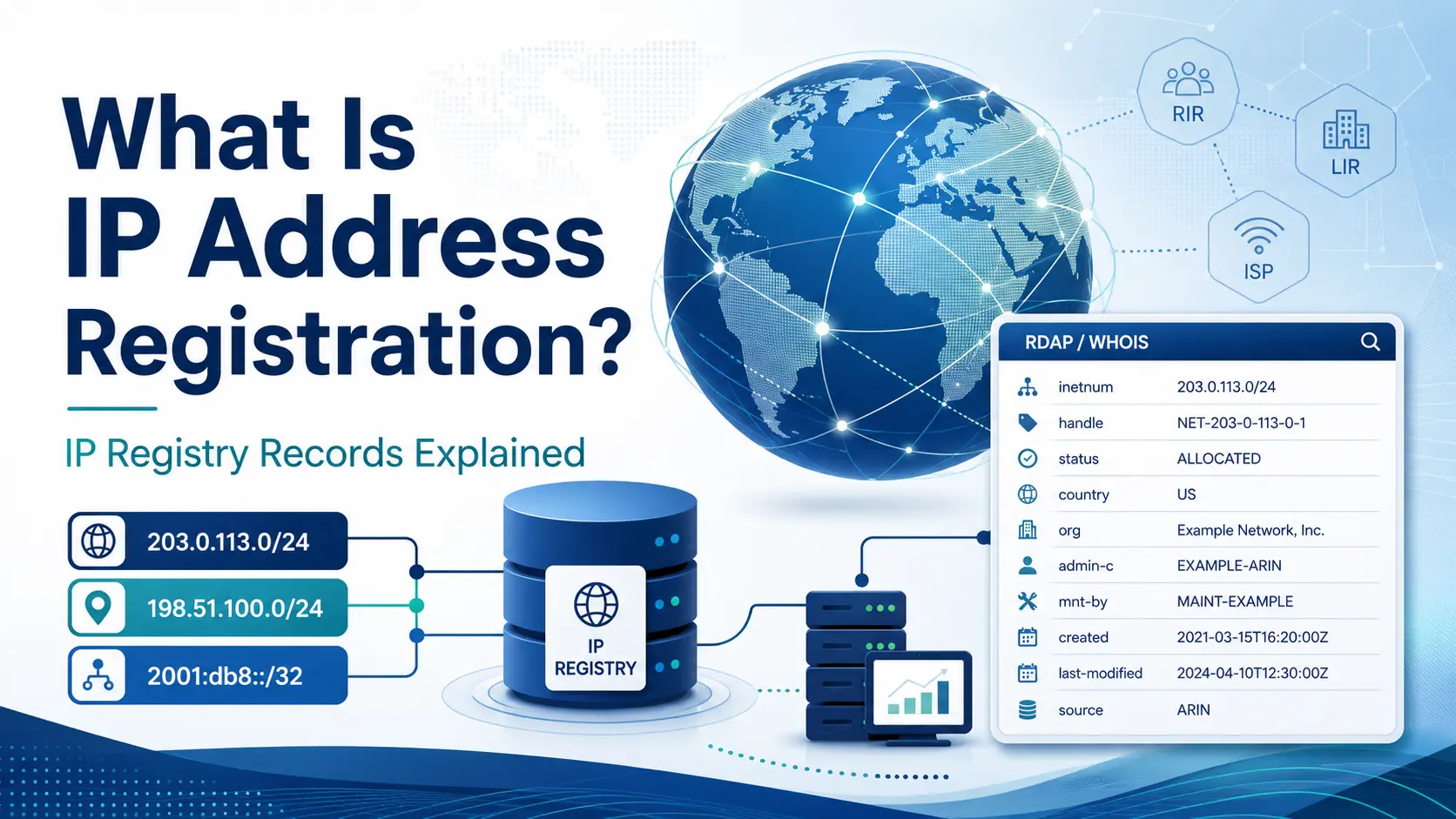
What Is IP Address Registration?
IP address registration is the process of maintaining authoritative registry information associated with Internet number resources such as IPv4 and IPv6 address blocks. Registration records can identify the address range, organisation, contacts, status, and other information needed to support coordination between independent networks.
IP address registration is easy to confuse with IP allocation, subnetting, routing, or IP Address Management (IPAM).
They are related, but they are not the same thing.
A registry record may tell you which organisation is associated with a public IP address block.
It does not necessarily tell you which individual server is using an address, whether the prefix is currently visible in BGP, which ASN is originating it today, or how the organisation has divided the range into internal subnets.
Understanding these differences is important because the Internet depends on several information layers working together.
Registration helps maintain an accurate shared record.
Routing tells networks how to reach prefixes.
IPAM helps individual organisations manage their own address space.
DNS associates names with addresses.
Routing-security systems provide additional information about authorised route origins.
Each layer answers a different question.
What Does IP Address Registration Mean?
At its simplest, IP address registration means recording information associated with an Internet number resource in a registry system.
For public Internet number resources, this can include:
- IPv4 address blocks;
- IPv6 address blocks; and
- related organisational and contact information.
Internet number resources must be coordinated because public addresses need to remain globally distinguishable across independent networks.
At the global level, the Internet Assigned Numbers Authority (IANA) coordinates Internet number resources and maintains authoritative top-level registries.
IANA's number-related registries cover the three core number-resource types:
- IPv4 addresses;
- IPv6 addresses; and
- Autonomous System Numbers.
LARUS Foundation explains this global coordination function in more detail in What Is IANA?.
Regional Internet Registries then operate registration and resource-administration systems within their respective service regions.
The five RIRs are:
- AFRINIC;
- APNIC;
- ARIN;
- LACNIC; and
- RIPE NCC.
The precise registration processes, terminology, data fields, and policies can differ between registry systems.
However, the core technical purpose is similar: maintaining reliable information about Internet number resources so that independent networks can coordinate around them.
Why Is IP Address Registration Necessary?
The Internet is not one centrally operated network.
It consists of many independent networks communicating with one another.
For this distributed architecture to work, globally used number resources must remain sufficiently coordinated.
Two unrelated networks should not be given conflicting authoritative registration records for the same public number resource without a mechanism for resolving the conflict.
Accurate registration also gives operators a shared place to look when they need to understand the administrative context surrounding a resource.
For example, a network operator investigating an address block may need to ask:
- What prefix is registered?
- Which organisation is associated with it?
- Which registry maintains the record?
- What technical contacts are available?
- Is there an abuse contact?
- What is the status of the resource?
- When was the record last changed?
Registration does not answer every operational question, but it creates an important shared information layer.
This is why registry accuracy matters.
LARUS Foundation discusses the operational value of reliable records in Why Accurate Registry Data Supports a Stable Internet.
What Information Can an IP Address Registration Record Contain?
The exact information varies by registry, resource type, record structure, and applicable data-publishing rules.
Common information may include:
- IP address range;
- network prefix;
- resource status;
- registered organisation;
- organisation identifier;
- administrative contacts;
- technical contacts;
- abuse contacts;
- parent or related network records;
- registration dates;
- modification dates; and
- registry-specific identifiers.
For example, a registry record might describe an IPv4 prefix such as:
203.0.113.0/24
The record could indicate the relevant organisation and contacts associated with that resource.
However, the registry record would not normally be expected to list every server or application using every individual address inside that /24.
That distinction is important.
Registration describes the shared resource record. Detailed deployment belongs closer to the network operator.
How Does the IP Address Registration System Work?
A simplified view of Internet number-resource coordination looks like this:
IANA
↓
Regional Internet Registries
↓
Network operators, service providers, organisations, or other resource holders
↓
Operational networks and end systems
This is a simplification rather than a universal transaction path. Actual allocation and assignment structures vary between regions and organisations.
At the global level, IANA maintains top-level number-resource registries and coordinates large address-space allocations according to established processes.
Regional systems then maintain more detailed resource and registration information.
Within individual networks, operators may further divide address space into smaller subnets and assign addresses according to their own infrastructure requirements.
This separation allows global uniqueness to be coordinated without requiring a global registry to describe every individual device using an IP address.
For more background on the distribution side of this system, see What Is IP Allocation?.
IP Address Registration vs IP Allocation
IP address registration and IP allocation are related but different concepts.
IP Allocation
Allocation generally refers to making an address block available to another level of the Internet number-resource hierarchy or to an organisation, depending on the context.
For example, large address blocks may move through different levels of the number-resource system before being used by operational networks.
IP Registration
Registration refers to maintaining records associated with the resource.
A useful simplified distinction is:
Allocation concerns the distribution of address space. Registration concerns the record describing the resource and its associated information.
In practice, allocation and registration often occur as part of related administrative processes, but they should not be treated as identical concepts.
IP Address Registration vs Assignment
Assignment is another term that can cause confusion.
An allocation may contain a larger block of addresses.
Parts of that space may then be assigned for particular networks, customers, infrastructure, or operational purposes depending on the addressing model being used.
Registration records may exist at different levels of this structure.
For example:
198.51.100.0/24
could represent a larger resource.
An operator might internally use:
- 198.51.100.0/26 for one service;
- 198.51.100.64/26 for another;
- 198.51.100.128/27 for infrastructure; and
- remaining capacity for future use.
Not every internal division necessarily needs to become a separate public registry record.
That depends on the relevant registration system and operational context.
The important point is that registration and internal network architecture are not the same layer.
IP Address Registration vs Routing
This is one of the most important distinctions.
An IP address being registered does not by itself mean that the address or prefix is currently being routed on the Internet.
Registration describes information associated with the number resource.
Routing describes how networks exchange reachability information.
On the public Internet, inter-network routing is commonly performed using the Border Gateway Protocol (BGP).
A prefix may have an accurate registration record while not currently being announced.
Likewise, a prefix may be visible in BGP through an operational arrangement that requires additional context to understand.
Therefore:
Registration tells you about the registry record.
BGP tells you about current routing announcements.
These two data sources can be compared, but one should not automatically be treated as a substitute for the other.
IP Address Registration vs RPKI
RPKI adds another layer.
Resource Public Key Infrastructure (RPKI) allows cryptographically verifiable information to be used in routing-security workflows.
A Route Origin Authorisation, or ROA, can indicate which ASN is authorised to originate a particular prefix within defined parameters.
This is different from ordinary registration information.
A simplified comparison is:
| Layer | Main Question |
|---|---|
| IP registration | What registry information is associated with this resource? |
| BGP | How is this prefix being announced now? |
| RPKI/ROA | Is an origin ASN authorised for this prefix under the published authorisation? |
| IPAM | How is the address space used internally? |
| DNS | What names or reverse records relate to the addresses? |
These systems work together, but each has its own role.
IP Address Registration vs IPAM
IP Address Management (IPAM) operates much closer to the individual network.
Suppose an organisation has a public IPv4 block.
The registration system may record the overall prefix and organisational information.
The organisation's IPAM system may contain:
- every subnet;
- individual address assignments;
- available addresses;
- reserved ranges;
- gateways;
- VLANs;
- device names;
- locations;
- DNS relationships; and
- lifecycle information.
For example, the registry might describe:
203.0.113.0/24
while IPAM records:
| Subnet | Internal Purpose |
|---|---|
203.0.113.0/27 | Public applications |
203.0.113.32/27 | Customer services |
203.0.113.64/28 | Network infrastructure |
203.0.113.80/28 | Security systems |
The registry does not need to become the organisation's internal network inventory.
Likewise, an internal IPAM database does not replace the shared registration system used for public Internet number-resource coordination.
LARUS Foundation's What Is IP Address Management (IPAM)? explains the operator-level function in more detail.
How Can You Look Up IP Address Registration Information?
Two important technologies in Internet registration-data access are WHOIS and RDAP.
What Is WHOIS?
WHOIS is a long-established protocol for querying registration information.
For many years, network operators have used WHOIS services to investigate IP addresses, ASNs, domain names, and related registration information.
However, WHOIS implementations and output formats have historically varied between systems.
That can make automated processing more difficult.
What Is RDAP?
RDAP stands for Registration Data Access Protocol.
RDAP provides structured access to registration data over HTTP.
For technical users and applications, structured responses make it easier to work with registration information programmatically.
The IETF documents the RDAP query model in RFC 9082 and the JSON response format in RFC 9083.
IANA also maintains RDAP bootstrap registries that help clients identify the appropriate registration-data service for IPv4, IPv6, and AS-number resources through its number-related registries.
In practical terms, an operator investigating an unfamiliar public IP address may use RDAP to determine which registration service should be queried and then examine the returned registration information.
What Can RDAP Tell You About an IP Address?
Depending on the available data, an RDAP response may provide information about:
- the IP network range;
- network name or handle;
- resource status;
- associated entities;
- contacts;
- events such as registration or modification;
- links to related records; and
- the registry responsible for the response.
However, RDAP should not be treated as a universal answer to every question about an IP address.
An RDAP record normally cannot, by itself, prove:
- that the prefix is currently reachable;
- which BGP paths are carrying it;
- which physical server uses an address;
- whether the address is currently active;
- what application is running behind it;
- whether an IP geolocation database is correct; or
- whether every external data source is up to date.
Registration data is one layer of operational evidence.
Does IP Address Registration Prove Who Is Routing the Address?
Not necessarily.
The organisation associated with a registry record and the network currently originating the prefix may differ for legitimate operational reasons.
Examples can include:
- upstream-provider arrangements;
- customer routing;
- managed network services;
- leased infrastructure;
- multi-network deployments; and
- changes that occur at different times across different systems.
When investigating a prefix, operators may therefore compare:
- registry data;
- live BGP information;
- Internet Routing Registry data;
- RPKI and ROAs;
- reverse DNS;
- internal documentation; and
- relevant operational authorisations.
The goal is to understand how the different layers relate to one another.
A mismatch does not automatically prove that something is wrong.
It means additional context may be required.
Why Accurate IP Address Registration Matters
Accurate registration data makes Internet coordination easier.
Consider what happens when an organisation changes:
- company name;
- technical team;
- network provider;
- administrative contact;
- corporate structure; or
- resource arrangement.
The network may continue functioning normally even if the registry information has not yet been updated.
That can create a gap between operational reality and the shared record.
The consequences may not be immediately visible.
They may appear later when someone needs to:
- investigate a network incident;
- contact the responsible organisation;
- audit number resources;
- update resource information;
- complete a corporate change;
- review routing authorisations; or
- coordinate a transfer.
Keeping records accurate reduces ambiguity.
This reflects a simple coordination principle:
Shared records are most useful when they reflect the network and organisational reality they are intended to describe.
Registration Is a Record, Not the Entire Network
An important way to understand IP address registration is to recognise its boundaries.
A registry record is valuable because it provides shared information.
But it is not the network itself.
Packets are forwarded by routers.
BGP distributes reachability information.
DNS resolves names.
RPKI can support route-origin validation.
IPAM records how operators organise their own address space.
Applications and customers create the real operational dependencies associated with individual addresses.
Registration is one important layer among these systems.
This distinction also aligns with a broader principle in Internet infrastructure: shared coordination works best when the common layer contains the information needed for interoperability and reliable records, while detailed operational decisions remain closer to the network operators who understand their own infrastructure.
The Heng.lu notes describe this concept as thin coordination, with emphasis on uniqueness, accurate records, security information, continuity, and operator-level decision making.
How IP Address Registration Supports Network Continuity
Registration may appear administrative, but accurate records can become important during network change.
Imagine an organisation that has used the same public address space for many years.
During that time, the addresses may become connected to:
- DNS records;
- firewalls;
- customer allowlists;
- partner systems;
- APIs;
- cloud services;
- monitoring platforms; and
- security configurations.
If the organisation later restructures its network, accurate resource and contact information helps maintain clarity around the number resources involved.
Registration does not create continuity by itself.
But reliable records support the processes needed to manage continuity.
This is particularly important when the same IP resources remain operational while other parts of the infrastructure change.
What Happens When IP Address Registration Records Become Outdated?
Outdated records usually do not make packets immediately stop moving.
That is exactly why they can remain unnoticed.
Common causes include:
- staff departures;
- company renaming;
- mergers;
- acquisitions;
- expired email addresses;
- provider changes;
- lost account credentials;
- network restructuring;
- outdated role accounts; and
- incomplete administrative updates.
The problem often becomes visible only when the record needs to be used.
For example, an organisation may discover that:
- the technical contact left years ago;
- an old domain is still attached to contact information;
- the registered company name no longer matches current records;
- nobody knows who manages the registry account; or
- different operational systems contain different information.
Regular reviews can reduce these problems.
IP Address Registration Best Practices
Organisations responsible for public Internet number resources can follow several practical principles.
Keep Contact Information Current
Technical, administrative, and abuse contacts should lead to appropriate, monitored destinations where required.
Role-based addresses may provide better continuity than relying entirely on one employee.
Update Records After Organisational Changes
Mergers, acquisitions, restructuring, rebranding, and legal-entity changes may create inconsistencies if resource records are not reviewed.
Protect Registry Account Access
Registry credentials are important operational assets.
Use appropriate access controls and avoid leaving critical accounts dependent on a single former employee.
Review Registration and Routing Separately
A correct registry record does not guarantee that routing information is correct.
Check the relevant operational systems independently.
Maintain Internal Documentation
Keep evidence explaining how registry records relate to internal networks, routing, and responsible teams.
Compare Important Data Sources
For significant public resources, operators may periodically compare:
- registry information;
- IPAM;
- BGP;
- RPKI;
- reverse DNS; and
- internal network records.
The objective is not to make every database identical.
It is to make sure differences are understood.
What Is the Difference Between Registration and a Network Source of Truth?
A registry record is usually an external shared record.
A network source of truth is normally an internal operational record.
For example, a registry might show that an organisation is associated with:
198.51.100.0/24
The organisation's internal source of truth may additionally record:
- where the prefix is deployed;
- which routers announce it;
- which subnets exist;
- which customers use addresses;
- which ROAs apply;
- who manages reverse DNS;
- which addresses are reserved; and
- which systems depend on stable addressing.
Both records are useful.
They simply answer different questions.
The shared registration layer should not be expected to contain every local operational decision.
Likewise, an internal database should not replace the externally coordinated resource record.
Is IP Address Registration the Same for IPv4 and IPv6?
The broad purpose is similar: maintain reliable registration information associated with Internet number resources.
However, IPv4 and IPv6 have different address sizes, allocation histories, operational practices, and deployment environments.
IPv4 uses 32-bit addresses.
IPv6 uses 128-bit addresses.
The much larger IPv6 address space also changes the way organisations approach internal address planning and subnetting.
Still, both rely on coordinated number-resource systems so that globally used resources can be identified and administered consistently.
IANA maintains separate top-level registries for IPv4 and IPv6 number resources.
Frequently Asked Questions
What is IP address registration?
IP address registration is the maintenance of registry information associated with public Internet number resources such as IPv4 and IPv6 address blocks. The records may include prefixes, organisations, contacts, status, and related administrative information.
Why are IP addresses registered?
Registration helps maintain accurate shared information about Internet number resources. This supports uniqueness, contactability, administration, troubleshooting, and coordination between independent networks.
Who registers IP addresses?
Registration occurs through the Internet number-resource registry system. IANA coordinates the global layer, while the Regional Internet Registries operate regional number-resource registration systems. Other organisations and network operators may participate at different levels depending on the resource arrangement.
What is the difference between IP address registration and allocation?
Allocation concerns the distribution of address space. Registration concerns maintaining information associated with the resource. The two processes are related but are not identical.
Is IP address registration the same as routing?
No. Registration records administrative information associated with the resource. Routing systems such as BGP describe how prefixes are currently announced and reached across networks.
Is IP address registration the same as IPAM?
No. IPAM helps an organisation manage its own subnets and individual address assignments. Registration operates at the shared Internet number-resource coordination layer.
What is the difference between WHOIS and RDAP?
Both can be used to access registration information. WHOIS is an older query protocol, while RDAP provides structured HTTP-based registration-data access using standardised response formats.
Does an RDAP record show who owns an IP address?
RDAP provides registration information associated with an IP resource. It should not automatically be interpreted as resolving every possible legal question about ownership, contractual rights, routing control, or operational use.
Does a registry record show whether an IP address is active?
Not necessarily. An address can appear in registration data without currently being routed or used by an active host. Routing and operational status need to be checked separately.
Why should organisations keep IP registration records updated?
Current records make it easier to identify responsible contacts, manage administrative changes, perform audits, coordinate network issues, and maintain clarity as infrastructure or organisations change.
Conclusion
IP address registration is one of the Internet's less visible coordination mechanisms.
It does not route packets.
It does not decide how an organisation should design its subnets.
It does not replace BGP, DNS, RPKI, or IPAM.
Instead, registration provides a shared record associated with Internet number resources.
That record helps independent networks answer important questions about address blocks, organisations, contacts, and administrative context.
The distinction matters.
Allocation distributes address space.
Registration records information about the resource.
Routing makes prefixes reachable.
RPKI supports route-origin authorisation and validation.
IPAM manages address usage inside the network.
When these layers are understood clearly and maintained accurately, network operators have a better foundation for troubleshooting, resource management, infrastructure change, and operational continuity.
The most useful registry is therefore not one that attempts to describe every decision inside a network.
It is one whose records are accurate enough to support reliable coordination while operators retain the detailed information needed to run their own infrastructure.
At LARUS Foundation, we support greater understanding of the technical and coordination systems that allow independent networks to function as one interoperable Internet. IP address registration is a practical example of how accurate shared information can support that goal.