
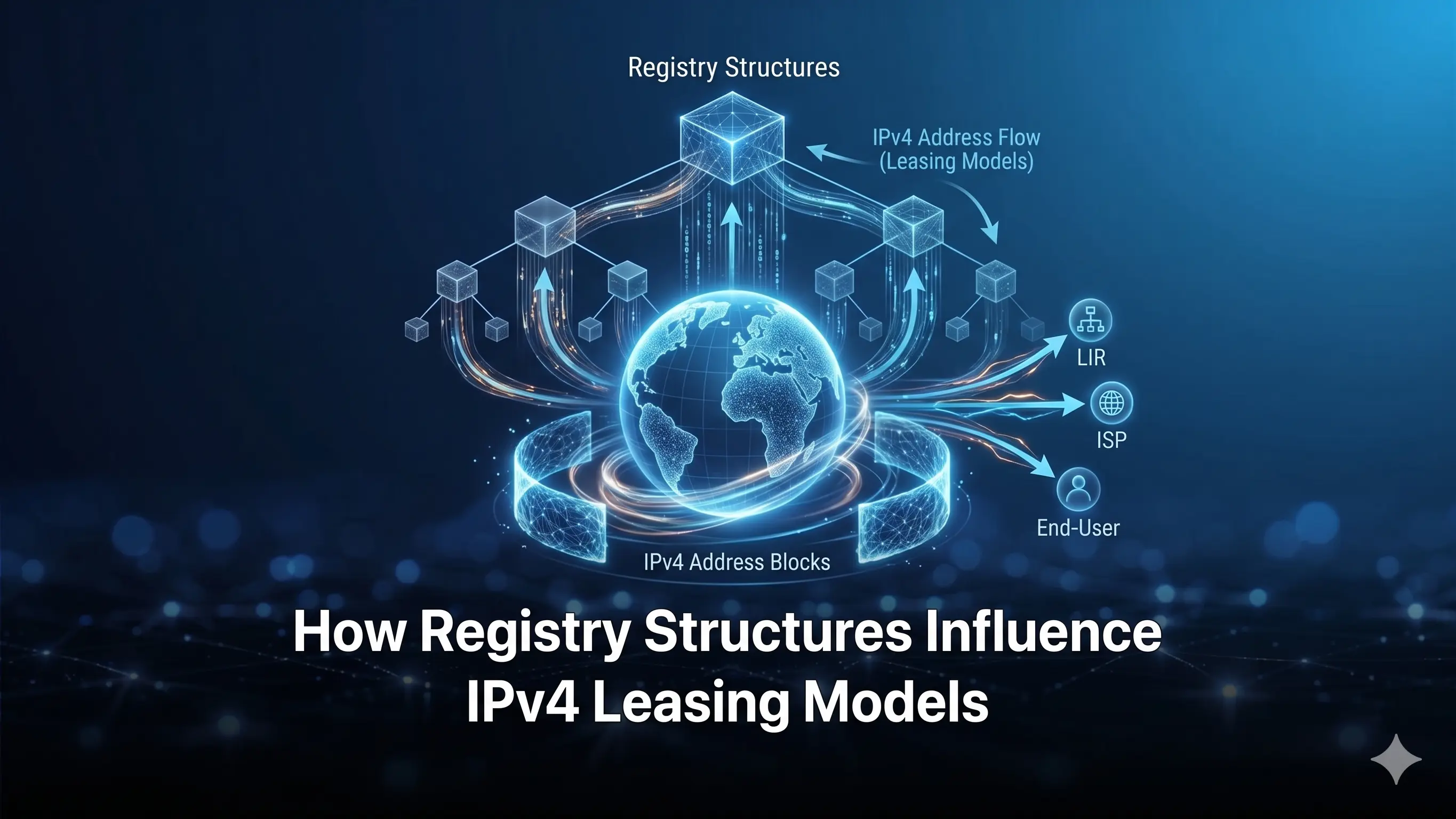
Introduction: The Foundation of IPv4 Leasing Markets
The global market for IPv4 leasing models is built on an infrastructure layer that was never designed for financialization. Originally, IPv4 address allocation was a technical coordination problem managed by neutral registries. Today, it is a scarce digital asset market with pricing, leasing, transferability, and institutional demand.
Organizations such as IANA, ARIN, RIPE NCC, and APNIC define the structural rules that determine how IPv4 resources are allocated and transferred globally.
This means that IPv4 registry structures directly shape the IPv4 leasing economy.
What Is IPv4 Leasing?
IPv4 leasing refers to the temporary rental of IPv4 address blocks from an organization or intermediary instead of permanent purchase.
Because IPv4 (IPv4) addresses are finite and fully exhausted in most regions, leasing has become a critical mechanism for:
- Scaling cloud infrastructure
- Supporting hosting and data center expansion
- Maintaining legacy network operations
- Avoiding IPv4 exhaustion constraints
IPv4 leasing is now a core component of global Internet infrastructure economics.
How Registry Structures Shape IPv4 Leasing Models
IPv4 leasing markets do not operate independently of registry systems. Instead, they are directly structured by registry rules and validation mechanisms.
1. Registry Control Defines IPv4 Transfer Legitimacy
IPv4 leasing depends on whether registry systems approve ownership and transfer recognition.
Each Regional Internet Registry (RIR) has its own policy framework:
- ARIN governs North America
- RIPE NCC governs Europe
- APNIC governs Asia-Pacific
These differences create fragmented IPv4 transfer markets, where leasing conditions vary significantly across regions.
2. IPv4 Registry Structures Influence Market Pricing
IPv4 pricing in leasing markets is shaped not only by supply and demand, but also by registry constraints, including:
- Transfer approval delays
- Policy compliance requirements
- Eligibility rules for address holders
- Administrative verification processes
These factors introduce structural friction into IPv4 leasing models, affecting both liquidity and price stability.
3. Registry Databases Create Market Trust
IPv4 leasing only functions because registry systems provide authoritative validation of address ownership and allocation status.
Without validation from systems such as IANA, IPv4 address blocks would lack global routing legitimacy.
This makes registry databases a critical trust layer in IPv4 leasing infrastructure.
Why IPv4 Has Become a Digital Asset Class
IPv4 addresses are no longer just technical identifiers. They now behave as a digital infrastructure asset class because they are:
- Scarce
- Transferable
- Leaseable
- Financeable
- Tradable in secondary markets
This transformation is driven by IPv4 exhaustion and the slow transition to IPv6 adoption.
As a result, IPv4 leasing models now resemble infrastructure asset markets rather than administrative allocation systems.
The Structural Imbalance in Registry Governance
A major structural issue in IPv4 leasing markets is the mismatch between:
- Registry authority over IPv4 resources
- The economic value of those resources
- The limited liability of registry institutions
Registry organizations often operate as non-profit coordination bodies, yet their decisions affect billions of dollars in global IPv4 value.
This creates a governance structure where:
- Control is centralized
- Liability is minimal
- Economic consequences are externalized
This imbalance is a defining feature of modern IPv4 registry structures.
Monopoly Characteristics in IPv4 Registry Systems
IPv4 registry systems function as quasi-monopolistic infrastructure layers because:
- There is no alternative global registry system
- All IPv4 allocations depend on registry recognition
- Market participants cannot bypass registry validation
This results in:
- High dependency on registry approval
- Limited competitive alternatives
- Strong institutional gatekeeping over IPv4 leasing models
In practice, registry systems function as critical infrastructure gatekeepers for IPv4 markets.
IPv4 Leasing Market Growth Trends
The IPv4 leasing market continues to expand due to structural Internet demand.
Key drivers include:
- Continued IPv4 scarcity worldwide
- Cloud infrastructure scaling
- Data center expansion
- Slow IPv6 adoption in legacy systems
Future trends in IPv4 leasing models:
- Increased institutional leasing agreements
- Expansion of secondary IPv4 markets
- Stronger compliance and transfer regulations
- Greater financialization of IPv4 assets
- More structured brokerage ecosystems
IPv4 leasing is expected to remain a core infrastructure strategy for the foreseeable future.
Conclusion
IPv4 leasing models are not independent market mechanisms—they are structurally shaped by registry governance systems.
Organizations like ARIN, RIPE NCC, and APNIC define the operational boundaries of IPv4 legitimacy, transferability, and market access.
As IPv4 continues to function as a scarce infrastructure asset, registry structures remain one of the most important forces shaping global IPv4 leasing models and pricing dynamics.
FAQ
1. What is IPv4 leasing?
IPv4 leasing is the process of renting IPv4 address blocks instead of purchasing them permanently. It is widely used due to IPv4 scarcity.
2. Why is IPv4 leasing important?
IPv4 leasing is important because it allows organizations to:
- Scale infrastructure without waiting for allocations
- Access scarce IPv4 resources
- Maintain legacy systems
- Support cloud and hosting environments
3. How do registry structures affect IPv4 leasing?
Registry structures determine:
- Whether IPv4 transfers are approved
- How ownership is validated
- Whether leased addresses are globally routable
- The rules governing IPv4 legitimacy
4. What organizations manage IPv4 registries?
Key organizations include:
- IANA
- ARIN
- RIPE NCC
- APNIC
5. Is IPv4 considered a digital asset?
Yes. Although originally designed as a technical identifier, IPv4 is now treated as a scarce digital infrastructure asset due to its market value and transferability.