
Introduction: When Sovereignty Moves Without Announcement
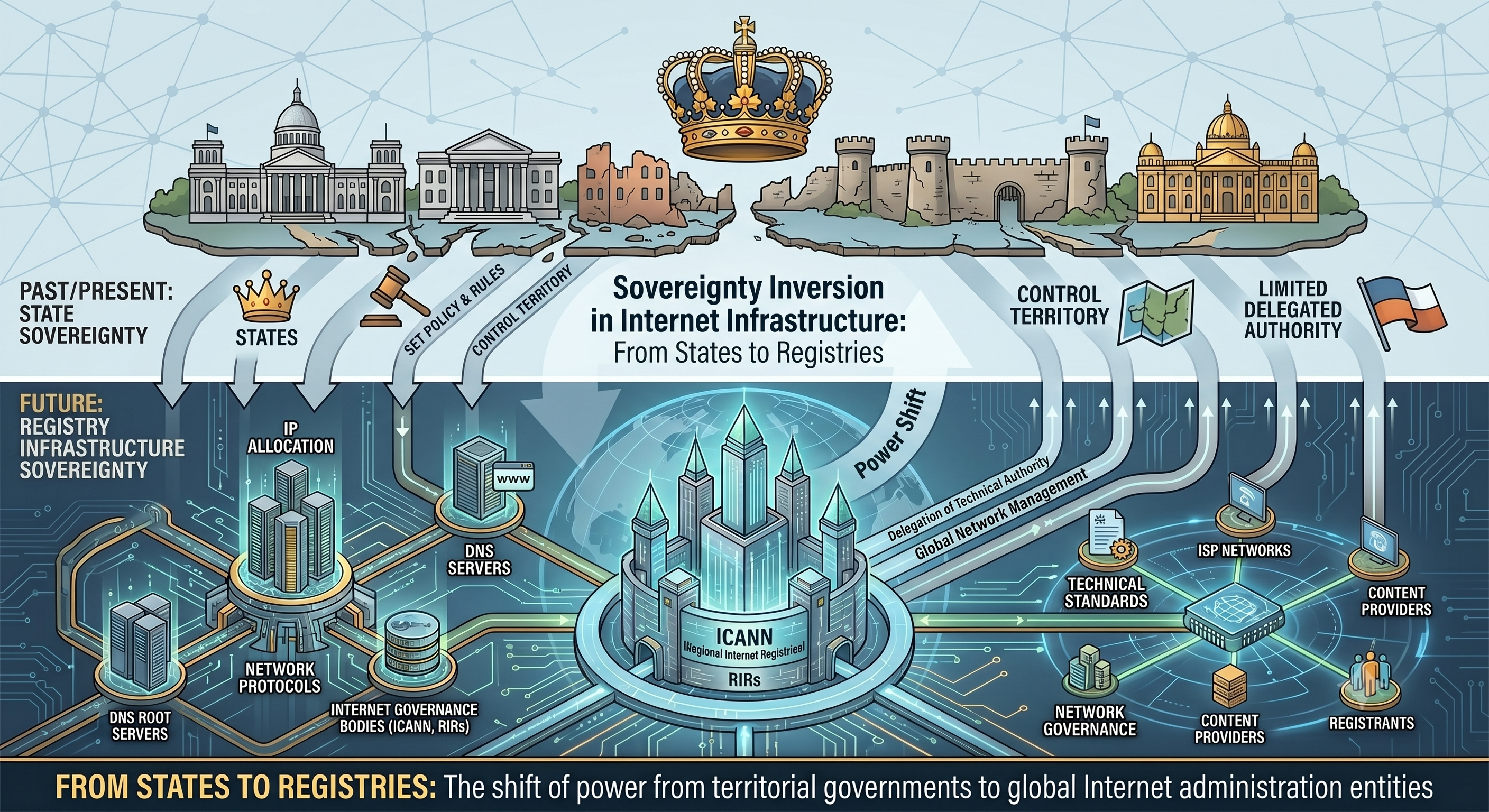
Sovereignty is usually discussed as something that belongs to states—territorial authority exercised through law, enforcement, and institutional legitimacy. But in the architecture of the Internet, sovereignty does not disappear. It migrates.
Over the past two decades, a quiet structural shift has taken place: elements of sovereign function have been displaced upward from states into a transnational coordination layer governed by Regional Internet Registries (RIRs). What appears on the surface as technical coordination of IP addresses and autonomous system numbers increasingly functions as a parallel governance system with real consequences for national economies, digital continuity, and infrastructure dependency.
This is what can be described as sovereignty inversion: a condition in which states retain responsibility for outcomes, but critical control over the underlying mechanisms has shifted into externally governed institutions.
The RIR Layer: Coordination That Became Governance
The Regional Internet Registry system—AFRINIC, ARIN, RIPE NCC, APNIC, and LACNIC—was originally designed as a lightweight coordination mechanism for ensuring uniqueness of Internet number resources.
The underlying assumption was simple: IP addresses are not property, but technical identifiers. Coordination, not coercion, was sufficient.
However, that assumption no longer matches reality. As IPv4 exhaustion turned addresses into scarce, transferable economic assets, the RIR layer began to operate in a hybrid zone between technical administration and de facto economic governance.
This shift is central to what has been described as double extraction: a system in which operators experience both suppressed asset value and full exposure to institutional risk.
Double Extraction: Value Suppression Meets Full Liability Exposure
In practice, the RIR system produces a structural asymmetry.
On one side, number resources are treated as non-ownership-based allocations, limiting their capitalization and constraining their treatment as fully liquid assets. On the other side, operators and states remain fully exposed to the consequences of registry-level decisions—allocation disputes, transfer restrictions, revocations, or administrative discontinuity.
The critical imbalance is not just operational. It is legal.
Many RIR agreements include liability caps that are nominal in scale—sometimes effectively as low as US$100 in total exposure. This creates a condition where an institution can exercise decisive influence over globally significant digital infrastructure while maintaining near-zero downside risk relative to the scale of potential systemic disruption.
This is not a minor contractual detail. It is a governance signal: control without proportional liability.
Sovereignty Inversion: When States Carry the Risk, but Not the Control
Sovereignty inversion occurs when three conditions converge:
1. Control is externalized
Key registry functions affecting national digital infrastructure are governed by entities incorporated under foreign legal systems.
2. Responsibility remains internalized
States remain accountable for economic stability, connectivity, cybersecurity outcomes, and digital continuity.
3. Liability is structurally minimized at the governance layer
Registry institutions retain limited legal exposure regardless of downstream impact.
The result is a structural paradox: states absorb systemic consequences, while the decisive control points sit in private, transnational bodies operating under contractual authority rather than sovereign mandate.
This is not classical outsourcing. It is not delegation under treaty. It is a deeper form of architectural displacement where governance capacity is embedded in infrastructure rather than legislation.
The Hidden Transformation: From Coordination Layer to Control Layer
The original justification for RIRs rested on a narrow technical need: global uniqueness of identifiers. But scarcity transformed that requirement into something broader.
When IPv4 became scarce, allocation stopped being a purely technical function and became a form of resource governance. Allocation decisions began to resemble policy decisions with economic and geopolitical consequences.
At this point, the RIR system ceased to be only a coordination mechanism. It became a control plane over digital resource legitimacy, where recognition itself carries value.
This is the core inversion:
a system designed to coordinate uniqueness evolved into a system that governs scarcity.
Jurisdictional Drift and the Problem of Embedded Foreign Law
Another layer of inversion emerges from jurisdictional structure itself.
Each RIR operates under the legal framework of the state where it is incorporated. Yet its operational reach extends globally. This creates what can be described as jurisdictional overflow: decisions made under one legal system materially affect digital infrastructure in entirely different sovereign territories.
The consequence is not theoretical. It is structural dependency:
- National networks depend on registry continuity
- Registry continuity depends on foreign legal environments
- Legal exposure is asymmetrically distributed across jurisdictions
This is the core tension: sovereignty is territorial, but registry governance is transnational and legally fragmented.
Why the Liability Cap Matters More Than It Appears
At first glance, liability caps appear to be standard legal boilerplate. But in this context, they serve a deeper structural role.
When an institution governs high-impact infrastructure but limits its legal downside, it creates a risk asymmetry between authority and accountability.
In normal sovereign systems, authority and liability are aligned through constitutional, administrative, and judicial constraints. In the RIR model, that alignment is partial at best.
This mismatch is not accidental. It is structural to a system that evolved without being designed as sovereign governance, yet now operates in domains with sovereign-level consequences.
Rethinking Sovereignty in the Internet Age
The question is no longer whether the RIR system “works” in technical terms. It clearly does.
The question is whether the distribution of authority it produces remains legitimate under conditions where:
- IP resources are economically significant
- registry actions affect national infrastructure continuity
- legal accountability is geographically decoupled from operational impact
In this environment, sovereignty cannot be understood as binary possession. It must be understood as a distribution across infrastructure layers.
And in the current configuration, that distribution is inverted.
Conclusion: The Real Policy Question
Sovereignty inversion does not imply that RIRs are malicious actors. It does not imply intent or conspiracy. It describes an emergent property of infrastructure evolution under scarcity, legal fragmentation, and institutional inertia.
But the consequences are real.
States remain responsible for outcomes they do not fully control. Registry institutions exercise control they are not fully accountable for. And between these two layers, a structural gap has formed.
“The shared layer should be reduced to the thinnest possible common record: auditable, neutral, and minimally discretionary.”
— heng.lu, Note:58 From Double Extraction to Sovereignty Inversion: How Nations Lose Sovereign Control to RIRs for US$100
The policy question, therefore, is not whether the RIR system should exist. It is whether its current scope of authority matches the level of consequence it now governs.
If it does not, then the issue is not operational efficiency. It is architectural correction.
Sovereignty, once inverted, does not disappear. It waits to be rebalanced.
FAQs
1. What does “sovereignty inversion” actually mean in this context?
Sovereignty inversion refers to a structural condition where states retain responsibility for digital infrastructure outcomes—such as connectivity, cybersecurity, and economic continuity—while key control mechanisms (like IP address allocation and registry governance) are exercised by transnational institutions such as Regional Internet Registries (RIRs). The “inversion” lies in the mismatch between authority, control, and liability.
2. Are Regional Internet Registries (RIRs) considered governmental bodies?
No. RIRs such as ARIN, RIPE NCC, APNIC, LACNIC, and AFRINIC are private, non-governmental organizations. However, despite their private status, they perform functions that directly affect global digital infrastructure governance, which creates ambiguity around accountability and sovereignty implications.
3. Why are IP addresses treated as a sovereignty issue?
Although IP addresses are technical identifiers, scarcity—especially in IPv4—has turned them into economically valuable and strategically important resources. Allocation decisions can affect national digital infrastructure resilience, market access, and network continuity. As a result, governance of IP space has moved beyond pure engineering into the realm of infrastructure policy with sovereign-level impact.
4. What is the significance of liability caps in RIR agreements?
Liability caps limit the legal and financial responsibility of registry organizations in the event of disputes or damages. Critics argue that when such institutions exercise significant influence over critical infrastructure but maintain extremely low liability exposure, it creates an asymmetry between authority and accountability. This is central to the “double extraction” concern discussed in sovereignty inversion theory.
5. Can sovereignty inversion be reversed or corrected?
Reversal is not necessarily about dismantling the RIR system, but about rebalancing governance architecture. Potential approaches include improving accountability mechanisms, revisiting jurisdictional alignment, increasing transparency in policy processes, and reassessing the legal frameworks that define liability and authority. The core question is whether current governance structures reflect the real-world impact of registry decisions in a globally interconnected internet.