Companies no longer operate from one office, one data center, or one cloud provider. Modern infrastructure is distributed across clouds, regions, APIs, remote teams, security platforms, partner systems, and edge locations.
This flexibility has made digital business faster. But it has also introduced a new infrastructure risk: what happens when the public network identity that customers, partners, security systems, and applications already trust suddenly changes?
For many organizations, IP addresses are not just technical resources. They become part of how the company is recognized on the internet. They are used in partner allowlists, security rules, API access controls, compliance workflows, routing policies, cloud environments, VPN systems, email reputation, and customer-facing services.
That is why companies need network identity continuity.
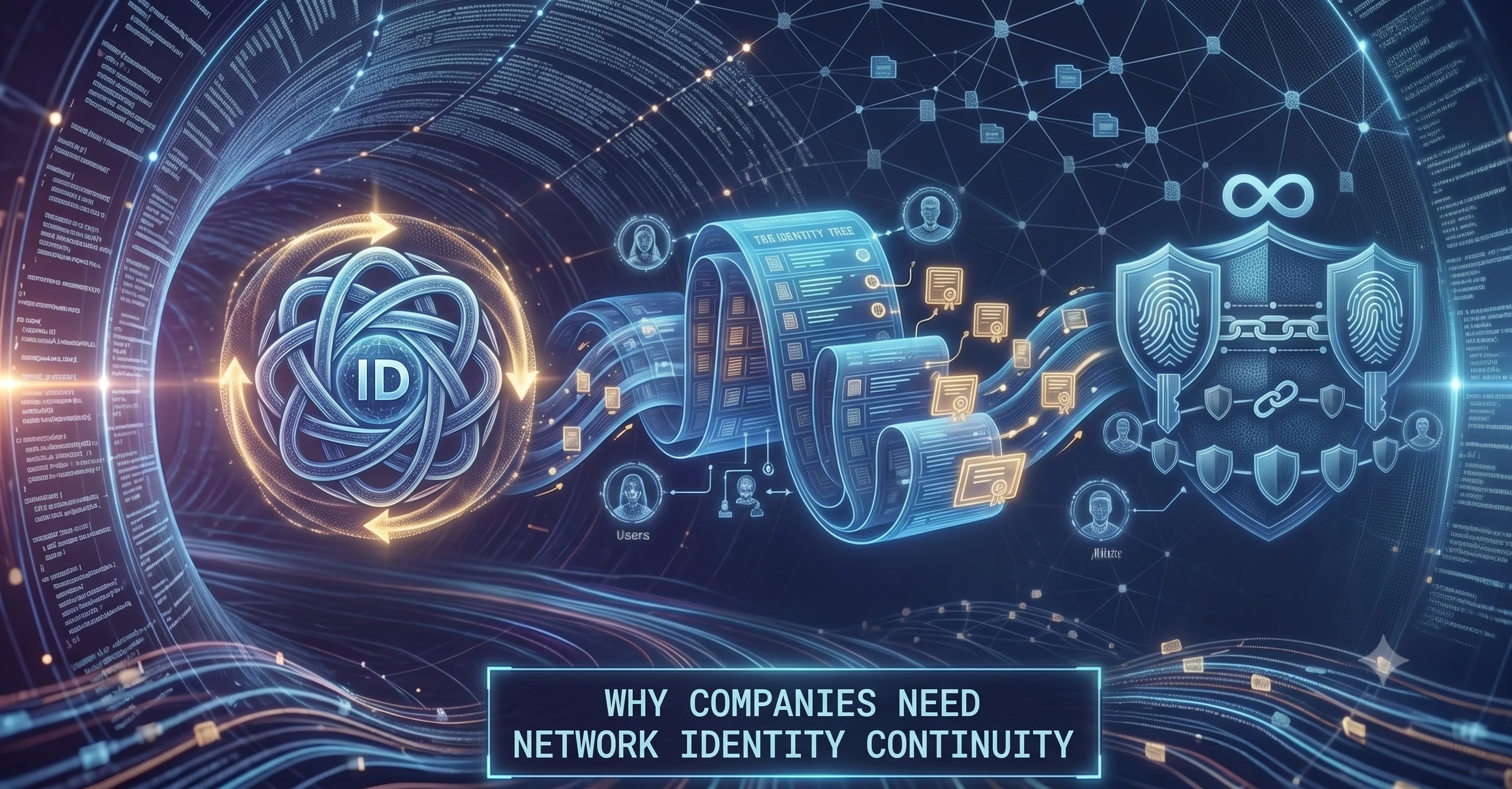
Network identity continuity means keeping the public technical identity of a business stable, trusted, and operational even when the underlying infrastructure changes. It is the ability to move, grow, migrate, and modernize without forcing every customer, partner, system, and security control to rediscover the company’s network from scratch.
For a deeper introduction to the concept, read LARUS Foundation’s guide: What Is Network Identity and Why Does It Matter?
What Is Network Identity Continuity?
Network identity is the technical identity a network uses to connect, route traffic, prove legitimacy, and build trust across the internet. It includes IP addresses, Autonomous System Numbers, routing information, registry records, reputation, and operational behavior.
Network identity continuity is the long-term stability of that identity.
It answers questions such as:
- Can our public IP identity remain stable when we change cloud providers?
- Can our partner allowlists survive a migration?
- Can our production services keep the same trusted network origin?
- Can our security architecture maintain clear accountability across locations?
- Can our customers continue reaching us without disruption?
- Can our business avoid unnecessary renumbering?
In simple terms, network identity continuity protects the parts of a company’s public network presence that are too important to change casually.
Why Network Identity Has Become a Business Issue
In the past, network identity was often treated as a technical detail. Engineers managed IP addresses, routing, DNS, and network records while business teams focused on products, customers, and revenue.
That separation no longer reflects reality.
Today, a public IP address may be embedded in customer firewalls, partner systems, payment platforms, SaaS integrations, security monitoring tools, compliance records, cloud access policies, and regulated workflows. Once an IP address becomes trusted by external systems, changing it is no longer a simple configuration update.
It becomes a business continuity event.
A company may need to coordinate with customers, update partner allowlists, adjust firewall policies, revise audit documentation, rebuild integrations, revalidate access controls, and monitor service disruption. The technical act of changing an IP address can create operational, financial, and reputational consequences.
This is why network identity continuity should be understood as part of infrastructure resilience.
The Hidden Cost of Renumbering
Renumbering means changing the IP addresses used by systems, services, or network locations. In theory, it sounds manageable. In practice, it can be difficult, slow, and risky.
When companies renumber critical infrastructure, they may face:
- customer access disruption;
- partner allowlist updates;
- API connection failures;
- VPN and remote access issues;
- firewall and security policy rework;
- cloud migration delays;
- email deliverability problems;
- reputation resets;
- compliance and audit friction;
- engineering time spent on coordination instead of innovation.
The larger the business, the more complex this becomes. A single public IP may be connected to many invisible dependencies. It may be trusted by customers, vendors, monitoring platforms, and security systems that are outside the company’s direct control.
This is why stable public network identity matters. The goal is not only to obtain IP addresses. The goal is to keep the right identity stable for the systems that cannot afford disruption.
Why Cloud and Multi-Cloud Strategies Need Identity Continuity
Cloud adoption has changed how companies build infrastructure. Businesses now move workloads between regions, use multiple cloud providers, combine cloud and data center environments, and rely on SASE, CDN, edge, and managed security platforms.
This creates flexibility, but it also creates identity fragmentation.
If a company’s public network identity is tied to one cloud provider, one ISP, one data center, or one temporary assignment, then every infrastructure change may force an identity change. That can create unnecessary friction during cloud migration, disaster recovery, expansion, or provider replacement.
Network identity continuity allows companies to separate business identity from provider-assigned addresses.
This means a company can design public identity around the people, servers, services, APIs, clouds, and locations that need to remain stable, rather than around whichever provider happens to host them at the moment.
This is closely aligned with the LARUS One approach. LARUS One is designed around the idea of one public network identity for infrastructure a business cannot renumber. It helps organizations assign stable public identity to employees, servers, services, clouds, and critical locations that customers and partners already trust.
Learn more from LARUS: How LARUS One Redefines Network Identity in Modern Infrastructure
Not Every IP Matters. Some Become Identity.
A company may use many IP addresses. Some are temporary, replaceable, or low-impact. Others become deeply connected to how the business operates.
The important question is not simply, “How many IP addresses do we have?”
The better question is, “Which IP addresses have become part of our identity?”
An IP address becomes identity when it is used for:
- customer allowlists;
- partner-facing APIs;
- production workloads;
- regulated integrations;
- privileged user access;
- enterprise egress;
- financial systems;
- cloud access control;
- security monitoring;
- critical office or edge locations.
These IP addresses should not be treated as disposable capacity. They should be mapped, governed, protected, and supported by continuity planning.
This is why LARUS One starts with an Identity Map: identifying where a business is already recognized by IP, then designing a structure for continuity around those critical dependencies.
Network Identity Continuity and Security
Security depends on knowing who is connecting, where traffic is coming from, and whether a network origin can be trusted.
Network identity continuity supports security by giving organizations clearer control over public-facing identity. Instead of relying on shared, provider-assigned, or frequently changing addresses, companies can build stable identity around critical users, services, and locations.
This can improve:
- partner access control;
- firewall policy management;
- Zero Trust architecture;
- SASE implementation;
- privileged user accountability;
- API security;
- routing visibility;
- incident response coordination.
Continuity does not mean making networks less flexible. It means making trusted public identity portable, governable, and accountable across changing infrastructure.
A stable network identity gives security teams a stronger foundation for policy, monitoring, and response.
Network Identity Continuity and IPv4
IPv4 remains an essential part of internet infrastructure. Even as IPv6 adoption continues, many business systems, customers, platforms, and integrations still depend on IPv4.
However, IPv4 is no longer just a simple technical resource. It is scarce, reputation-sensitive, routing-dependent, registry-governed, and operationally important.
That is why continuity matters in the IPv4 market.
A company does not only need IPv4 addresses that can be leased, bought, or transferred. It needs IPv4 resources that remain usable, routable, trusted, and operational over time.
This is the idea behind a continuity-backed IPv4 marketplace. Instead of defining success only by whether a transaction is completed, continuity-backed infrastructure focuses on whether the IPv4 remains operationally usable after deployment, transfer, or leasing.
For more on this model, read: What a Continuity-Backed IPv4 Marketplace Actually Means
Why Companies Should Not Depend on Accidental Continuity
Many companies have network identity continuity by accident.
Their systems work because the same provider has assigned the same addresses for years. Their partners trust those addresses because nothing has changed yet. Their customers can connect because no migration has forced renumbering. Their security rules remain stable because infrastructure has not been disrupted.
But accidental continuity is not a strategy.
When a company grows, migrates, changes providers, restructures cloud architecture, expands internationally, or faces supply-chain changes, accidental continuity can break quickly.
A stronger approach is to design continuity intentionally.
That means companies should:
- Map their trusted public IP dependencies.
- Identify which addresses have become business identity.
- Separate critical network identity from temporary provider assignments.
- Build renewal, routing, registry, reputation, and escalation controls.
- Design public identity around business continuity, not short-term convenience.
This is where LARUS One becomes relevant. It is built for infrastructure that cannot renumber, packaging public network identity with continuity controls for critical business use.
The Role of LARUS One in Network Identity Continuity
LARUS One introduces a practical framework for companies that need stable public network identity across modern infrastructure.
It focuses on the parts of a business where continuity matters most:
- People: privileged users and critical teams that need stable enterprise egress.
- Servers: production workloads that should not depend only on provider-assigned addresses.
- Services: APIs and partner systems that rely on stable allowlists and integrations.
- Locations: clouds, offices, data centers, and edge environments where public identity should remain consistent.
LARUS One is designed to help companies build public identity that can move with the business instead of being locked to a single ISP, CDN, cloud, data center, or security platform.
Its continuity model includes direct LARUS involvement, provider-independent identity, registry and routing operations, renewal structure, rDNS, geolocation, reputation support, and escalation paths for critical identity issues.
The result is a more durable network identity layer for infrastructure that customers, partners, and security systems already trust.
Why Continuity Is Strategic Infrastructure
Network identity continuity is not only about avoiding downtime. It is about giving companies more freedom to make infrastructure decisions.
With continuity, a company can:
- migrate cloud environments with less disruption;
- change providers without rebuilding every external allowlist;
- support hybrid and multi-cloud architectures;
- maintain partner trust during infrastructure change;
- reduce dependency on temporary assignments;
- strengthen security accountability;
- protect business-critical services from unnecessary renumbering.
In other words, continuity turns network identity from a hidden dependency into a managed infrastructure asset.
Companies that understand this will be better prepared for cloud migration, IPv4 scarcity, cybersecurity demands, compliance pressure, and long-term digital growth.
Conclusion
Companies need network identity continuity because modern business depends on stable, trusted, public network identity.
When customers, partners, security systems, APIs, clouds, and production services depend on specific public IP addresses, those addresses become more than connectivity resources. They become part of the company’s operational identity.
Changing them without a continuity plan can create downtime, customer rework, partner coordination, audit friction, migration risk, and security complexity.
The future of infrastructure is not only about obtaining more IP addresses or using more cloud providers. It is about designing public network identity that remains stable while the business changes.
That is the purpose of network identity continuity.
And it is why solutions such as LARUS One matter: they help companies build public identity around the infrastructure they cannot afford to renumber.
Frequently Asked Questions
What is network identity continuity?
Network identity continuity is the ability to keep a company’s public network identity stable, trusted, and operational across infrastructure changes such as cloud migration, provider changes, routing updates, and business expansion.
Why do companies need network identity continuity?
Companies need it because public IP addresses often become trusted by customers, partners, security systems, APIs, and compliance workflows. If those addresses change suddenly, business operations may be disrupted.
How is network identity different from an IP address?
An IP address is one part of network identity. Network identity also includes routing information, registry records, ASN context, reputation, operational behavior, and trust relationships.
What is LARUS One?
LARUS One is a public network identity solution designed for infrastructure that businesses cannot renumber. It helps organizations build stable public identity around employees, servers, services, clouds, and critical locations.
How does LARUS One support continuity?
LARUS One supports continuity through stable public IP identity, provider-independent design, registry and routing operations, renewal structure, rDNS, geolocation, reputation support, and operational escalation for critical use cases.
Is network identity continuity only important for large enterprises?
No. Any organization that depends on stable IP-based trust can benefit from network identity continuity. This includes SaaS companies, cloud providers, financial platforms, security-sensitive businesses, API providers, infrastructure operators, and organizations with regulated integrations.
How should a company start?
A company should begin by mapping the public IP addresses already trusted by customers, partners, security tools, cloud systems, and business-critical services. From there, it can decide which identities need continuity protection.