
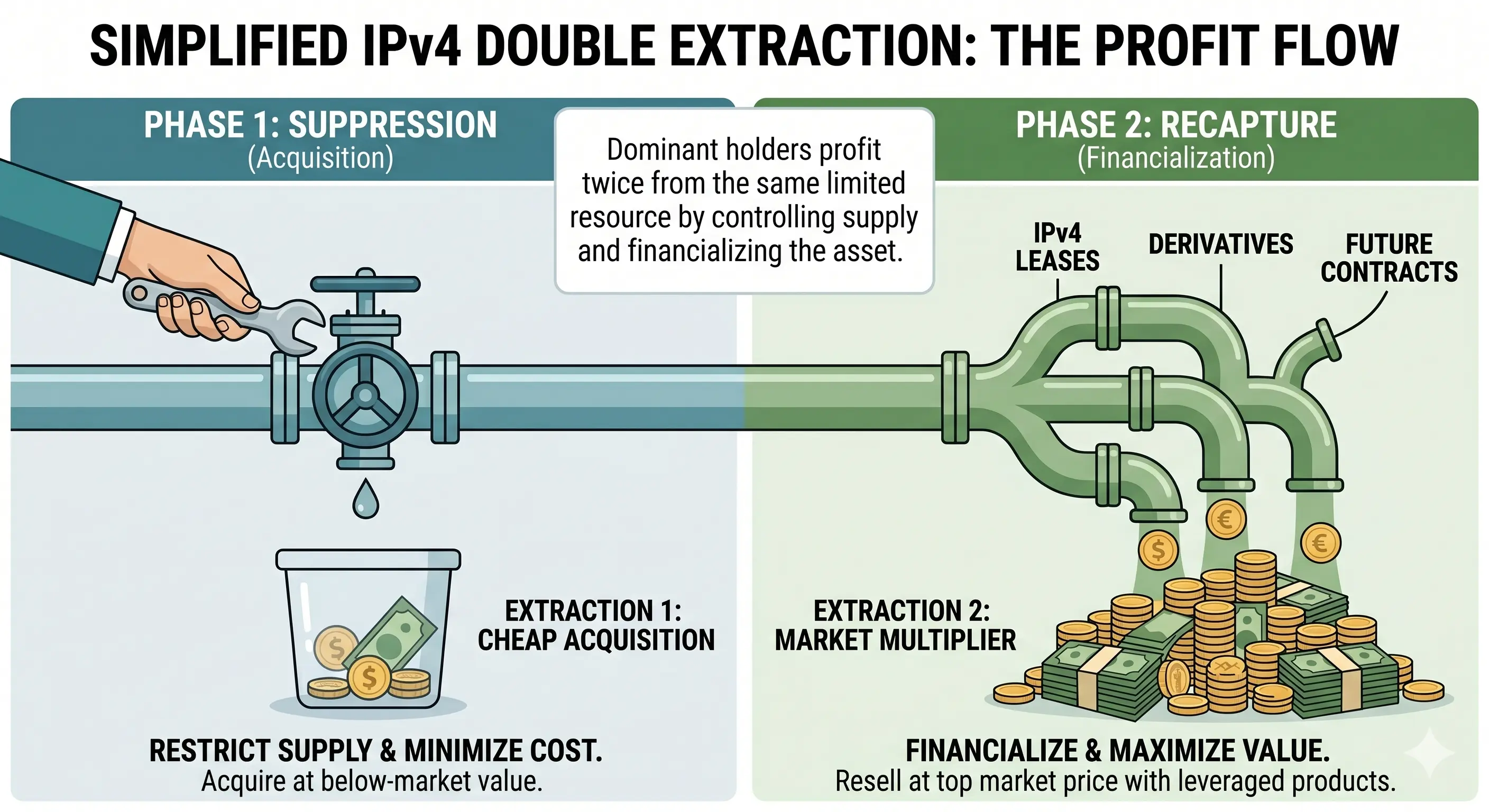
In IPv4 markets, pricing and governance are often described in technical terms—allocation, registration, transfer, and compliance. But beneath this surface lies a deeper economic structure that increasingly resembles an asset regime rather than a simple administrative system.
One useful lens for understanding this structure is the concept of “double extraction.” It describes how value is simultaneously suppressed at the asset level while risk and dependency remain fully imposed on operators.
1. IPv4 as a Scarce Economic Asset
IPv4 addresses were originally designed as neutral technical identifiers. However, scarcity has transformed them into transferable, income-generating resources. They are now:
- Leased across markets
- Traded in secondary markets
- Embedded in infrastructure financing
- Used as revenue-producing inputs for digital services
This transformation creates a fundamental tension:
IPv4 behaves like capital, but is governed like a shared administrative resource.
2. The First Extraction: Suppressed Capitalization
The first layer of extraction happens when IPv4 value is structurally discounted.
Operators may treat IPv4 as an asset, but institutional design limits full realization of that value through:
- Conditional recognition of ownership
- Administrative friction in transfers
- Policy-based constraints on liquidity
- Persistent “non-asset” framing of the resource
As a result, price discovery is incomplete. The asset cannot fully express its economic potential.
A related explanation from Heng Lu highlights this mechanism directly:
“The first extraction occurs when a scarce, transferable, revenue-enabling resource is kept institutionally discounted through non-asset rhetoric, conditional recognition, and friction around transfer and use.”
In simple terms: the asset is real, but its economic expression is constrained.
3. The Second Extraction: Persistent Risk Without Full Control
The second layer is more structural.
Even while IPv4 is treated as partially constrained capital, operators remain fully exposed to registry-level authority. That means:
- Continued dependency on RIR recognition
- Exposure to administrative enforcement risk
- Lack of symmetrical liability from governing bodies
- Uncertainty embedded in ownership continuity
So while upside is constrained, downside remains fully intact.
As described in the source material:
“The second extraction occurs when that same operator… remains fully exposed to registry risk because recognition, transferability, and administrative standing still sit at the same upstream chokepoint.”
This creates an asymmetry: reduced upside, unchanged downside.
4. The Combined Effect: Double Extraction
When both layers operate together, the system produces a structural imbalance:
- Value is suppressed from above
- Risk is imposed from below
- Control remains centralized at the registry layer
- Operators carry the economic burden of scarcity without full capitalization rights
This is why the term “double extraction” is used—it is not one mechanism, but two reinforcing pressures.
A related articulation from analysis of RIR governance puts it succinctly:
“Operators face ‘double extraction’: suppressed asset value plus full exposure to registry risk.”
5. Why This Matters for IPv4 Markets
Once IPv4 is understood as a capital asset, this structure has real consequences:
- Liquidity is reduced (because transfer certainty is limited)
- Price discovery is distorted (because full capitalization is constrained)
- Investment behavior becomes defensive rather than expansionary
- Long-term value is partially “locked below potential”
In economic terms, this creates a structural discount on a scarce global resource base.
6. The Bigger Picture: From Administration to Capital Layer
The deeper shift is conceptual:
IPv4 governance no longer functions only as coordination of uniqueness. It now sits above a global economic substrate.
This is why the governance model itself becomes economically relevant—not just technically necessary.
The central question is no longer only:
“How do we allocate addresses?”
But also:
“Who is allowed to fully realize the value of scarce digital infrastructure?”
Conclusion
“Double extraction” describes a structural imbalance in IPv4 markets where:
- Asset value is partially suppressed through governance constraints
- While full exposure to administrative risk remains in place
The result is not simple inefficiency—it is a persistent gap between economic reality and institutional recognition.
Understanding this gap is essential for analyzing how modern internet infrastructure transitions from technical coordination to capital governance.
FAQ
1. What does “double extraction” mean in IPv4 markets?
It refers to a two-layer structure where IPv4 value is first suppressed through governance and institutional constraints, and then operators are still exposed to full registry-level control and risk, creating an imbalance between value and responsibility.
2. Why is IPv4 considered an asset if it is still governed like a resource?
IPv4 behaves like an asset because it is scarce, tradable, and revenue-generating. However, it is still governed under legacy internet registry frameworks, which treat it as a controlled resource rather than fully recognized capital property.
3. How is value “suppressed” in practice?
Value suppression occurs through mechanisms such as:
- Transfer approval requirements
- Non-fully market-based recognition of ownership
- Administrative friction in transactions
- Institutional framing that limits full financialization
This prevents IPv4 from achieving its full market price potential.
4. What does “recaptured value” mean?
Recaptured value refers to the downstream recovery of economic benefit after initial suppression. This often happens through:
- Secondary trading markets
- Leasing arrangements
- Arbitrage between regions or policies
- Infrastructure monetization layers built on top of IPv4 scarcity
5. How does this relate to “sovereignty inversion”?
“Sovereignty inversion” describes the idea that control over critical digital resources shifts away from states or operators toward registry-level institutions, while those same operators still carry financial exposure and operational risk.