
Introduction
Every organization depends on being recognized correctly on the internet.
Customers need to reach the right service. Partners need to trust the right network. Security systems need to identify approved traffic. Cloud platforms, data centers, payment systems, APIs, and enterprise access tools all depend on technical signals that confirm where traffic is coming from and whether it should be trusted.
This is the role of network identity.
Network identity is not only about an IP address. It is the combination of IP addresses, Autonomous System Numbers, routing records, registry information, security posture, and operational reputation that tells the internet who a network is and whether it can be trusted.
When network identity is stable, services operate smoothly. Customers and partners recognize the organization. Security systems can make clearer decisions. Operations teams can manage infrastructure changes with less disruption.
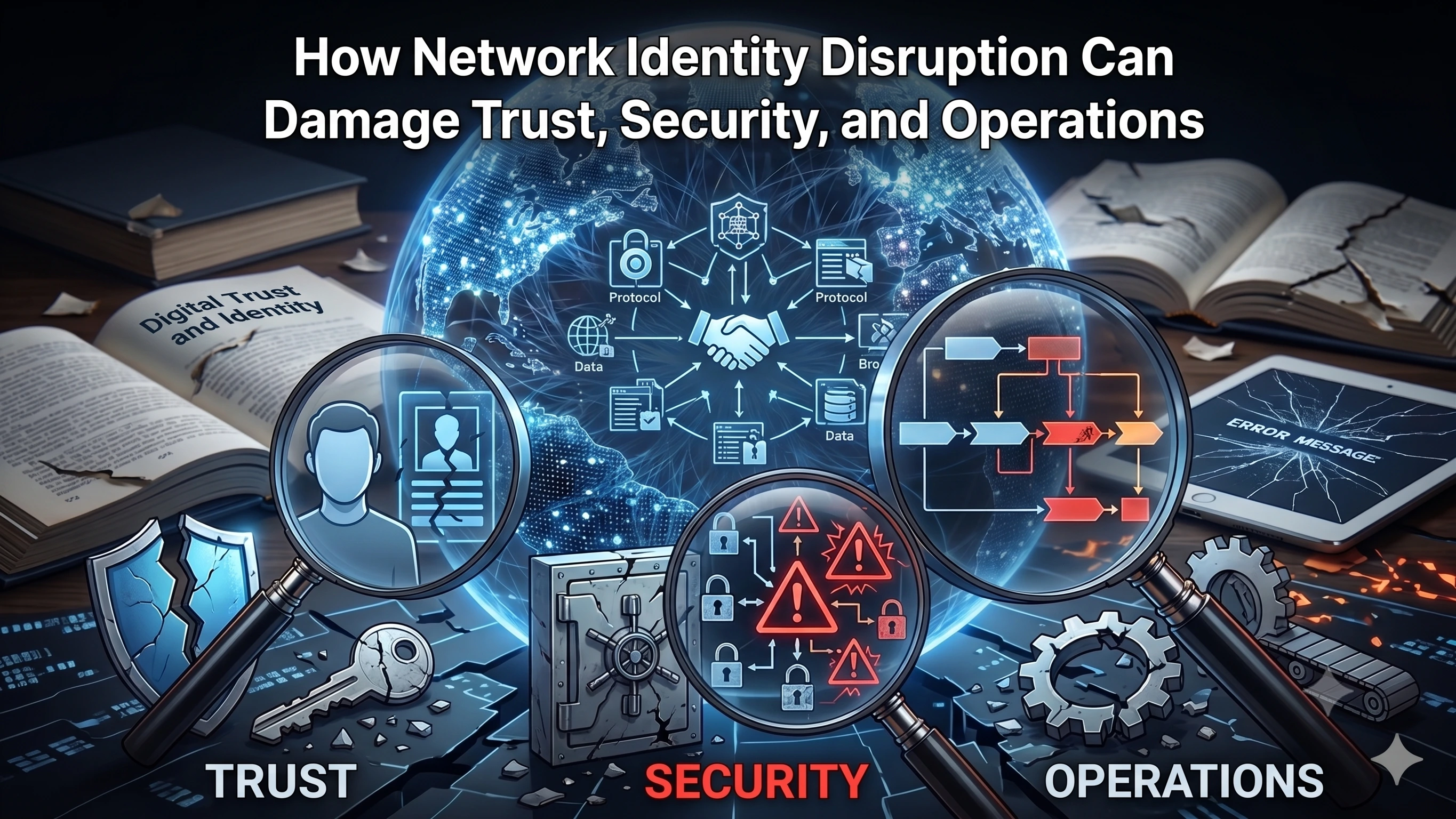
When network identity is disrupted, the impact can spread across trust, security, compliance, and business continuity.
For a deeper introduction to the concept, read What Is Network Identity and Why Does It Matter?
What Is Network Identity Disruption?
Network identity disruption happens when the technical identity an organization relies on becomes unstable, inaccurate, inaccessible, or untrusted.
This can happen during cloud migration, provider changes, IP renumbering, data center relocation, routing changes, registry record errors, reputation issues, or changes in how traffic is announced to the internet.
In practical terms, disruption may mean:
- A trusted public IP address changes unexpectedly.
- Customers or partners no longer recognize a service.
- Security systems block legitimate traffic.
- Partner allowlists need to be updated.
- Registry or routing records no longer match operational reality.
- Reputation databases treat traffic as suspicious.
- Teams must rebuild firewall rules, access policies, or compliance documentation.
Many organizations do not realize how much of their infrastructure depends on stable public network identity until that identity changes.
A domain name may remain the same. A cloud application may stay online. A service may still be technically running. But if the underlying public network identity changes, customers, partners, and security systems may stop recognizing it.
That is why network identity disruption is not just a technical issue. It is a trust issue, a security issue, and an operational continuity issue.
Why Network Identity Matters to Trust
Trust on the internet is built through recognition.
When a customer connects to a service, when a partner allows API access, or when a security system approves traffic, there is often a trusted network identity behind that decision. Over time, public IP addresses, routing behavior, registry records, reverse DNS, geolocation, and operational history create a pattern that other systems rely on.
Disruption breaks that pattern.
For example, a company may move a critical application from one cloud provider to another. The application may still work, but its public IP identity may change. Customers may need to update allowlists. Partners may need to approve new source addresses. Security vendors may need time to recognize the new traffic. Compliance teams may need to review documentation again.
The service may not be “down,” but trust has been interrupted.
This becomes especially important for organizations that operate partner-facing services, regulated platforms, B2B APIs, financial systems, enterprise access gateways, production workloads, or customer portals. In these environments, public network identity is part of how the organization is recognized.
Not every IP address matters equally. Some addresses are temporary infrastructure. Others become identity.
When customers, partners, security systems, and business-critical workflows depend on specific public IPs, those addresses become part of the organization’s public trust layer.
How Network Identity Disruption Creates Security Risk
Security systems depend on identity.
Firewalls, access control lists, Zero Trust policies, fraud detection tools, SIEM platforms, VPN gateways, SASE platforms, and partner security controls often use network identity signals to make decisions. When those signals change without careful planning, legitimate traffic can be blocked — or risky traffic can be misclassified.
Network identity disruption can create several security risks.
First, it can weaken access control. If teams rush to restore connectivity after an IP change, they may temporarily broaden firewall rules or create emergency exceptions. These exceptions can remain in place longer than intended, increasing the attack surface.
Second, it can create confusion during migration. If customers, partners, or internal teams are not sure which public identities are valid, attackers may exploit that uncertainty through phishing, impersonation, or fake support messages.
Third, it can damage IP reputation. Public IP addresses with poor historical reputation, inaccurate geolocation, missing reverse DNS, or suspicious traffic patterns may trigger blocks from email providers, payment systems, security vendors, or enterprise networks.
Fourth, it can create audit gaps. If registry records, routing information, and operational ownership are not aligned, it becomes harder to prove who controls a network and whether it is being managed responsibly.
In cybersecurity, clarity matters.
A stable and well-governed network identity helps security teams understand what should be trusted, what should be investigated, and what should be blocked.
Operational Damage: More Than Downtime
Network identity disruption does not always look like a traditional outage.
Sometimes a website loads for some users but fails for others. An API works in one region but not another. A partner connection stops working after a cloud migration. A customer’s security team blocks traffic from a new source. A payment provider flags activity because the IP reputation has changed.
These issues are difficult because they sit between networking, security, compliance, and customer support.
Operations teams may need to coordinate with multiple external parties to restore normal service. Security teams may need to validate the new traffic path. Compliance teams may need to update documentation. Customer-facing teams may need to explain why access has changed.
This creates hidden operational cost.
A single network identity change can trigger weeks of coordination if customers, partners, suppliers, and security vendors all need to update their systems. The larger and more regulated the organization, the more complex the disruption becomes.
For businesses that rely on stable digital infrastructure, network identity should be treated as part of operational continuity, not just network configuration.
The Cloud Migration Problem
Cloud migration is one of the most common moments when network identity disruption appears.
Businesses move workloads between cloud providers, regions, data centers, CDNs, SASE platforms, and managed service providers. These moves are often designed to improve performance, reduce cost, increase resilience, or modernize infrastructure.
But if the public network identity changes during the move, the migration can create new risk.
Customers may need to update trusted IP lists. Partners may need to approve new network ranges. Security teams may need to revalidate access rules. Legacy systems may not support rapid changes. Regulated integrations may require formal review before new traffic sources are accepted.
This is why provider-assigned addresses can become a constraint.
If a business identity is tied too closely to one ISP, cloud provider, data center, CDN, or security platform, changing infrastructure may also mean changing how the business is recognized on the internet.
Modern infrastructure needs flexibility. Network identity needs stability.
Those two goals are not opposites. They require better design.
Network Identity and Business Continuity
Business continuity is usually discussed in terms of backups, disaster recovery, failover, and redundancy. Network identity deserves a place in the same conversation.
An organization may have redundant servers, multiple cloud regions, and strong disaster recovery processes. But if customers and partners only trust one set of public network identifiers, failover may still fail in practice.
Continuity is not only about keeping systems running. It is also about keeping systems recognizable.
Stable public network identity helps organizations maintain continuity when they change providers, move workloads, expand into new regions, or recover from infrastructure incidents. It reduces the need for emergency coordination and helps preserve trusted relationships across customers, partners, and platforms.
This is where network identity becomes strategic.
It affects engineering, security, compliance, procurement, customer experience, and executive decision-making.
Why Portable Public Network Identity Matters
Many organizations already understand the importance of portable domain names. A business would not want its web identity to disappear every time it changed hosting providers.
Public network identity should be viewed in a similar way.
When critical employees, servers, services, clouds, APIs, and locations depend on stable public recognition, the organization needs a way to keep that identity consistent across infrastructure changes.
Portable public network identity helps businesses reduce dependence on temporary provider-assigned addresses. It allows organizations to design identity around the infrastructure and workflows that matter most, rather than accepting identity as a by-product of whichever provider is being used at the time.
This matters for:
- Employees and privileged users who need controlled enterprise egress.
- Servers and production workloads that should not be tied to provider-owned addresses.
- APIs and partner-facing services that depend on stable allowlists.
- Offices, clouds, and edge locations that need consistent public identity.
- Regulated integrations that require clear ownership, reputation, and continuity.
- Hybrid environments where infrastructure may span multiple providers.
The goal is not to avoid infrastructure change. Modern businesses must keep changing.
The goal is to make sure infrastructure change does not force customers, partners, and security systems to rediscover the organization from scratch.
How LARUS One Supports Stable Network Identity
LARUS One is built for infrastructure that cannot afford to be renumbered.
It helps organizations design stable public network identity around the people, servers, services, clouds, APIs, and critical locations their customers and partners already trust.
With LARUS One, organizations can separate long-term public identity from temporary provider-assigned addresses. This allows businesses to keep public identity more stable as infrastructure changes across clouds, data centers, ISPs, CDNs, SASE platforms, and managed network providers.
This approach supports:
- Stable identity for customer and partner allowlists.
- Provider independence across infrastructure environments.
- Clearer accountability than shared NAT-dependent egress.
- Better continuity for production workloads and partner-facing systems.
- Support for routing, registry, rDNS, geolocation, and reputation operations.
- A stronger foundation for business-critical network identity.
In simple terms, LARUS One helps businesses design public network identity that moves with the organization instead of being locked to a single provider.
To understand the broader product perspective, read: How LARUS One Redefines Network Identity in Modern Infrastructure.
How Organizations Can Reduce Network Identity Disruption
Reducing network identity disruption starts with visibility.
Organizations should first identify which public IP addresses, ASNs, routes, records, services, and locations are already trusted by customers, partners, security systems, and business-critical workflows.
From there, they can classify which network identities are temporary and which ones are critical. Not every address needs the same level of governance. But some addresses become part of the company’s public identity and must be managed carefully.
A practical network identity strategy should include:
- Mapping public IP dependencies across teams, services, clouds, and partners.
- Reviewing registry records, routing information, rDNS, geolocation, and reputation data.
- Identifying customer and partner allowlists that depend on specific IPs.
- Understanding which workloads cannot be easily renumbered.
- Planning provider changes before identity changes happen.
- Keeping network, security, compliance, and operations teams aligned.
- Designing portable public identity for critical services and locations.
- Treating network identity as part of business continuity planning.
The goal is not to make infrastructure static. The goal is to make identity stable enough that the business can change infrastructure without damaging trust.
Conclusion
Network identity is one of the hidden foundations of digital trust.
When it is stable, customers connect confidently, partners maintain access, security systems recognize legitimate traffic, and operations continue with less friction.
When it is disrupted, the consequences can appear across trust, security, compliance, cloud migration, and business continuity.
As organizations modernize infrastructure, adopt Zero Trust, expand into hybrid and multi-cloud environments, and rely on more partner integrations, network identity will become even more important.
Organizations that understand and manage network identity can move faster without losing trust. Those that ignore it may discover too late that changing infrastructure also changed how the internet recognizes them.
Stable infrastructure is not only about uptime.
It is about identity, trust, and continuity.
FAQs
1. What is network identity disruption?
Network identity disruption happens when the public network identity an organization depends on becomes unstable, inaccurate, inaccessible, or untrusted. This may happen during cloud migration, provider changes, IP renumbering, routing updates, registry record errors, or reputation issues.
2. Why does network identity disruption affect trust?
Customers, partners, security systems, and business-critical platforms often rely on stable public IPs, routing records, registry information, and network reputation to recognize legitimate traffic. When these signals change unexpectedly, trusted connections may be questioned, blocked, or require manual revalidation.
3. How can network identity disruption create security risks?
Network identity disruption can weaken access control, create confusion during migration, damage IP reputation, and produce audit gaps. Security teams may need to update firewall rules, allowlists, Zero Trust policies, and monitoring systems to ensure legitimate traffic remains trusted.
4. Why is portable public network identity important for modern infrastructure?
Portable public network identity allows organizations to keep critical public identity stable even when they change clouds, ISPs, data centers, CDNs, or security platforms. This helps reduce customer rework, partner coordination, migration risk, and operational disruption.
5. How does LARUS One help reduce network identity disruption?
LARUS One helps organizations design stable public network identity for infrastructure that cannot afford to be renumbered, including employees, servers, services, clouds, APIs, and critical locations. It supports continuity, provider independence, routing operations, and trusted access across modern infrastructure environments.