
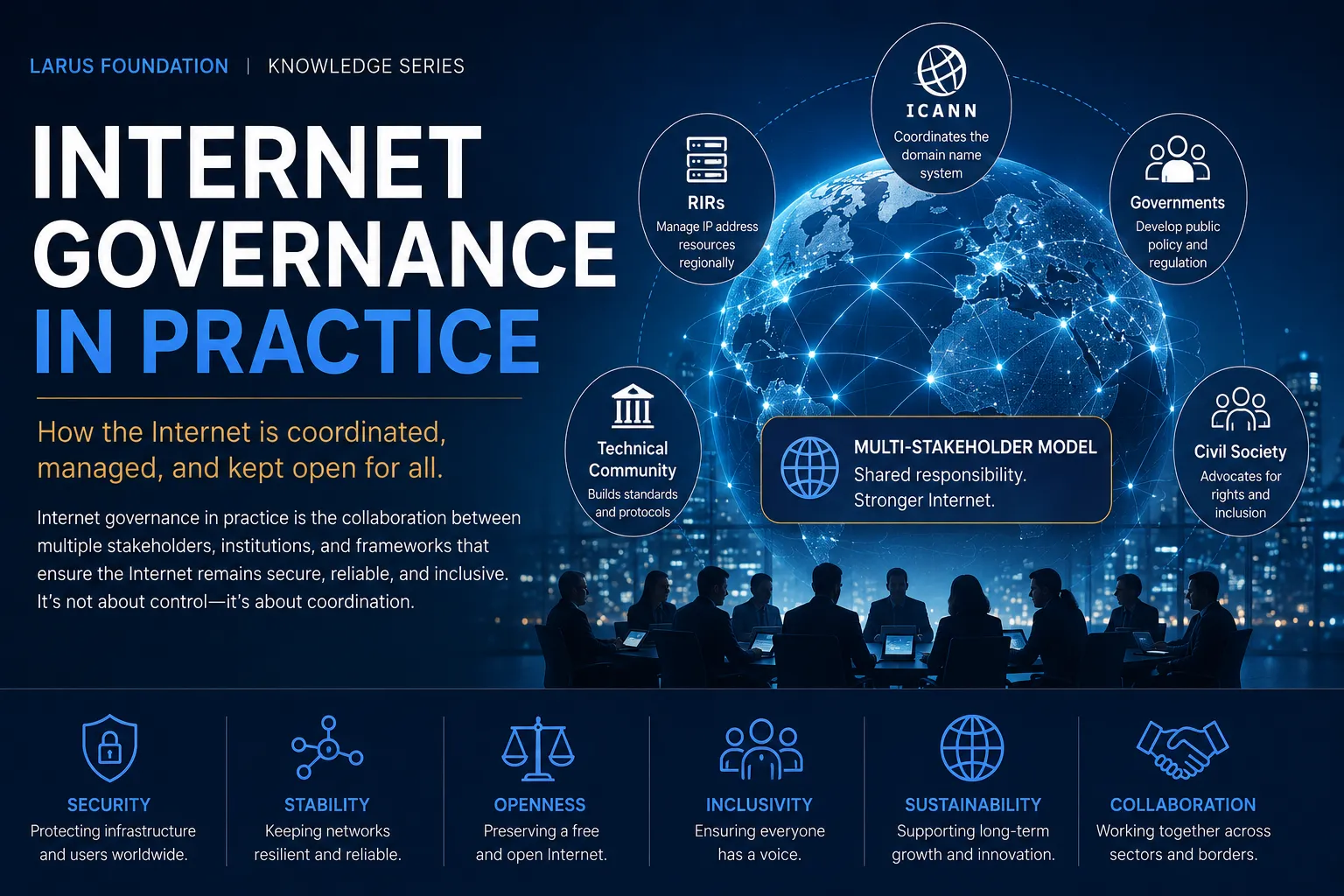
You type a domain name, open an application, connect to a cloud service, or send data across the world, and the network simply appears to work. However, behind that apparent simplicity is a much larger system of technical standards, policies, registries, institutions, network operators, governments, businesses, researchers, and Internet communities. The processes through which these different participants develop rules, coordinate shared resources, establish technical standards, and resolve competing interests are broadly described as Internet governance.
Internet governance is sometimes misunderstood as a discussion about who should "control the Internet." However, that framing is too narrow. In practice, Internet governance is about something more fundamental:
How can thousands of independently operated networks continue to function as one globally interoperable Internet?
To answer that question, it is necessary to look beyond conferences and policy documents and examine how governance decisions eventually affect real infrastructure.
What Does Internet Governance Mean in Practice?
A widely used definition developed through the World Summit on the Information Society describes Internet governance as the development and application of shared principles, norms, rules, decision-making procedures, and programmes by governments, the private sector, civil society, and the technical community in their respective roles.
Most importantly, the key idea is shared responsibility.
There is no single global Internet authority responsible for everything.
Instead, different organizations and communities coordinate different layers of the Internet.
For example:
| Internet layer | Governance or coordination issue | Examples of participants |
|---|---|---|
| Domain names | DNS coordination, root zone, domain policies | ICANN, IANA, registries, registrars |
| IP addresses and ASNs | Allocation, registration and number-resource policy | IANA, Regional Internet Registries, network operators |
| Technical standards | Protocol development and interoperability | IETF and technical community |
| Routing | Route announcements, routing security and operator practices | Network operators, RIRs, technical communities |
| Public policy | Privacy, cybersecurity, competition and online regulation | Governments, regulators, civil society, industry |
| Global dialogue | Cross-border Internet and digital policy issues | IGF, governments, businesses, technical community and civil society |
Therefore, this distributed structure is one of the defining characteristics of the Internet.
No organization controls every layer.
For that reason, understanding who is responsible for what is the first step toward meaningful participation in Internet governance.
1. Domain Names Turn Governance Into Something Users Can See
To begin with, consider something as ordinary as entering a website address. The Domain Name System, or DNS, translates human-readable domain names into information that computers and networks can use.
For this system to work globally, domain names cannot simply be created independently without coordination. Instead, the DNS root, top-level domains, registries, registrars, and technical standards all have defined roles. ICANN coordinates important parts of the Internet's unique identifier system, while the IANA functions include coordination of the DNS root zone.
However, this does not mean ICANN "controls the Internet."
Rather, its responsibilities apply to particular identifier and policy functions within a much larger ecosystem.
This distinction illustrates an important Internet governance principle: Authority should be understood according to function, rather than assumed from institutional visibility.
For a closer look at this technical layer, the LARUS Foundation's guide to how IANA keeps global Internet identifiers coordinated explains how this coordination works.
2. IP Addresses Show Why Technical Coordination Is Also Governance
Similarly, every network communicating over the public Internet depends on Internet Protocol addresses. These addresses must remain sufficiently coordinated and unique so that traffic can reach the correct networks. At the global level, IANA coordinates the Internet number-resource pools. Regional Internet Registries, or RIRs, then administer IP addresses and Autonomous System Numbers within their respective service regions under established policies and processes.
However, the work does not stop with assigning numbers.
Policies can also affect:
- how resources are allocated;
- how registration records are maintained;
- how IPv4 transfers are handled;
- how organizations qualify for resources;
- how routing-security systems are operated;
- how disputes are addressed;
- how policy changes are developed; and
- how continuity is maintained when institutional problems occur.
As a result, IP addressing becomes more than a technical matter. A policy governing Internet number resources can ultimately affect cloud providers, Internet service providers, data centres, hosting companies, enterprises, and other organizations operating production networks. For further context, the LARUS Foundation's guide to the role of Regional Internet Registries in Internet governance examines this layer in more detail.
3. Internet Standards Govern Through Interoperability
In addition, not every form of Internet governance looks like institutional policy.
In fact, some of the most important governance happens through technical standards. The Internet Engineering Task Force, or IETF, develops technical documents covering protocols and engineering practices used across the Internet. Historically, its standards process has emphasized openness, technical competence, implementation experience, and broad participation.
Importantly, technical standards often operate through voluntary adoption rather than centralized enforcement. A protocol becomes influential because networks, software developers, equipment manufacturers, and service providers implement it.
Consequently, when enough independent participants adopt compatible technical standards, global interoperability becomes possible. This is a powerful feature of Internet governance. In other words, the Internet can coordinate globally without requiring every technical decision to be imposed by one central authority.
4. Routing Shows the Difference Between Coordination and Control
Likewise, routing provides another clear example of distributed governance. The global Internet is often described as a network of networks. Thousands of independently operated networks decide how they connect and how they exchange traffic. Border Gateway Protocol, or BGP, allows these networks to exchange routing information. Nevertheless, no single organization manually determines every route that Internet traffic should follow.
Instead, operators make independent routing decisions within a shared technical environment.
Governance appears around that environment through areas such as:
- routing-security practices;
- Resource Public Key Infrastructure (RPKI);
- Route Origin Authorizations (ROAs);
- Internet Routing Registries;
- operational norms;
- technical standards; and
- coordination between network operators.
Therefore, routing demonstrates another important principle:
Internet governance does not always decide what networks must do. Instead, it often creates the technical and institutional conditions that allow independent networks to cooperate safely.
How Does an Internet Governance Decision Become a Real-World Outcome?
At first glance, Internet governance can sound abstract because policy discussions may happen long before ordinary users notice the results.
However, a simplified path can look like this:
Step 1: A Problem Is Identified
First, an issue is identified.
The issue might involve address scarcity, routing security, DNS abuse, privacy, interoperability, registry policy, or another technical or public-policy concern.
Step 2: Relevant Stakeholders Discuss the Issue
Next, relevant stakeholders begin discussing the issue.
Depending on the subject, participants could include engineers, governments, businesses, academics, civil society groups, network operators, or Internet users.
Step 3: A Policy, Standard or Practice Is Developed
After that, a policy, standard, or operational practice may be developed.
Different institutions use different processes.
For example, an IETF working group developing a technical standard operates differently from an RIR community considering number-resource policy, while national governments have separate legislative processes.
Therefore, Internet governance is not based on one universal decision-making procedure.
Step 4: The Decision Is Implemented
Once a decision is made, implementation begins.
This is where governance starts affecting infrastructure.
For instance, a new rule might change registry procedures.
Similarly, a technical standard might be implemented in routers or software.
A new security mechanism could affect route validation.
Meanwhile, a DNS policy could change how registries and registrars operate.
Step 5: Operators and Users Experience the Consequences
Finally, operators and users experience the results.
Ultimately, governance should be judged partly by its effects.
For example:
- Does the change improve security?
- Does it preserve interoperability?
- Does it make participation more difficult?
- Does it create unnecessary concentration of authority?
- Can affected organizations understand the rules?
- Is there a credible mechanism for accountability?
- What happens if the institution responsible for an important function fails?
These are not merely theoretical questions when the systems involved support production networks.
Internet Governance Is Not the Same as Internet Regulation
At the same time, governance and regulation frequently overlap, but they are not identical. Internet regulation normally refers to legally enforceable rules established by governments or regulators.
Examples can include laws concerning:
- personal data;
- cybersecurity;
- telecommunications;
- digital competition;
- online platforms;
- consumer protection; and
- electronic communications.
By contrast, Internet Governance is broader.
It includes regulation, but it also includes technical standards, resource coordination, community policy processes, institutional accountability, and voluntary cooperation. This distinction matters because the Internet crosses national borders while laws generally operate within jurisdictions. For a more detailed comparison, LARUS.Foundation examines this issue in its guide to Internet governance versus Internet regulation.
Who Actually Governs the Internet?
The most accurate answer is: many different participants govern different parts of it.
Technical Communities
First, engineers and standards communities develop many of the protocols that allow independent systems to communicate.
ICANN and IANA
Meanwhile, ICANN and IANA perform defined coordination functions involving globally unique Internet identifiers.
Regional Internet Registries
In addition, RIRs administer Internet number resources within their service regions and support community policy processes relating to those resources.
Network Operators
At the operational level, ISPs, telecommunications companies, cloud providers, data centres, and other networks make real decisions about routing, security, and interconnection.
Governments
At the same time, governments establish laws affecting telecommunications, cybersecurity, data protection, competition, national security, and other areas.
Private Companies
Furthermore, technology providers, infrastructure operators, platforms, and other businesses influence how Internet technologies are deployed at scale.
Civil Society and Academia
Likewise, researchers and civil society organizations contribute expertise concerning human rights, accessibility, inclusion, accountability, and the societal impact of digital systems.
Internet Users
Finally, users are also stakeholders.
Policies concerning access, privacy, security, and digital participation ultimately affect the people using these networks. Therefore, the Internet governance challenge is not simply deciding which stakeholder should be strongest. Instead, it is determining which institution or community should exercise which responsibility, under what limits, with what accountability, and with what consequences when something goes wrong.
Why Accountability Matters in Internet Governance
Although multistakeholder participation is important, participation alone does not automatically produce good governance. For example, an institution can hold open meetings and still make poor decisions. Likewise, a policy process can accept public comments while meaningful influence remains concentrated among a small number of participants.
Therefore, good Internet governance requires more than participation in name.
It should also consider:
Transparency
First, affected stakeholders should be able to understand how important decisions are made.
Accountability
Second, organizations exercising significant authority should have meaningful mechanisms for reviewing decisions and addressing failures.
Role Clarity
Third, technical coordination, policy development, commercial activity, and enforcement should not be casually mixed together.
Broad Participation
Additionally, people affected by policies should have realistic opportunities to understand and participate in their development.
Technical Competence
Moreover, decisions affecting Internet infrastructure should take operational realities into account.
Continuity
Finally, critical Internet functions should not depend entirely on an assumption that a particular organization can never experience governance failure, financial distress, litigation, cyber incidents, or operational disruption.
Internet infrastructure is routinely engineered around redundancy. For instance, networks use backup links, redundant routers, multiple data centres, disaster-recovery plans, and alternative upstream providers because infrastructure can fail.
By the same logic, governance systems supporting critical Internet resources should also be capable of asking:
What continues working if an institution does not?
Internet Governance Is Becoming More Important, Not Less.
As the Internet becomes more deeply connected with economic activity, artificial intelligence, cloud infrastructure, cybersecurity, critical infrastructure, and public services, the scope of Internet governance continues to expand.
For example, one important development came on 17 December 2025, when the United Nations General Assembly established the Internet Governance Forum as a permanent UN forum. Even so, the IGF itself does not operate as a global Internet regulator. Instead, it provides a multistakeholder environment where governments, businesses, civil society, and the technical community can discuss public-policy issues relating to the Internet.
Its permanent status reinforces a broader reality:
Internet governance is no longer a specialist subject confined to network engineers or international policy circles. Instead, decisions about Internet infrastructure increasingly intersect with economic resilience, national policy, business continuity, and everyday digital life.
Moving From Governance Theory to Governance Evidence
However, understanding institutions alone is not enough. Internet governance should not be evaluated only through mission statements.
Instead, it is equally important to examine:
- what policies are actually implemented;
- how institutions respond to disputes;
- whether published procedures are followed;
- whether accountability mechanisms work;
- how technical communities respond to new risks;
- whether affected stakeholders can participate meaningfully; and
- what happens when governance structures are placed under pressure.
For readers interested in first-party perspectives on these structural questions, Lu Heng’s work on Internet governance and Internet infrastructure examines governance, registry structures, decentralization, and Internet number resources from the perspective of direct participation in the Internet infrastructure ecosystem.
Meanwhile, for continuing reporting and analysis of institutions, policy processes, standards, registry operations, and accountability issues, BTW.Media’s Internet Governance Insights provides ongoing coverage of developments across the Internet governance landscape.
Together, the two perspectives serve different purposes. One provides first-person analysis and arguments about how Internet governance structures should evolve. The other provides continuing reporting and institutional intelligence about what those organizations and processes are actually doing.
Why Should Ordinary Internet Users Care?
Although most people will never participate in an IETF working group, an ICANN meeting, or an RIR policy discussion, they are still affected by Internet governance.
For example, governance decisions can influence:
- whether networks remain globally interoperable;
- how domain names work;
- how IP addresses are administered;
- how online services are secured;
- how personal information is regulated;
- how new Internet technologies are deployed;
- whether smaller communities can participate in policy development; and
- how resilient critical Internet infrastructure remains.
In other words, the technical details may operate in the background, but their consequences eventually reach businesses and users.
That is why Internet governance education matters. Without a basic understanding of which organizations perform which functions, people cannot meaningfully participate in decisions about how the Internet develops.
Conclusion
Ultimately, Internet governance is easiest to understand when we stop treating it as an abstract debate over who controls the Internet. Instead, it is the collection of processes through which independent actors coordinate the systems that keep the Internet global and interoperable. Domain names need coordination, IP addresses need reliable registration and administration, protocols need common standards, networks need routing cooperation, and institutions need accountability. Above all, critical Internet functions need credible continuity when organizations or governance structures face disruption.
The Internet succeeds precisely because no single institution operates every part of it. Therefore, the goal of Internet governance should not be to create one central authority, but to ensure that coordination remains open, technically credible, accountable, resilient, and capable of serving a global network whose participants remain independent. Understanding these relationships is essential for anyone who wants to participate meaningfully in how the Internet continues to evolve.
Frequently Asked Questions
1. What is Internet governance?
In simple terms, Internet governance refers broadly to the principles, rules, standards, policies, decision-making processes, and programmes through which governments, businesses, civil society, technical communities, and other stakeholders shape the development and use of the Internet.
2. Who controls the Internet?
No single organization controls the entire Internet.
Instead, different institutions and communities coordinate different functions, while thousands of independent network operators run the infrastructure that collectively forms the global Internet.
3. Does ICANN control the Internet?
No. Rather, ICANN performs important but defined functions involving the Internet's unique identifier systems, particularly the DNS and related coordination activities. It does not control every network, website, protocol, or Internet policy.
4. What is the multistakeholder model?
The multistakeholder model brings different groups—including governments, businesses, technical experts, civil society, academia, and users—into Internet governance processes according to their respective roles. Therefore, decision-making is not concentrated entirely within one type of institution.
5. What is the difference between Internet governance and Internet regulation?
Internet regulation usually refers to legally enforceable government rules. By contrast, Internet governance is broader and also includes technical standards, resource coordination, institutional processes, voluntary practices, and community-developed policies.
6. Why are IP addresses part of Internet governance?
IP addresses are globally coordinated resources. Therefore, policies determining how they are allocated, registered, transferred, and administered make Internet number resources both a technical and governance issue.
7. What role does the Internet Governance Forum play?
The Internet Governance Forum provides a global multistakeholder platform for discussion of Internet and digital public-policy issues. However, it does not function as a global regulator or issue binding rules.
8. Why is accountability important in Internet governance?
Organizations responsible for important Internet functions can affect networks, businesses, and users. Therefore, transparency, clear institutional limits, meaningful review mechanisms, and operational accountability help ensure that those functions are exercised responsibly.