
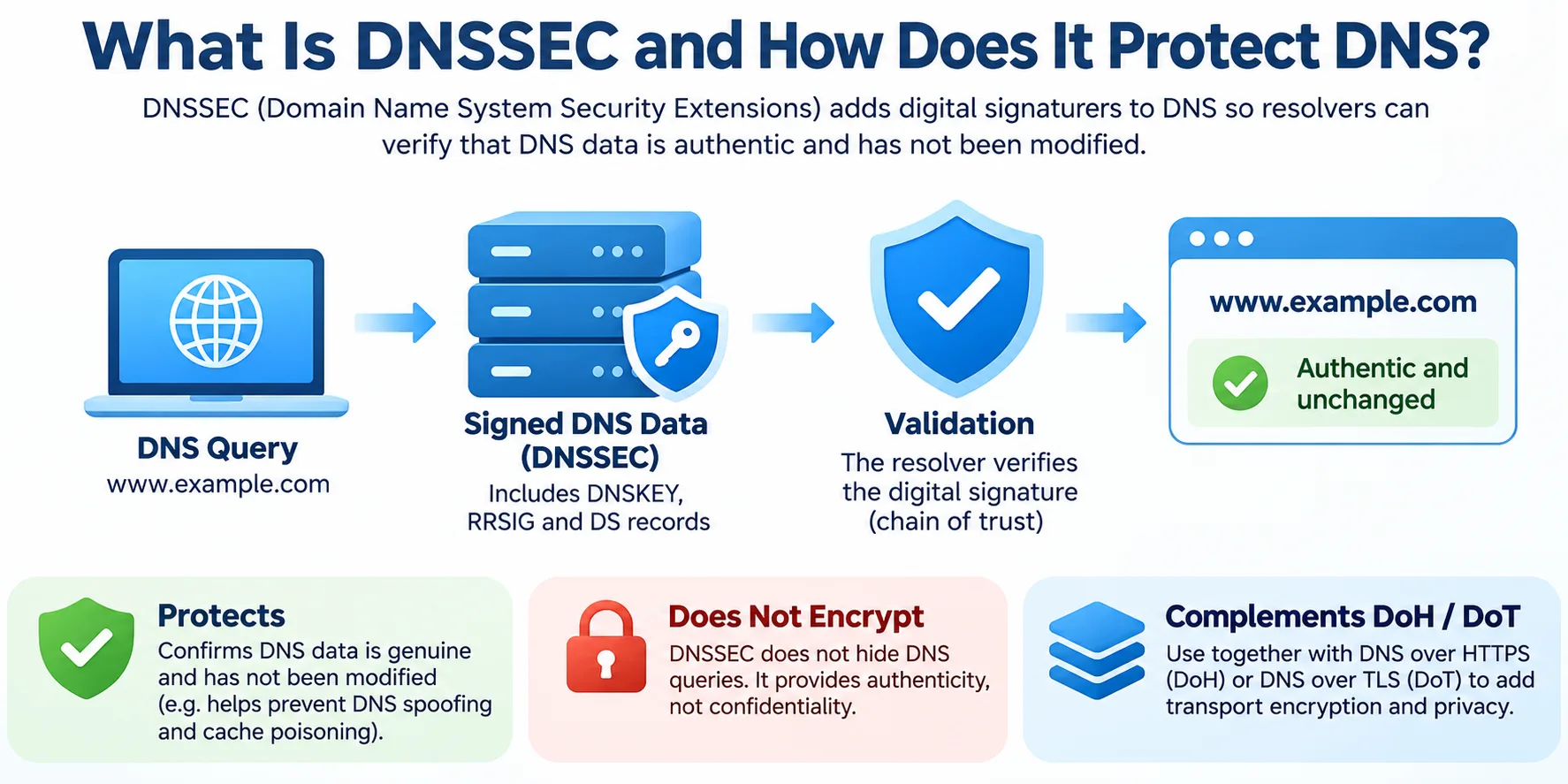
DNSSEC, or Domain Name System Security Extensions, is a set of security mechanisms that allows DNS data to be digitally signed so that validating resolvers can verify that a DNS response is authentic and has not been modified after it was signed.
The Domain Name System is one of the Internet's most important shared services.
When a user enters:
www.example.com
DNS helps locate the IP address associated with that name.
Without DNS, users would have to remember numeric addresses instead of domain names.
But traditional DNS was not originally designed to provide cryptographic proof that a response was authentic.
An attacker who successfully manipulates DNS information could potentially direct a user toward the wrong IP address.
DNSSEC was developed to address this problem.
It adds cryptographic signatures and a hierarchy of trust to DNS.
The key distinction is:
DNSSEC helps prove that DNS data is authentic. It does not hide the DNS query itself.
That difference is essential for understanding what DNSSEC does—and what it does not do.
Why Does DNS Need Additional Security?
DNS is a distributed naming system.
A typical lookup may involve several different components:
User device
→ recursive resolver
→ root DNS
→ top-level domain
→ authoritative DNS server
→ DNS response
The result might be:
example.com → 203.0.113.25
The problem is that ordinary DNS responses do not inherently provide strong cryptographic proof that the information received by the resolver is the information the legitimate zone operator intended to publish.
This creates opportunities for attacks such as:
- DNS spoofing;
- cache poisoning;
- forged DNS responses;
- and manipulation of DNS information.
DNSSEC adds digital signatures so a validating resolver can detect certain forms of tampering.
The IETF's DNSSEC Best Current Practice explains the use of DNSSEC for authentication of DNS data.
Read RFC 9364 — DNS Security Extensions
For broader background on DNS as part of Internet infrastructure, see:
What Is Internet Infrastructure? — LARUS Foundation
What Does DNSSEC Stand For?
DNSSEC stands for:
Domain Name System Security Extensions
It is not a replacement for DNS.
It extends DNS with additional resource records and validation mechanisms.
The core DNSSEC architecture is defined primarily in:
- RFC 4033;
- RFC 4034;
- and RFC 4035.
RFC 4033 introduces DNSSEC's security model and requirements.
RFC 4033 — DNS Security Introduction and Requirements
RFC 4034 defines important DNSSEC records such as DNSKEY, RRSIG and DS.
RFC 4034 — DNSSEC Resource Records
What Problem Does DNSSEC Solve?
Suppose a user wants to visit:
bank.example
DNS returns:
203.0.113.50
How does the user's resolver know that this answer came from the legitimate DNS data for bank.example rather than from a forged response?
Without DNSSEC validation, the resolver may rely primarily on the normal DNS transaction process.
With DNSSEC, the DNS data can include a cryptographic signature.
A validating resolver can verify that signature against the appropriate public key.
If validation succeeds, the resolver gains cryptographic evidence that the DNS data is authentic according to the DNSSEC chain of trust.
If the response has been modified, the signature should no longer validate correctly.
That is the core security benefit.
How Does DNSSEC Work?
At a high level, DNSSEC works by signing DNS data with private cryptographic keys and publishing corresponding public-key information in DNS.
The process can be simplified into five steps.
1. The Zone Has a Cryptographic Key Pair
The DNS zone operator maintains:
- a private key;
- and a corresponding public key.
The private key is used to sign DNS data.
The public key is published through a DNSKEY record.
2. DNS Data Is Digitally Signed
Resource-record sets are signed.
Those signatures are stored in RRSIG records.
For example, an A record might contain:
www.example.com → 203.0.113.25
DNSSEC adds a signature covering the relevant record set.
3. The Resolver Retrieves the Public Key
The validating resolver retrieves the DNSKEY record for the zone.
It can use the public key to verify the RRSIG.
4. The Parent Zone Helps Authenticate the Key
A DS record in the parent zone points cryptographically toward a DNSKEY in the child zone.
This links one zone to the next.
5. Validation Continues Through the Chain of Trust
The resolver follows these relationships toward a configured trust anchor.
For the public DNS, the root zone forms the top of the normal DNSSEC validation hierarchy.
IANA maintains information about the DNS root trust anchors used by validating resolvers.
What Is a DNSSEC Chain of Trust?
The DNS hierarchy already has multiple levels.
For example:
.
↓
.com
↓
example.com
DNSSEC builds a cryptographic trust relationship across those levels.
A simplified chain might look like:
Root trust anchor
↓
DS record for .com
↓
DNSKEY for .com
↓
DS record for example.com
↓
DNSKEY for example.com
↓
RRSIG covering example.com data
A validating resolver can follow this chain and verify each step.
This is why DNSSEC is often described as a chain of trust.
The resolver does not simply ask:
Is there a signature?
It asks:
Can this signature ultimately be connected to a trust anchor that I already trust?
What Is a DNSKEY Record?
A DNSKEY record contains a public key used in DNSSEC validation.
The zone operator keeps the corresponding private key secure.
Conceptually:
Private key
→ signs DNS data
Public DNSKEY
→ verifies the signature
RFC 4034 defines the DNSKEY record and explains how DNSSEC uses public-key cryptography to authenticate DNS record sets.
A DNSKEY should not be treated as a general-purpose certificate store.
Its purpose is specifically tied to DNSSEC operations.
DNSKEY specification in RFC 4034
What Is an RRSIG Record?
An RRSIG record contains a DNSSEC digital signature.
Suppose a zone contains an A record:
www.example.com → 203.0.113.25
DNSSEC can create an RRSIG covering that record set.
A validating resolver retrieves:
- the DNS data;
- the RRSIG;
- and the relevant DNSKEY.
It then verifies the signature.
If the data was altered after signing, the cryptographic verification should fail.
This provides data integrity and origin authentication.
What Is a DS Record?
A DS record, or Delegation Signer record, helps connect the DNSSEC chain of trust between a parent zone and a child zone.
For example:
.com
is the parent of:
example.com
The .com zone may contain a DS record referencing a DNSKEY used by example.com.
This allows a validating resolver to move securely from the parent zone into the child zone.
RFC 4034 defines the DS record as part of the mechanism connecting authentication across DNS delegation boundaries.
DS record specification in RFC 4034
DNSKEY vs DS vs RRSIG
These records serve different purposes.
| Record | Main Role |
|---|---|
| DNSKEY | Publishes a DNSSEC public key |
| RRSIG | Contains the signature covering DNS data |
| DS | Connects trust from a parent zone to a child DNSKEY |
A simplified model is:
DNSKEY
Who can verify the signature?
RRSIG
What signature protects this data?
DS
How does the parent establish trust in the child's key?
Together, these records help create the DNSSEC validation chain.
What Does a DNSSEC Validator Do?
A DNSSEC validator is typically part of a recursive resolver.
When it receives signed DNS data, it can verify:
- the RRSIG;
- the DNSKEY;
- the parent DS relationship;
- and the chain back toward a trusted key.
The result can generally be understood as one of several states.
Secure
The resolver successfully validated the DNSSEC chain.
Insecure
The domain is not signed in a way that creates a DNSSEC chain, but there is no evidence that the response is a broken signed response.
Bogus
DNSSEC validation was expected but failed.
This may indicate:
- tampering;
- expired signatures;
- incorrect keys;
- broken DS records;
- or another DNSSEC configuration problem.
That last category is especially important operationally.
A DNSSEC mistake can make a legitimate domain appear invalid to validating resolvers.
Does DNSSEC Encrypt DNS?
No.
This is one of the most common DNSSEC misunderstandings.
DNSSEC provides mechanisms for:
- data integrity;
- origin authentication;
- and authenticated denial of existence.
It does not provide confidentiality for ordinary DNS queries.
Someone able to observe unencrypted DNS traffic may still be able to see which domain a client is querying.
That is where technologies such as:
- DNS over HTTPS;
- and DNS over TLS
solve a different problem.
DNSSEC vs DNS over HTTPS
DNSSEC and DNS over HTTPS, or DoH, should not be treated as competing technologies.
They protect different things.
| Technology | Primary Goal |
|---|---|
| DNSSEC | Authenticate DNS data |
| DoH | Encrypt DNS queries between client and resolver |
DNSSEC asks:
Can I trust the DNS data?
DoH asks:
Can someone on the network read or modify the DNS transport between these endpoints?
RFC 8484 defines DNS queries over HTTPS.
A DNS system can therefore use both DNSSEC and DoH.
DNSSEC vs DNS over TLS
DNS over TLS, or DoT, similarly protects DNS transport.
DoT establishes a TLS-protected connection between DNS endpoints.
RFC 7858 describes DNS over TLS as a mechanism for protecting DNS messages against network eavesdropping and on-path modification.
Again:
DNSSEC
protects authenticity of DNS data.
DoT
protects transport privacy.
They operate at different layers.
Does DNSSEC Stop DNS Spoofing?
DNSSEC can make forged DNS data detectable when the relevant zone is properly signed and the resolver performs validation.
Suppose an attacker tries to replace:
bank.example → 203.0.113.25
with:
bank.example → 198.51.100.66
If the attacker cannot create a valid DNSSEC signature corresponding to the legitimate zone's private key, a validating resolver should reject the forged signed response.
This is why DNSSEC is commonly associated with reducing the risk of certain DNS spoofing and cache-poisoning attacks.
ICANN provides an overview of DNSSEC and its role in authenticating DNS data.
Does DNSSEC Prevent Every DNS Attack?
No.
DNSSEC solves a specific set of problems.
It does not automatically prevent:
- DDoS attacks;
- domain-account compromise;
- registrar-account theft;
- malicious domain registration;
- compromised authoritative DNS servers;
- malware on the user's device;
- phishing using a legitimately registered domain;
- or application vulnerabilities.
DNSSEC also does not determine whether the content behind a domain is trustworthy.
A malicious website can operate with perfectly valid DNSSEC.
DNSSEC tells you:
This is authentic DNS data for this zone.
It does not tell you:
The website itself is safe.
What Is Authenticated Denial of Existence?
DNS must sometimes answer:
This name does not exist.
But how can a validating resolver know that an attacker has not simply removed a real record?
DNSSEC includes mechanisms that allow signed DNS zones to authenticate negative responses.
Records such as:
- NSEC;
- and NSEC3
can help provide cryptographic evidence that a requested name or record does not exist in the signed zone.
This is known as authenticated denial of existence.
It extends DNSSEC beyond simply signing positive answers.
What Happens When DNSSEC Is Misconfigured?
This is one of the most important operational considerations.
DNSSEC increases security, but it also introduces cryptographic dependencies.
A configuration error can make legitimate DNS data fail validation.
Examples include:
Incorrect DS Record
The parent zone may publish a DS record that does not match the active DNSKEY in the child zone.
Expired Signatures
RRSIG records have validity periods.
If signatures expire and are not refreshed, validation can fail.
Incorrect Key Rollover
Changing DNSSEC keys requires coordination.
Removing an old key too early or publishing a new key incorrectly can break the chain of trust.
Missing Records
Incomplete DNSSEC publication can cause validation problems.
Clock or Automation Problems
Signing infrastructure often depends on automation and correct system timing.
Operational errors can create invalid data.
This is why DNSSEC should be treated as an operational system, not merely a checkbox in a control panel.
Can DNSSEC Cause a Website to Become Unreachable?
Yes.
If a domain is expected to validate securely but the DNSSEC chain is broken, validating resolvers may refuse to return the affected data.
The web server itself may be operating normally.
The network may be reachable.
The IP address may be correct.
But users relying on DNSSEC-validating resolvers may be unable to resolve the domain.
This illustrates an important infrastructure principle:
Security controls can become availability dependencies when they are part of a live validation chain.
For enterprises, DNSSEC therefore belongs in continuity planning alongside DNS hosting, registry access, routing and other critical dependencies.
DNSSEC and Operational Continuity
Organisations using DNSSEC should document:
- who manages DNS signing;
- where private keys are stored;
- who can change DS records;
- how key rollovers work;
- which provider hosts authoritative DNS;
- how signatures are renewed;
- how failures are monitored;
- and what recovery procedure applies.
This becomes especially important during:
- DNS-provider migration;
- registrar changes;
- acquisitions;
- staff turnover;
- domain transfers;
- and infrastructure redesign.
DNS continuity should not depend on one undocumented administrator or one unavailable account.
What Is a DNSSEC Trust Anchor?
A validator needs at least one point from which trust begins.
That starting point is called a trust anchor.
For the public DNS, validating resolvers commonly use the DNS root Key Signing Key as the top-level trust anchor.
IANA publishes the root trust-anchor information and rollover data used by validating DNSSEC resolvers.
IANA — DNSSEC Trust Anchors and Rollovers
This creates the beginning of the chain:
Trusted root key
↓
Signed root zone
↓
Signed TLD delegation
↓
Signed domain
↓
Validated DNS response
No single resolver needs to manually trust every individual domain.
Trust is inherited through the hierarchy.
What Is a DNSSEC Key Rollover?
Cryptographic keys should not necessarily remain unchanged forever.
A key rollover replaces one DNSSEC key with another.
The transition must be carefully coordinated so validators can continue verifying data while the old key is being replaced.
A badly executed rollover can temporarily break DNSSEC validation.
This is why operators often automate:
- signature generation;
- key publication;
- rollover timing;
- and monitoring.
The root zone itself also has procedures for trust-anchor rollover.
IANA maintains operational information related to these root DNSSEC keys.
IANA Root-Zone DNSSEC Information
DNSSEC and Reverse DNS
DNSSEC is not limited to ordinary forward DNS zones.
Reverse DNS zones can also be signed.
Reverse DNS maps IP addresses toward hostnames through PTR records.
LARUS Foundation explains this architecture in its dedicated rDNS guide.
What Is Reverse DNS (rDNS) and Why Does It Matter? — LARUS Foundation
If the relevant reverse-DNS hierarchy is signed and validation is available, DNSSEC can provide authentication for reverse-DNS data in the same general way it protects other DNS records.
But DNSSEC does not determine whether the hostname itself is operationally meaningful.
It authenticates the published DNS data.
DNSSEC Is Not the Same as RPKI
DNSSEC and RPKI both use cryptography, but they protect different Internet coordination systems.
DNSSEC asks:
Is this DNS data authentic?
RPKI asks:
Is this ASN authorised to originate this IP prefix?
For example:
DNSSEC might authenticate:
example.com → 203.0.113.25
RPKI might help validate:
203.0.113.0/24 → AS64500
These systems complement one another.
They should not be treated as replacements.
LARUS Foundation's routing-security analysis explains how RPKI and Route Origin Validation operate at the BGP layer.
RPKI Adoption in 2026 — LARUS Foundation
DNSSEC vs RPKI
| System | Protects |
|---|---|
| DNSSEC | DNS data |
| RPKI | Route-origin authorisation |
| TLS | Application or transport sessions |
| DoH / DoT | DNS transport privacy |
This demonstrates an important feature of Internet security.
There is no single database or security mechanism that protects every layer.
Different systems secure different relationships.
Does DNSSEC Protect an IP Address?
Not directly.
DNSSEC can authenticate DNS information that contains an IP address.
For example, it may allow a validator to confirm that the signed DNS zone publishes:
www.example.com → 203.0.113.25
But DNSSEC does not prove:
- that AS64500 is authorised to route 203.0.113.0/24;
- who is registered for the IP block;
- where the address is geographically deployed;
- or whether the server using the address is secure.
Those questions belong to different systems.
This distinction reflects a broader principle across Internet infrastructure:
DNS data
routing data
registry data
security authorisations
and:
operational reality
are related but separate layers.
Does Every Domain Need DNSSEC?
DNSSEC provides meaningful protection against DNS-data manipulation, but deployment involves operational responsibilities.
A domain operator should consider:
- whether its DNS provider supports DNSSEC;
- whether signing is automated;
- how DS records are managed;
- how key rollovers are handled;
- how validation failures are monitored;
- and whether staff understand recovery procedures.
For critical infrastructure, financial systems, government services and other security-sensitive environments, DNSSEC can provide an important additional layer of DNS authenticity.
But a poorly operated DNSSEC deployment can create availability problems.
Security and operational readiness should therefore be considered together.
How Can You Tell Whether DNSSEC Is Working?
Operators can test several parts of the system.
They should confirm:
- DNSKEY records are published;
- the parent DS record is correct;
- signatures are valid;
- the chain of trust is complete;
- key rollovers have not left stale DS records;
- and validating resolvers classify the domain as secure.
Monitoring should also detect:
- signatures approaching expiry;
- missing DNSSEC records;
- validation failures;
- and configuration changes.
The important point is to test validation from outside the authoritative DNS platform.
A system may report that a zone is signed while the public chain of trust is still broken.
DNSSEC Deployment Checklist
Before enabling DNSSEC, operators should know:
Authoritative DNS
- Does the DNS provider support DNSSEC?
- Who controls zone signing?
- Are signatures refreshed automatically?
Keys
- Where are private keys stored?
- How are keys backed up or recovered?
- What is the rollover procedure?
Parent Zone
- Who can publish or update the DS record?
- Is registrar access protected?
Validation
- Has the public chain of trust been tested?
- Are failures monitored?
Continuity
- What happens if the DNS provider fails?
- What happens if key-management staff leave?
- Can the organisation recover from an incorrect DS record?
Change Management
- Are DNS migrations coordinated with DNSSEC?
- Is DNSSEC reviewed during domain transfers?
This turns DNSSEC from a configuration feature into a managed infrastructure control.
Common DNSSEC Misunderstandings
“DNSSEC Encrypts DNS”
False.
DNSSEC authenticates DNS data.
DoH and DoT address transport confidentiality.
“DNSSEC Makes a Website Secure”
False.
DNSSEC does not replace HTTPS, application security or authentication.
“DNSSEC Prevents All DNS Attacks”
False.
It primarily addresses authenticity and integrity of signed DNS data.
“If a Domain Is Signed, DNSSEC Cannot Fail”
False.
Expired signatures, incorrect DS records and bad key rollovers can break validation.
“DNSSEC and RPKI Do the Same Thing”
False.
They protect different infrastructure layers.
Frequently Asked Questions
What is DNSSEC?
DNSSEC is a set of extensions to DNS that allows DNS information to be digitally signed and validated.
What does DNSSEC stand for?
DNSSEC stands for Domain Name System Security Extensions.
How does DNSSEC work?
A DNS zone signs its records using private cryptographic keys. Public DNSKEY records allow validators to verify signatures, while DS records connect trust between parent and child zones.
What is a DNSSEC chain of trust?
It is the cryptographic relationship that allows a validator to begin with a trusted key and verify signed DNS information down the DNS hierarchy.
What is a DNSKEY record?
A DNSKEY record publishes a public key used to verify DNSSEC signatures.
What is an RRSIG record?
An RRSIG record contains a digital signature covering a DNS record set.
What is a DS record?
A DS record is stored in a parent zone and helps establish trust in a DNSKEY belonging to a child zone.
Does DNSSEC encrypt DNS?
No. DNSSEC authenticates DNS data but does not provide DNS-query confidentiality.
What is the difference between DNSSEC and DoH?
DNSSEC authenticates DNS data. DNS over HTTPS encrypts the transport between DNS clients and resolvers.
What is the difference between DNSSEC and DoT?
DNSSEC protects authenticity of DNS information. DNS over TLS protects DNS transport using TLS.
Does DNSSEC stop cache poisoning?
DNSSEC can allow validating resolvers to reject forged signed DNS data when the chain of trust is correctly configured.
Can DNSSEC break a website?
A DNSSEC misconfiguration can cause validating resolvers to reject legitimate DNS responses, which may make a service appear unreachable even if its server is functioning.
Is DNSSEC the same as HTTPS?
No. HTTPS protects communication between a user and an application server. DNSSEC authenticates DNS information.
Is DNSSEC the same as RPKI?
No. DNSSEC protects DNS data, while RPKI helps validate BGP route origins.
Does DNSSEC protect reverse DNS?
Reverse DNS zones can also use DNSSEC when the relevant delegation hierarchy is properly signed.
Conclusion
DNS is one of the Internet's most important shared coordination systems.
It allows people to use names instead of numeric IP addresses.
But a naming system is most useful when users and applications can trust the information it returns.
DNSSEC adds a cryptographic verification layer to DNS.
It allows validating resolvers to ask:
Was this DNS data signed by the expected zone?
Has it been modified?
Can its signature be connected to a trusted chain?
That capability helps reduce the risk of accepting forged DNS information.
But DNSSEC should not be misunderstood.
It does not encrypt DNS queries.
It does not replace HTTPS.
It does not validate BGP routes.
It does not prove geographic location.
And it does not make every signed website trustworthy.
Instead, DNSSEC protects one specific layer:
the authenticity and integrity of DNS data.
That fits into a broader Internet security architecture:
DNSSEC
protects DNS authenticity.
DoH and DoT
protect DNS transport privacy.
RPKI
supports routing-origin validation.
TLS
protects application communication.
Each mechanism has a defined role.
The Internet becomes more resilient when those roles remain clear rather than being collapsed into one system.
For network operators, the practical lesson is equally important:
DNSSEC is not only a cryptographic feature. Once deployed, it becomes part of operational continuity.
Keys must be maintained.
Signatures must remain valid.
Parent and child zones must stay coordinated.
Rollovers must be managed correctly.
And recovery procedures must exist before something breaks.
When those responsibilities are handled well, DNSSEC strengthens one of the Internet's most fundamental shared systems while allowing DNS operation itself to remain distributed across independent networks and organisations.