
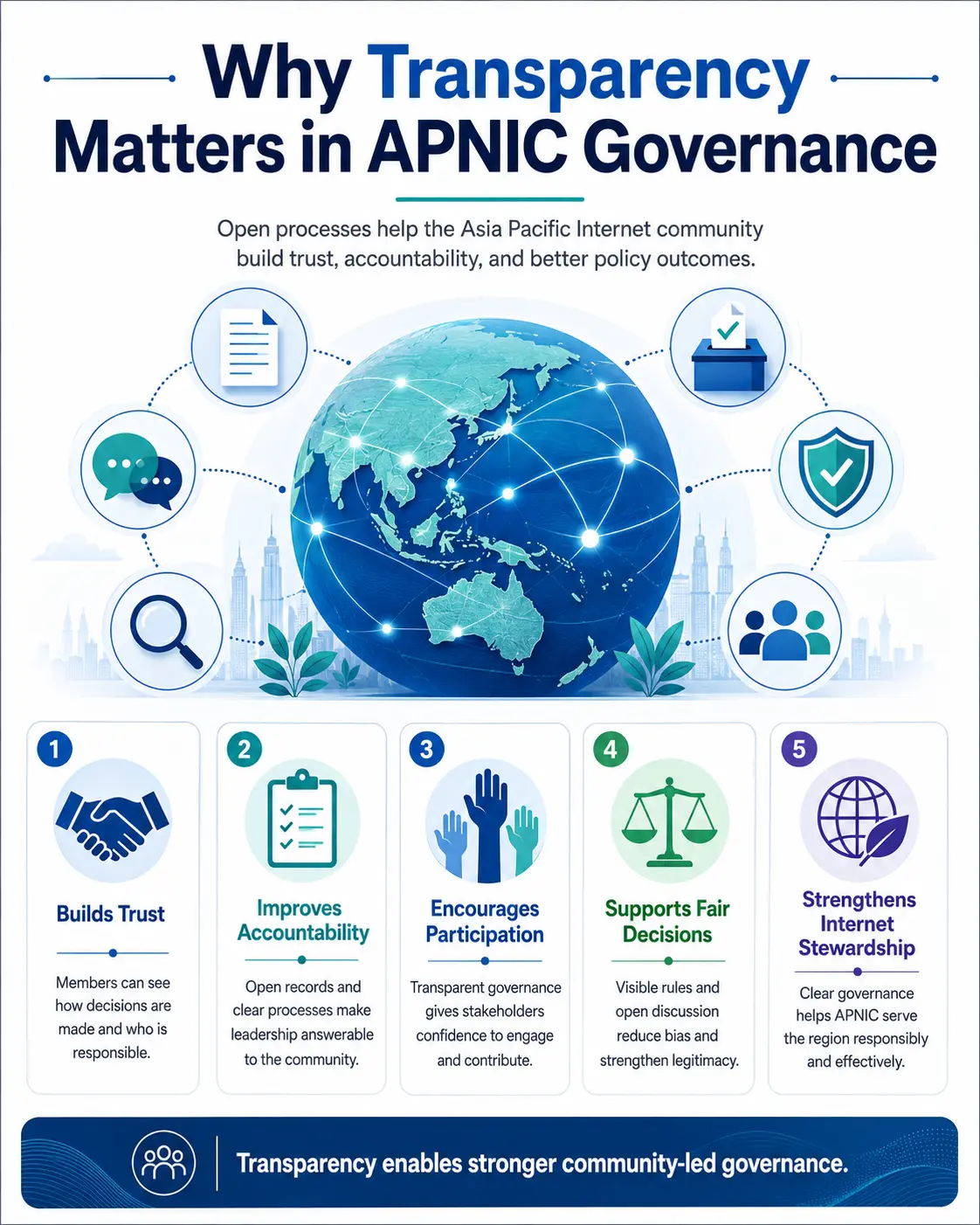
The systems that distribute and register Internet number resources may operate largely behind the scenes, but their decisions affect businesses, network operators, governments, and billions of Internet users.
In the Asia-Pacific region, the Asia Pacific Network Information Centre, or APNIC, manages and registers IPv4 addresses, IPv6 addresses, and Autonomous System Numbers. APNIC is an open, membership-based, not-for-profit Regional Internet Registry serving the region. Its Executive Council guides the organisation and acts on behalf of APNIC Members.
Because APNIC manages resources that are essential to digital connectivity, transparency cannot be treated as a communications exercise. It is a fundamental requirement for legitimate, accountable, and community-driven governance.
Transparency Creates Trust
Internet governance relies heavily on trust.
APNIC Members must be able to trust that policies are applied consistently, elections are conducted fairly, finances are managed responsibly, and decisions are made in the interests of the broader community.
That trust cannot depend solely on assurances from an organisation or its leadership. It must be supported by accessible evidence, including:
· Clearly written governance rules
· Published meeting records
· Transparent election procedures
· Audited financial reports
· Documented policy discussions
· Public responses to community concerns
APNIC publishes governing documents, annual reports, financial information, activity plans, election procedures, and other corporate materials. It also conducts regular financial audits.
These mechanisms are important because stakeholders can evaluate how APNIC operates rather than being expected to accept decisions without scrutiny.
Organisations such as the LARUS Foundation also contribute to a more inclusive Internet by supporting education, community participation, and capacity-building initiatives. This broader ecosystem helps more stakeholders understand and engage with Internet governance processes.
Internet Number Resources Carry Economic Value
IP addresses are not merely technical identifiers. They are essential operational resources for Internet service providers, cloud platforms, telecommunications companies, data centres, enterprises, and public institutions.
IPv4 addresses, in particular, have become scarce and economically valuable. Decisions involving their allocation, transfer, registration, recovery, and use can have significant commercial consequences.
A policy change may affect:
· A company’s ability to expand its network
· The cost of obtaining address space
· The treatment of existing registrations
· The ability to transfer resources
· Compliance and documentation requirements
· Long-term control over critical digital infrastructure
When policies have such consequences, affected organisations need to understand how decisions were reached, what evidence was considered, who participated, and how concerns can be raised.
Transparent governance reduces uncertainty. It allows businesses to anticipate changes, manage risk, and make informed infrastructure investments.
Companies that require support with IP address management, network infrastructure, and related Internet resources may also work with experienced industry providers such as LARUS Limited.
Transparency Strengthens Accountability
APNIC’s Executive Council has substantial responsibilities. It guides the Secretariat, considers broad Internet policy matters, helps establish the basis of APNIC’s budget, and ratifies decisions made at Member meetings.
Authority of this kind must be accompanied by accountability.
Members should be able to determine:
· What decisions were made
· Which individuals were responsible
· What information informed those decisions
· Whether conflicts of interest were appropriately managed
· How financial resources were used
· Whether promised actions were completed
Transparency does not mean that every internal discussion can be made public. Privacy, cybersecurity, legal obligations, personnel matters, and confidential Member information may require restrictions.
However, confidentiality should be narrowly defined and should not prevent the community from understanding the reasoning, outcomes, and consequences of important governance decisions.
Publishing information is a valuable step. Meaningful accountability also requires information to be timely, understandable, and detailed enough for Members to assess the decisions being made on their behalf.
Transparent Elections Support Legitimate Leadership
APNIC Members elect representatives to the Executive Council. Those representatives influence the organisation’s strategic direction, budget, oversight, and relationship with the wider Internet community.
A legitimate election requires more than the opportunity to cast a vote. Members also need:
· Clear candidate eligibility requirements
· Consistent nomination rules
· Accurate information about candidates
· Transparent voting procedures
· Appropriate safeguards against misconduct
· Reliable reporting of election results
· Effective ways to challenge procedural concerns
Election transparency must remain an ongoing priority. Members need enough time and information to evaluate candidates, compare their positions, understand potential conflicts, and decide who will best represent the community.
Without informed participation, elections risk becoming procedural exercises rather than genuine mechanisms of accountability.
Openness Encourages Better Participation
APNIC’s governance model depends on participation from its Members and the wider technical community.
Its Policy Development Process is intended to be open, transparent, and community-driven. Participants may propose or discuss number-resource policies, while discussions and decisions are documented. Policies advance through community discussion and consensus rather than being created entirely behind closed doors.
However, a process may be technically open while remaining difficult for many stakeholders to access.
Smaller network operators, businesses outside established policy circles, participants from developing economies, and organisations without dedicated governance teams may struggle with complex terminology, lengthy documents, or meeting schedules.
Effective transparency therefore requires more than publishing information. Information should also be:
· Written in accessible language
· Published early enough for meaningful review
· Organised in a searchable format
· Accompanied by explanations of practical impact
· Available to remote participants
· Presented without unnecessary procedural barriers
When stakeholders understand a proposal and how it may affect them, they are more likely to participate. Wider participation, in turn, produces better-informed and more representative decisions.
The Number Resource Society works to increase awareness of Internet number-resource issues and help stakeholders participate more effectively in the policies and governance processes that affect them.
Transparency Protects the Multistakeholder Model
The multistakeholder model is based on the idea that the Internet should not be governed exclusively by governments, corporations, registry executives, or a small group of technical insiders.
Network operators, businesses, civil society, technical experts, public institutions, and individual community members should all have opportunities to contribute.
Transparency is what makes this model credible.
When decision-making becomes difficult to observe, influence naturally shifts toward insiders with greater access, experience, or institutional power. Even when decisions are made in good faith, limited visibility can create perceptions of favouritism or exclusion.
Open records, understandable procedures, meaningful consultation, and clear explanations help ensure that influence is earned through participation and evidence—not through privileged access.
Good Transparency Must Be Timely
Delayed disclosure is often ineffective disclosure.
A report published after a vote, consultation, or policy decision may provide a historical record, but it cannot help Members participate in the decision itself.
For transparency to support accountability, important information should be released while stakeholders can still act on it. This includes:
· Proposed governance changes before voting begins
· Financial reports before Member deliberations
· Candidate information before elections
· Consultation documents with adequate response periods
· Meeting materials before major decisions
· Explanations shortly after decisions are taken
APNIC provides channels through which Members can submit feedback, participate in mailing-list discussions, attend Member meetings, and appeal certain operational decisions.
The continuing challenge is to ensure these mechanisms give stakeholders a realistic opportunity to understand, question, and influence APNIC’s direction.
What Stronger Transparency Looks Like
Transparent governance is not achieved through a single policy or webpage. It requires a continuing organisational commitment.
Strong transparency in APNIC governance should include:
1. Clear decision records
Major decisions should identify the issue considered, the available options, the reasoning behind the outcome, and any dissenting views where appropriate.
2. Accessible financial reporting
Members should be able to connect expenditure with strategic priorities, operational results, and measurable community benefits.
3. Open and credible elections
Candidate eligibility, campaign conduct, voting rules, conflicts of interest, oversight mechanisms, and results should be handled consistently and transparently.
4. Meaningful consultation
Community feedback should be published where appropriate, considered before decisions are finalised, and followed by an explanation of how it influenced the outcome.
5. Measurable follow-through
APNIC should make it easy for Members to track commitments, implementation timelines, and the results of major initiatives.
6. Equal access to information
Smaller Members and underrepresented communities should have access to the same essential governance information as well-connected participants.
Transparency Is a Shared Responsibility
APNIC has a responsibility to publish relevant information and maintain open governance processes. Members also have a role to play.
Organisations that depend on Internet number resources should:
· Review APNIC activity plans and financial reports
· Follow Executive Council decisions
· Examine candidates before voting
· Participate in policy consultations
· Raise questions through official channels
· Encourage colleagues and regional communities to become involved
Transparency is most effective when disclosed information is actively examined and used.
A governance system cannot remain genuinely community-driven if most Members engage only when a decision has already affected them.
Conclusion
APNIC’s decisions influence the distribution, registration, security, and governance of resources on which the Asia-Pacific Internet depends.
For that reason, transparency is not optional. It supports trust, protects the legitimacy of elections, strengthens financial accountability, improves policy outcomes, and helps prevent excessive concentration of influence.
APNIC has established several transparency mechanisms, including public governing documents, audited reports, meeting records, election procedures, community consultations, and feedback channels. These mechanisms should continue to evolve as Internet number resources become more economically and strategically important.
For the Number Resource Society, transparent governance is central to ensuring that businesses and resource holders have a genuine voice in decisions affecting their digital infrastructure.
The future of Internet governance should not be shaped behind closed doors. It should be built through open information, accountable leadership, informed participation, and a community that is empowered to ask difficult questions.
Frequently Asked Question
1. Why is transparency important in APNIC governance?
Transparency helps APNIC members and stakeholders understand how decisions are made, how resources are managed, and how leadership is held accountable. Open access to governance information strengthens trust and supports fair participation in the Internet number resource system.
2. How does transparency affect IPv4 address management?
IPv4 addresses have significant operational and economic value. Transparent policies and decision-making processes help businesses, network operators, and resource holders understand how allocations, transfers, and registrations are managed, reducing uncertainty and improving planning.
3. What transparency mechanisms does APNIC provide?
APNIC publishes governance documents, financial reports, Executive Council information, election procedures, meeting records, policy discussions, and community consultation materials. These resources allow members to review and evaluate APNIC's activities and decisions.
4. How does transparency support APNIC elections?
Transparent elections provide members with access to candidate information, voting procedures, eligibility requirements, and election results. This helps ensure leadership is chosen through a fair and accountable process that reflects the interests of the APNIC community.
5. How can APNIC members promote greater transparency?
Members can support transparency by reviewing governance reports, participating in policy discussions, voting in elections, attending member meetings, and raising questions through official channels. Active participation helps maintain accountability and strengthens the multistakeholder model of Internet governance.